
In Detroit historic districts, roof replacement must be approved by the Detroit Historic District Commission before a building permit can be issued. That makes roof replacement for historic homes in Detroit more than a choice of materials: the proposed work must respect the home’s exterior character and meet applicable building codes.
It’s reasonable to focus first on leaks, aging shingles, or the cost of a new roof. But a leak doesn’t automatically mean the entire roof needs replacing. The right solution depends on the roof’s condition, original materials, and the scope of work. Historic review can also affect which materials and design details are appropriate.
This guide explains Detroit’s approval process, what affects repair and replacement costs, and how to balance historic design with modern code requirements. You’ll also learn why a detailed project scope matters and when repairing or preserving existing roof components may make more sense than replacing them.
Key Takeaways
- Historic-district roof work may need Detroit Historic District Commission approval before a building permit can follow, so the project scope and exterior details matter.
- A leak doesn’t always mean full replacement; the roof’s condition and the repairability of its materials help shape the decision.
- Preserving the roof’s historic character while meeting current code requirements can influence material choices and project planning.
- For replacement or repair work, Miller's Home Improvement can help address residential roofing needs, including appropriate flat-roof systems.
Detroit Historic District Commission approval for exterior work
In a Detroit local historic district, exterior roof work requires Historic District Commission approval. The commission reviews proposed materials and visible changes before the building permit stage.
Historic Roof Approval and Material Lead Times
Historic roof approval is the commission’s review of proposed exterior work, including its materials and details. It matters because the decision can affect the roof design and project schedule. A submission should describe the full scope, including dormers, gutters, soffit, and fascia. Slate lead times can shape planning: according to the National Park Service, new roofing slate takes 4 to 12 weeks, and special orders can take up to 1 year. Matching slate from another quarry can take several months. Copper panel lead times are measured in weeks after the profile and finish are set.
Risks of Unapproved Roof Changes
Unapproved exterior work in a Detroit local historic district can be recorded as a violation that stays with the property. The city may pursue inspections, fines, stop-work orders, or court orders to remedy the violation. An unresolved violation can also complicate or prevent a property sale. The commission’s review has no fee, and the city warns about phishing emails demanding payment.
Local rules cover properties within Detroit’s designated historic districts, not every older home or neighborhood. Confirming whether an address lies inside a district boundary is essential before planning visible roof changes. National Register eligibility is a separate designation: according to the National Park Service, significance within the past 50 years ordinarily isn’t sufficient by itself.
The project review is online, and a building permit follows commission approval. A roofing professional can document the proposed materials, visible roof changes, and related exterior work in a detailed scope, then submit the project for review. Approval is required for exterior work even when homeowners do it themselves.
When choosing a historic-home roofing contractor, look for relevant experience with traditional materials and documenting details such as roof profiles, dormers, and fascia. That knowledge helps create a clear submission and align the proposed work with the building’s character.
The federal historic rehabilitation tax credit is 20 percent of qualified expenses, claimed ratably over 5 years, and applies to income-producing buildings. The available facts do not establish a Detroit homeowner grant or financing program, so those options shouldn’t be assumed for an owner-occupied roof project.
Repair and replacement cost estimates for historic roofs
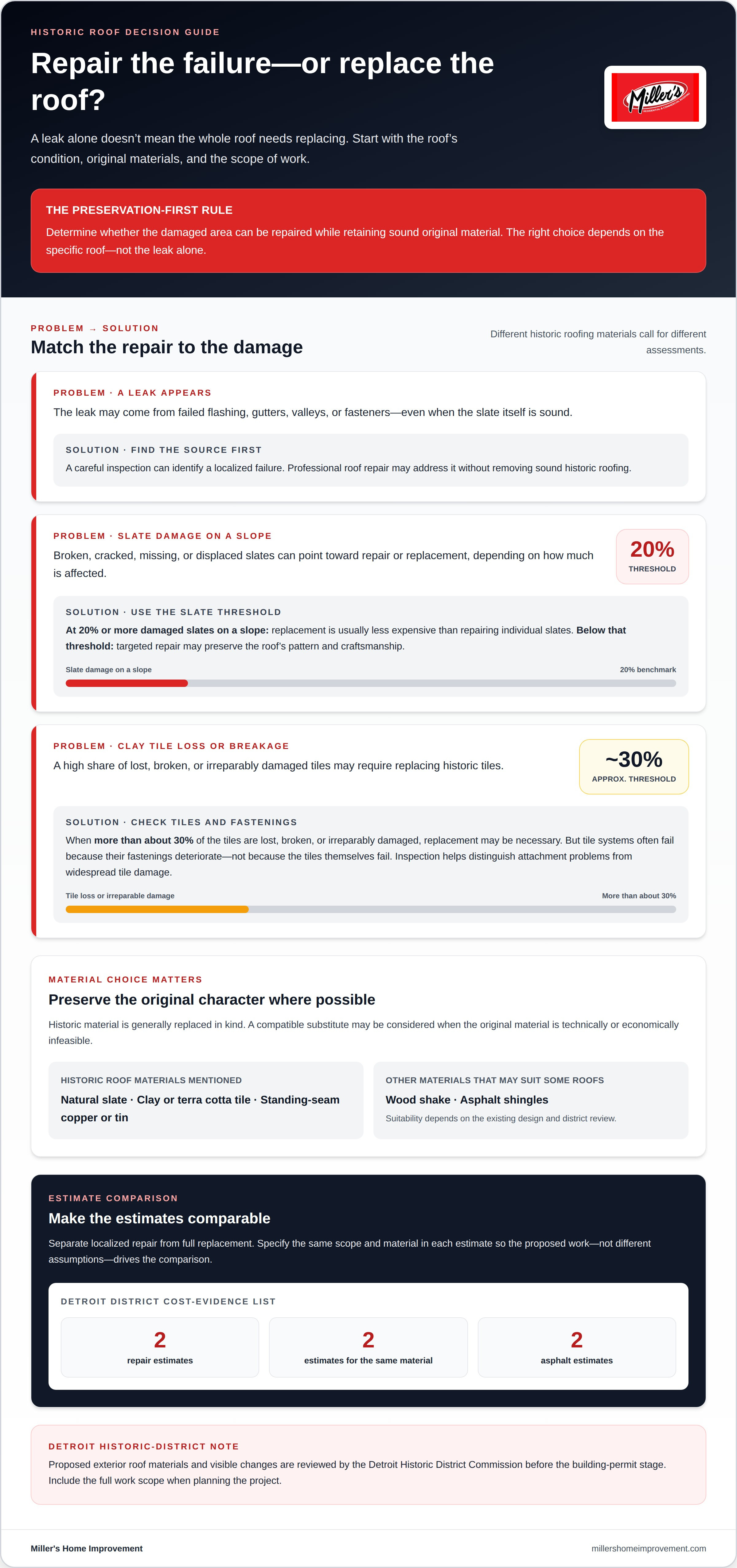
A roof leak alone doesn’t mean the whole roof needs replacing. For historic preservation, first determine whether the damaged area can be repaired while retaining sound original material.
Slate roofs show why condition matters. When 20% or more of the slates on a slope are broken, cracked, missing, or displaced, replacement is usually less expensive than repairing individual slates. Below that threshold, a targeted repair may preserve the roof’s pattern and craftsmanship. A leak can also come from failed flashing, gutters, valleys, or fasteners, even when the slate remains sound.
Clay tile requires a different assessment. If more than about 30 per cent of the tiles are lost, broken, or irreparably damaged, replacing the historic tiles may be necessary. Yet tile systems often fail because their fastenings deteriorate, not because the tiles themselves fail. A careful inspection can distinguish repairable attachment problems from widespread tile damage.
Material affects both the estimate and the preservation decision. Natural slate, clay or terra cotta tile, and standing-seam copper or tin appear on many pre-1950s commercial and institutional buildings. Wood shake and asphalt shingles may suit other historic roofs, depending on the existing design and district review. Historic material is generally replaced in kind; a compatible substitute may be considered when the original material is technically or economically infeasible. Detroit’s district cost-evidence list calls for two repair estimates, two estimates for the same material, and two asphalt estimates.
For a sound comparison, separate localized repair from full replacement and specify the same scope and material in each estimate. That lets the proposed work, rather than different assumptions, drive the comparison. For a localized leak, professional roof repair may address the failure without removing sound historic roofing.
Balancing original design with modern building codes
A historic roof proposal has two practical tests: the building’s exterior character and the roof assembly’s technical requirements. In Detroit, Historic District Commission review addresses visible exterior work, while building-code review concerns the proposed construction. Keeping those questions distinct helps prevent a design choice from being mistaken for a complete technical plan.
Start with what can be seen from public viewpoints. Roof shape, edge details, dormers, and materials all contribute to a building’s appearance. A visible slate roof, for example, raises a different preservation question from a membrane roof concealed behind a parapet. Describe the roof and related exterior elements clearly in the project scope so the commission can assess the proposed changes.
Hidden flat roofs may allow more flexibility. A flat roof concealed from every elevation may be eligible for a modern built-up or membrane roof as a substitute. Visibility is the key distinction: a membrane on a concealed plane affects the exterior differently from a new surface exposed above the street-facing façade. The proposed system still needs to be considered as part of the project.
For a visible roof, preserving the original material and profile can help retain the building’s historic character. Replacing slate with a visibly different surface or altering the roofline raises different design considerations from replacing concealed roofing. Historic approval does not settle technical construction questions, so the scope should account for both.
A useful project plan connects each decision to a specific roof area. Identify which surfaces are visible, which original details remain, and where a modern substitute is proposed. For example, a building might retain its visible roof edge while using a membrane on a flat area hidden from every elevation. This distinction supports preservation while allowing contemporary roofing methods where appropriate.
Roof replacement for historic homes
A successful replacement protects the building while retaining the roof details that define its character. Start by assessing the existing covering, flashing, valleys, fasteners, and supporting roof structure. A leak near a window, for example, may come from the flashing rather than failed shingles, so diagnose the affected area before proposing a replacement.
Preservation favors retaining sound original components wherever practical. Historic slate can often be repaired when the slates remain serviceable, while deteriorated flashings, gutters, or fasteners may need attention. Natural slate roofs, when properly installed, can last 75 to 150 years. Their pattern and craftsmanship are part of the building’s character, making wholesale removal a consequential choice.
Material matching guides replacement decisions. Historic roofing is generally replaced in kind, such as slate with slate or clay tile with clay tile. Replacement tiles should match the existing ones. If the original material is technically or economically infeasible, a compatible substitute may be considered. The assessment should account for how the new covering relates to the roof’s profile, visible edges, and nearby exterior details.
Installation quality depends on more than the visible surface. A complete scope should identify the roof areas to be replaced and account for transitions, valleys, flashing, and connections to gutters. On a clay tile roof, failure may begin in the fastening system even when the tiles remain usable. A careful assessment separates reusable material from components that need replacement.
For a historic home, the clearest decision is the one supported by the roof’s actual condition: repair sound sections, preserve defining details, and replace failed areas with compatible materials. A professional assessment can help establish that scope before work proceeds. Arrange a professional roof assessment for your historic roof project.
Miller's Home Improvement
Miller's Home Improvement provides residential roofing repairs and replacements. For a historic property, discuss the roof’s condition, the proposed scope, and how the work relates to the home’s design and any required approval. This can clarify whether the project calls for a repair, a full replacement, or roofing for a flat section. Miller's Home Improvement also handles commercial roofing, including PVC and EPDM flat roofing systems, for applicable properties.
Contact Miller's Home Improvement to discuss your roofing project and the next step.
Move forward with a clear project plan
Turn your roof concerns into a defined project scope. Note where you see signs of damage, which roof areas need attention, and any original details you hope to retain. These observations give a roofing professional a useful starting point to assess the work and explain the available options.
For roof replacement for historic homes in Detroit, connect the design, approval process, and construction planning from the outset. A clear scope helps keep decisions about materials and roof details together when they affect the finished exterior. It also gives you a better basis for discussing priorities and timing before work begins.
Choose a next step that gives you room to understand the proposed work before committing to a direction. You can contact Miller's Home Improvement to discuss your roofing project and move toward a considered plan for your home.
Frequently Asked Questions
What permits are required for roof replacement on historic homes in Detroit?
For a home in a Detroit local historic district, Historic District Commission approval comes before the building permit. The submission should describe the full exterior scope, including related roof elements, so the commission can review the proposed work. Permit requirements depend on the project details. Plan for historic review and permitting as separate parts of the approval process.
Does Detroit require Historic District Commission approval for roof replacement?
Yes, exterior roof work on a property within a Detroit local historic district requires commission approval, including work performed by homeowners. A replacement that changes visible materials or details may require a Certificate of Appropriateness review. District boundaries determine which local preservation rules apply, so an older home outside a designated district isn’t automatically covered by this process.
How much does roof replacement cost for a historic home in Detroit?
The price depends on the project and is provided after a quote request. Roof area, material, tear-off needs, and historic details shape the estimate. For example, slate or tile work can involve sourcing compatible materials and preserving existing features. A useful estimate clearly defines the proposed scope, distinguishing necessary replacement work from components that can remain in place.
What are typical roof replacement costs per square foot in Detroit?
There isn’t one per-square-foot figure that fits every historic roof project in Detroit. Estimates are comparable only when they use the same material, measured roof area, removal scope, and detail work. Valleys, dormers, roof edges, and material requirements can affect the work beyond the main roof surface. Compare the scope behind each estimate, not just its unit rate.
How can homeowners tell whether a historic roof can be repaired instead of replaced?
A professional assessment can map damage by roof section and show whether failures are localized or widespread. It should distinguish damaged covering from issues with supporting components and connections. For example, a leak concentrated near one valley may call for a different scope than failures across several slopes. The cause and distribution of damage help determine whether a repair can preserve sound material.
Which Detroit neighborhoods and homes are covered by local historic preservation rules?
Local rules apply to homes within Detroit’s designated historic districts, not every older home or neighborhood. Confirm whether the property is inside a district boundary before planning visible roof changes.


