
The most expensive quote you receive for your flat roof might actually be the one that saves your business the most money over the next two decades. When you're evaluating the commercial PVC roofing cost Michigan contractors are quoting for 2026, it's easy to fixate on the initial price tag. However, Michigan's relentless freeze-thaw cycles and heavy snow loads require a system that does more than just sit on top of your building. A cheap installation often leads to repeated seam failures and moisture infiltration that compromises your entire operation.
We know you're likely tired of managing high cooling costs in the summer and chasing leaks every time the snow melts. You need a solution that provides peace of mind and meets the current R-30 insulation standards for Climate Zone 5. This article breaks down the real-world factors influencing PVC prices today, from labor shifts to new energy code compliance. You'll learn why this durable material offers the best return on investment for local businesses and how a master craftsman approach ensures your roof lasts for 25 years or more.
Key Takeaways
- Understand why heat-welded PVC seams offer superior protection against Michigan's extreme freeze-thaw cycles compared to traditional adhesives.
- Learn how square footage and substrate condition directly impact the commercial PVC roofing cost Michigan businesses face when planning for 2026.
- Discover the long-term ROI of meeting R-30 insulation requirements to lower your facility's heating and cooling expenses.
- Identify why a complete roof tear-off provides the most reliable foundation for a system designed to last 25 years or more.
- Gain insights into navigating Michigan building codes and insurance claims with the guidance of a seasoned master craftsman.
What is PVC Flat Roofing and Why is it Growing in Michigan?
PVC stands for Polyvinyl Chloride, a high-performance thermoplastic membrane that's become a staple in the commercial construction industry. Unlike older rubber systems that rely on adhesives, PVC is unique because of its chemical composition. The material allows for seams to be permanently heat-welded together. While this labor-intensive process influences the commercial PVC roofing cost Michigan owners see in their initial quotes, it creates a single, continuous waterproof sheet across your entire building.
White PVC has seen a surge in popularity due to its "Cool Roof" energy ratings. The membrane reflects a vast majority of the sun's rays, which keeps the building's interior cooler and reduces the load on HVAC systems. In the Midwest, where summer temperatures can fluctuate wildly, this thermal management is essential. A well-installed PVC system typically offers a life expectancy of 20 to 30 years, making it a stable investment for any business looking to avoid the cycle of frequent repairs.
Businesses across Michigan choose PVC for several distinct reasons:
- Chemical resistance: It withstands grease and oils, which is vital for restaurants and industrial plants.
- Energy efficiency: High solar reflectivity helps lower annual cooling bills.
- Permanent seams: These are physically fused together rather than taped or glued.
The Anatomy of a PVC Membrane
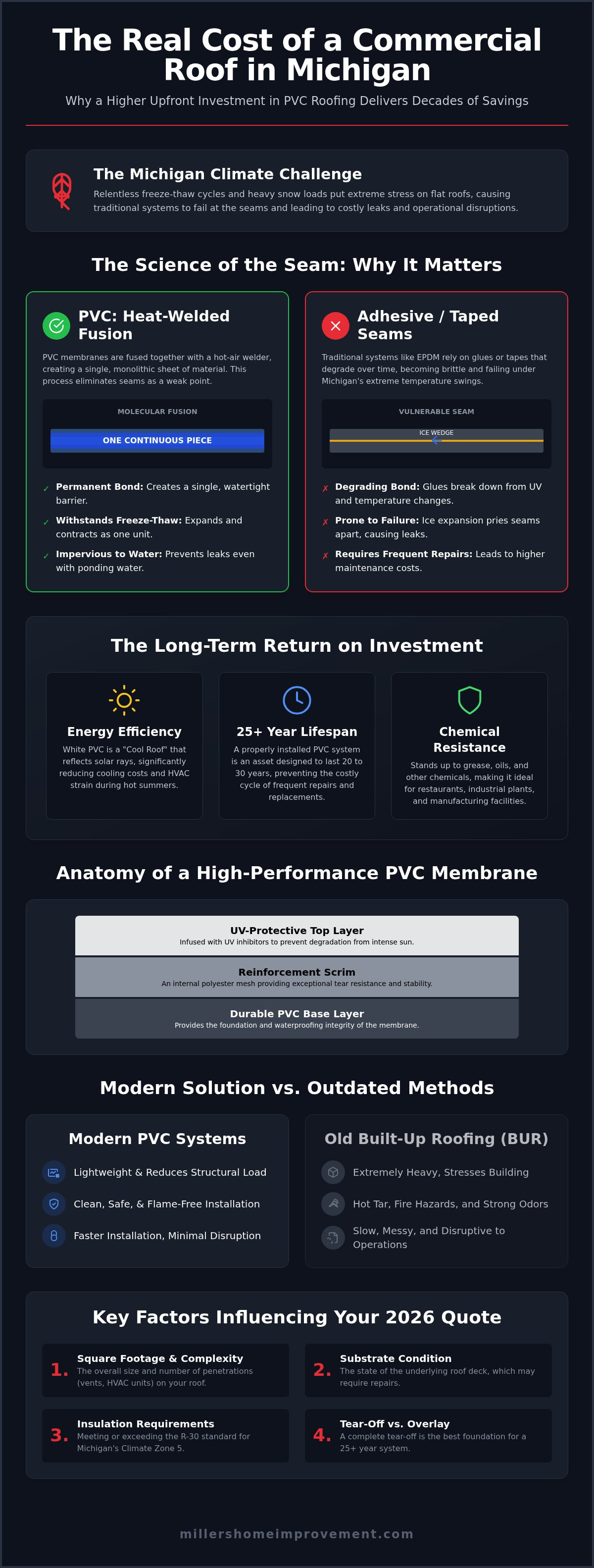
A quality PVC membrane isn't just a simple sheet of plastic. It's an engineered system featuring a reinforcement scrim, which acts as the structural backbone of the material. This internal mesh provides incredible tear resistance and dimensional stability. Additionally, the top layer is infused with UV inhibitors that protect the roof from degradation caused by intense summer sun. While standard thicknesses usually begin at 50 or 60 mils, high-performance options are available for buildings that require extra durability against foot traffic or extreme weather.
PVC vs. Traditional Built-Up Roofing (BUR)
Modern Michigan businesses are increasingly moving away from traditional multi-layer asphalt roofs, often called Built-Up Roofing (BUR). One of the most immediate benefits of thermoplastic single-ply roofing membranes is their weight. PVC is significantly lighter than heavy gravel and asphalt systems, which reduces the structural stress on your building.
Safety and speed are also major factors. Installing a PVC roof is a clean, flame-free process. We don't use hot tar kettles or open torches, which minimizes fire risks and unpleasant odors during construction. Because the installation is more streamlined, we can complete projects faster. This efficiency helps manage the overall commercial PVC roofing cost Michigan businesses pay while ensuring the facility remains operational with minimal disruption.
The Science of the Seam: Why Michigan Winters Require PVC
Michigan's climate presents a unique challenge for commercial property owners. During a typical winter, temperatures can swing from a midday thaw to a midnight freeze. This cycle causes materials to expand and contract rapidly, putting immense stress on the seams of a flat roof. While the initial commercial PVC roofing cost Michigan contractors quote may seem higher than other options, the science behind the material's seams justifies the investment. When water seeps into a weak seam and freezes, it expands, acting like a wedge that slowly pries the roof apart. PVC is specifically engineered to withstand this physical pressure.
In Detroit and surrounding areas, ponding water is a common sight on older flat roofs. When water sits on a roof and goes through repeated freeze-thaw cycles, it can quickly degrade inferior materials. PVC is a high-performing, low slope, single-ply roofing solution specifically because it remains impervious to standing water. The material doesn't just sit on the roof; it becomes a monolithic barrier that remains watertight even under the most demanding Midwestern weather conditions.
Heat-Welding vs. Adhesive Bonding
Traditional EPDM roofs rely on adhesive bonding, which is essentially a high-grade glue. Over time, the volatile organic compounds in these glues evaporate, causing the seams to become brittle and eventually fail during extreme temperature shifts. In contrast, PVC utilizes hot-air welding to create molecular fusion between sheets. This process melts the top and bottom membranes together to create a single, continuous piece of material. Heat-welding stands as the gold standard for leak prevention in 2026 because it eliminates the reliance on temporary chemicals and tapes. When we perform commercial roof repairs, we often see that welded seams are the only parts of an old roof still holding strong.
Handling Heavy Snow Loads and Ice Dams
Michigan ground snow loads vary significantly, ranging from 25 pounds per square foot in the southern regions to over 80 pounds per square foot in the north. This weight creates significant downward pressure that can cause inferior membranes to crack or stretch. PVC is engineered with a reinforced scrim that provides high tensile strength, allowing it to support these heavy loads without losing its structural integrity. The material's natural flexibility ensures it won't become brittle during sub-zero January nights.
The smooth surface of a white PVC membrane also encourages snow to shed more easily and helps meltwater reach the drains faster. This efficiency prevents the formation of ice dams, which are a leading cause of winter leaks in our region. Factoring in these environmental protections is essential when evaluating the total commercial PVC roofing cost Michigan businesses must budget for over the life of the building.
Commercial PVC Roofing Cost vs. TPO and EPDM
Choosing the right flat roof for a Michigan business involves balancing the initial investment against the total cost of ownership. It's a fact that PVC typically carries the highest upfront price tag among the three major single-ply systems. While the initial commercial PVC roofing cost Michigan building owners see in a quote might be higher than EPDM or TPO, the price reflects the specialized labor required for installation. Every seam, flashing, and penetration must be meticulously heat-welded by a skilled technician. This process is more time-intensive than simply rolling out adhesive, but it results in a bond that is physically stronger than the membrane itself.
Beyond the installation, PVC offers unique protections that other materials can't match. It's the only membrane among the three that is naturally resistant to oils, fats, and harsh chemicals. For food processing plants, restaurants with rooftop exhaust fans, or industrial facilities, this resistance is a critical factor. While EPDM or TPO might swell and degrade when exposed to these substances, PVC remains stable. This durability prevents premature failure and ensures you aren't paying for a full replacement a decade earlier than expected.
The 20-Year ROI Breakdown
When you look at a 20-year horizon, the financial narrative shifts in favor of PVC. EPDM systems, while affordable to install, often require more frequent maintenance as the glued seams begin to pull apart due to Michigan’s temperature swings. TPO is a strong contender, but early-generation TPO had issues with heat aging that PVC has historically avoided. A PVC roof typically requires fewer service calls over two decades. When you combine reduced repair frequency with the longevity of the material, the "Life Cycle Cost" often ends up lower than the "cheaper" alternatives. We focus on providing a system that minimizes your long-term financial exposure.
Energy Efficiency and Michigan Utility Rebates
Michigan's humid summers can put an enormous strain on commercial HVAC systems. White PVC membranes feature a high Solar Reflective Index (SRI), which means they reflect the majority of solar heat rather than absorbing it into the building. This thermal efficiency helps property owners meet the R-30 continuous insulation requirements mandated in most of the state's climate zones. By reducing the "heat island" effect on your roof, you can see a noticeable drop in monthly cooling expenses.
There are also external financial incentives to consider. Many Michigan utility providers offer rebates for businesses that upgrade to energy-efficient building envelopes. Additionally, federal tax credits for green building improvements can often be applied to high-reflectance roofing projects. These incentives, combined with lower utility bills, help offset the initial commercial PVC roofing cost Michigan contractors quote, accelerating your return on investment while shrinking your building's carbon footprint.
Factors Driving Commercial PVC Roofing Cost in Michigan
Every commercial roof is a unique structural assembly. While material prices remain relatively stable across the industry, several specific variables dictate the final commercial PVC roofing cost Michigan property owners will encounter. Total square footage plays a major role in the initial quote. Larger industrial warehouses often benefit from an economy of scale where the cost per square foot decreases because mobilization and setup expenses are spread over a wider area. Smaller retail spaces with complex rooflines or multiple levels may see higher unit costs due to the increased detail work involved.
The condition of your existing substrate is perhaps the most significant variable. A recover project involves laying a new membrane over the old one, which can reduce labor and disposal costs. However, we typically advise a complete tear-off for buildings with older or failing systems. Removing saturated insulation and degraded materials ensures a clean, stable foundation for the new PVC membrane. While a full tear-off increases the immediate investment, it prevents trapped moisture from compromising your structural deck or causing premature failure of the new installation.
Accessibility in urban centers like Detroit also influences the budget. If your building requires cranes or specialized lifts to move materials to a high-rise rooftop, logistical costs will rise. The number of penetrations on the roof, including HVAC units, plumbing vents, and skylights, also matters. Each of these requires meticulous hand-welding and custom flashing to maintain the integrity of the system, which adds to the total labor hours required for a successful project.
Insulation and Michigan Building Codes
Modern Michigan building codes, based on the 2021 International Building Code, require a minimum of R-30 continuous insulation for commercial roofs in Climate Zone 5. Meeting this standard usually involves installing multiple layers of polyisocyanurate (polyiso) insulation boards. The total thickness of these boards and the method used to secure them will impact your project quote. Mechanically fastened systems are often more cost-effective, while fully adhered systems provide superior wind uplift resistance and eliminate thermal bridging from metal fasteners.
Logistics: Permits, Safety, and Disposal
Project logistics extend to municipal permits and safety compliance. Michigan's 1,240 municipalities each have their own building departments with varying permit fees. Additionally, MIOSHA regulations require strict fall protection, such as physical barriers or personal fall arrest systems, for any work near an unprotected edge. Disposal fees for old roofing materials at Southeast Michigan landfills must also be factored into the budget. Finally, while we install roofs year-round, winter projects may involve surcharges to cover snow removal and the specialized care needed to maintain proper welding temperatures in sub-freezing weather.
If you're ready to get an accurate assessment of your building's specific needs, contact us for a free commercial roofing estimate.
Why Miller's Home Improvement is Michigan’s PVC Specialist
Miller's Home Improvement brings over 25 years of owner-operated experience to the Southeast Michigan commercial sector. We understand that evaluating the commercial PVC roofing cost Michigan businesses face is about more than just comparing bottom-line numbers. It's about selecting a partner who will be there for the next two decades. Our team specializes in high-performance flat roofing systems, with a particular focus on the technical precision required for PVC heat-welding. We treat every project as a long-term commitment to the stability and safety of your facility.
We don't believe in shortcuts. While some contractors might suggest a recover to save on labor, we prioritize complete roof tear-offs. This meticulous approach allows us to inspect the structural deck, replace damaged insulation, and ensure the new membrane has a clean, stable substrate. By doing the job correctly the first time, we protect your investment from the moisture-related issues that often plague Michigan industrial properties. A clean start is the only way to guarantee a roof that lasts its full 25-year life expectancy.
Our roots are firmly planted in Detroit and Macomb County. This local presence means we understand the specific weather patterns that trigger insurance claims in our region. When high winds or hail damage your facility, we act as your proactive guide through the restoration process. We leverage our extensive experience with commercial insurance claims to ensure you receive the coverage you deserve, helping you transition from a damaged roof to a superior PVC system with minimal stress. We know the local adjusters and the specific documentation they require to approve a high-quality replacement.
The Miller’s Difference: Master Craftsmanship
We prioritize quality materials and disciplined installation techniques over being the cheapest bid on the table. Our reputation as a seasoned master craftsman is built on integrity and the long-term performance of our roofs. We maintain clean job sites and coordinate our work to ensure minimal disruption to your daily business operations. We provide a no-pressure, educational estimate process that focuses on informing you about your options rather than pushing a sale. Our goal is to provide you with the facts you need to make a confident decision for your building.
Next Steps for Your Commercial Property
Protecting your property starts with a clear understanding of its current condition. We offer a free, comprehensive on-site roof assessment to identify vulnerabilities and potential energy savings. Following the inspection, we present a detailed proposal that outlines every factor of your project, from code-compliant insulation to final flashing details. This transparency ensures there are no surprises once the project begins. You can take the first step toward a leak-proof future today. Get a Free Commercial PVC Roofing Estimate and see the difference that 25 years of local expertise makes for your business.
Secure the Future of Your Michigan Facility
Investing in a high-performance roof is a significant decision that impacts your business for decades. While the initial commercial PVC roofing cost Michigan contractors quote reflects the specialized labor of heat-welding, the true return on investment comes through decades of leak-free performance and reduced cooling expenses. You've seen how this monolithic system stands up to our state's harsh freeze-thaw cycles and meets the latest R-30 insulation standards.
Choosing a seasoned partner ensures these technical details are managed correctly from the start. Miller's Home Improvement brings 25+ years of owner-led experience to every project. We're a fully licensed and insured Michigan contractor specializing in high-performance PVC systems. We're ready to help you navigate building codes or insurance claims with transparency and professional assurance. Let's build a roof that protects your assets and provides lasting peace of mind.
Request Your Free Commercial Roofing Estimate Today
Frequently Asked Questions
How much does a commercial PVC roof cost per square foot in Michigan?
The total commercial PVC roofing cost Michigan property owners encounter is determined by variables like membrane thickness, R-value insulation requirements, and the complexity of the roof's layout. While PVC represents a higher initial investment than EPDM or TPO, the price includes the specialized labor of heat-welding every seam to ensure a monolithic, waterproof barrier. Factors such as building height and the need for crane services in urban areas like Detroit will also influence the final project quote.
How long does a PVC roof last in the Michigan climate?
A professionally installed 60 mil PVC roof typically lasts between 25 and 35 years in the Michigan climate. Its ability to remain flexible during sub-zero temperatures prevents the cracking often seen in older asphalt-based systems. Because the seams are physically fused together, they don't suffer from the adhesive failure that can occur during our state's extreme freeze-thaw cycles.
Can you install a PVC roof over an existing flat roof?
It is possible to install a PVC membrane over an existing flat roof in a process known as a recover, provided the building code and structural integrity allow for it. However, we generally recommend a complete tear-off for commercial properties. Removing the old material allows us to inspect the decking for rot and ensures that saturated insulation isn't trapped under your new, high-performance system.
Is PVC better than TPO for Michigan businesses?
PVC is often considered superior to TPO for specific Michigan businesses, particularly those in the food service or industrial sectors. PVC offers excellent resistance to grease, oils, and harsh chemicals that can cause TPO or EPDM to swell and degrade. While both are reflective "cool roofs," PVC has a longer track record of stable performance regarding heat aging and seam integrity.
What maintenance does a commercial PVC roof require?
PVC is a low-maintenance material, but it still requires a proactive approach to reach its full life expectancy. We recommend bi-annual inspections to clear debris from drains and scuppers, especially after heavy Michigan autumns. Checking the integrity of flashings around HVAC units and ensuring that no mechanical damage has occurred from foot traffic will prevent minor issues from becoming costly repairs.
Does Michigan offer tax credits for white PVC "cool roofs"?
Michigan businesses can often leverage federal tax credits, such as the Section 179D deduction, for installing energy-efficient building envelopes like white PVC. Additionally, local utility providers like DTE and Consumers Energy sometimes offer rebates for commercial upgrades that significantly reduce HVAC energy consumption. You should consult with a tax professional to see which current incentives apply to your 2026 roofing project.
How does PVC roofing handle ice dams and heavy snow?
PVC roofing handles heavy snow loads exceptionally well due to its high tensile strength and reinforced internal scrim. The smooth, reflective surface of the membrane helps solar heat melt snow more quickly than dark-colored roofs, which aids in faster drainage. This efficient shedding of water helps prevent the formation of ice dams that can put dangerous weight on your building's structure.
What is the best time of year to replace a commercial roof in Detroit?
The most efficient window for a commercial roof replacement in Detroit is between April and November when temperatures are consistently above freezing. While we can install PVC systems during the winter months, the process requires additional care to maintain proper welding temperatures for the seams. Planning your project for the spring or autumn typically allows for the fastest installation timelines and minimal weather-related delays.


