
Imagine waking up to a half-finished roof just as a heavy rain begins, only to find your contractor's phone number has been disconnected and their crew is nowhere to be found. For many homeowners, this isn't just a stressful thought; it's a financial reality that occurs when a "fly-by-night" operation disappears with a deposit. Choosing a bonded roofing contractor Detroit homeowners can rely on is the most effective way to ensure you aren't left holding the bill for an incomplete or non-compliant project.
We understand the deep anxiety that follows a storm or a sudden leak, especially when the difference between a licensed professional and a risky independent laborer feels unclear. You deserve to feel confident that your investment is secure. This guide explains exactly what it means to be bonded and how that status acts as a fail-safe for your property. We'll examine the specific $5,000 bond requirements set by the City of Detroit and the critical April 2026 Michigan Residential Code updates that protect your home's integrity. You'll learn how to verify a company's stability so you can move forward with the peace of mind that your roof is in expert, local hands.
Key Takeaways
- Understand how a surety bond acts as a financial guarantee, protecting you if a contractor fails to finish the job or meet local building codes.
- Distinguish between general liability insurance and bonding to ensure your home investment is shielded from every angle of financial risk.
- Identify the specific red flags of "storm chasers" and learn why choosing a bonded roofing contractor Detroit homeowners trust is vital for long-term property stability.
- Learn the exact steps to verify a roofer’s credentials through the Michigan LARA database and direct bond number validation.
- Discover the value of partnering with seasoned local craftsmen who prioritize transparency and have a documented history of serving the Detroit community.
What is a Bonded Roofing Contractor in Detroit?
A bonded roofing contractor Detroit homeowners choose is a professional who has gone beyond basic state requirements to provide an extra layer of financial security. While many contractors claim to be "fully covered," bonding is a specific legal tool that protects the customer, not the business. To understand the mechanics of this protection, it helps to know what is a surety bond. Essentially, it's a three-party agreement between the roofing company, the homeowner, and a surety company. If the contractor fails to fulfill the contract, the surety company steps in to provide financial restitution.
In the Detroit market, this credential is a vital sign of stability. Our city often faces intense seasonal storms that bring out "storm chasers" from across state lines. These operators often lack the local ties and financial backing that a bond represents. By hiring a bonded professional, you're ensuring that the company has been vetted by a third-party financial institution. A bond acts as a filter. It separates the established local businesses from those who might disappear before the first shingle is even nailed down.
The Purpose of a Roofing Surety Bond
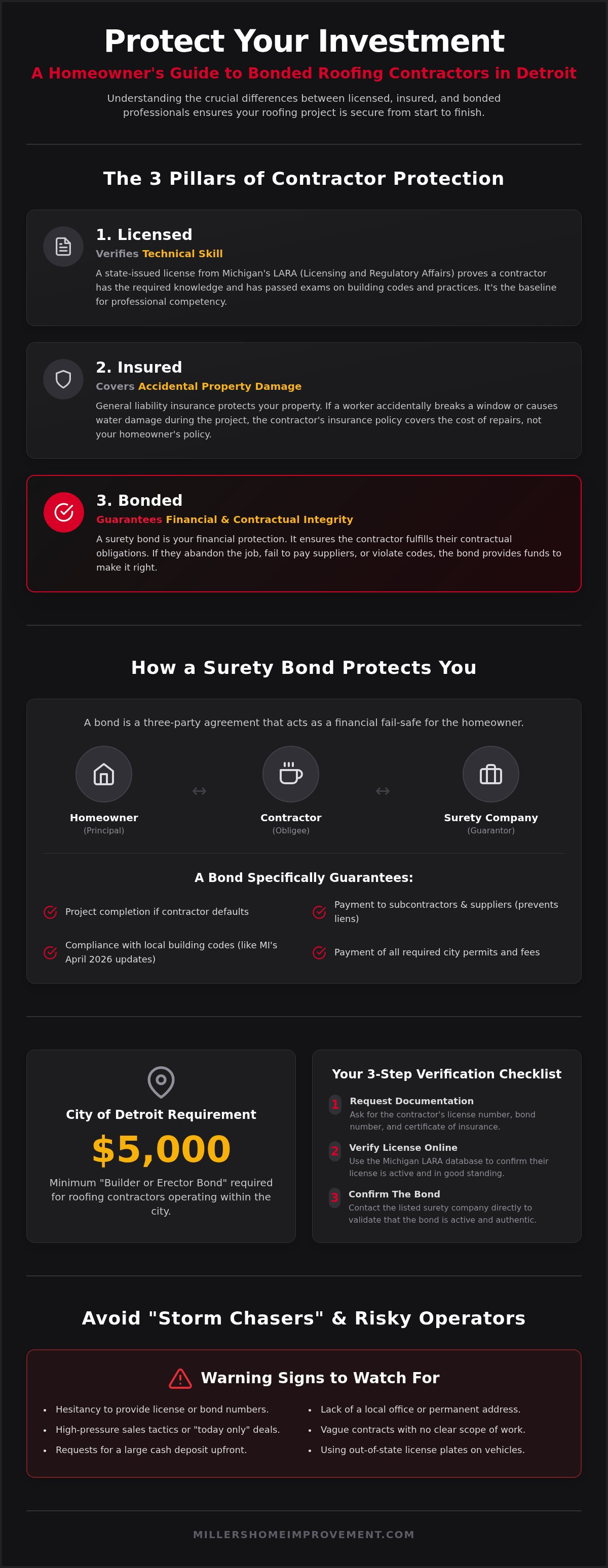
The primary role of a bond is to provide a "fail-safe" for your project’s completion. If a contractor walks away from a job or goes out of business mid-project, the bond funds can be used to hire a new crew to finish the work. Beyond simple completion, the bond covers several critical legal and financial risks:
- Unpaid Permits: Ensures all City of Detroit permit fees are settled so you don't face municipal fines or legal delays.
- Subcontractor Liens: Protects you if the main contractor fails to pay their material suppliers or laborers, preventing liens against your property title.
- Code Compliance: Provides recourse if the work fails to meet the Michigan Residential Code updates effective April 2026, such as mandatory ice and water shield requirements.
Bonded vs. Licensed: Why One Isn’t Enough
It's a common mistake to assume that a license covers everything. In Michigan, the Licensing and Regulatory Affairs (LARA) department oversees residential builder licenses, which require a $195 fee and a passing exam score. This license proves technical competency. It shows the roofer knows how to install a shingle or a flat roof system correctly. It doesn't, however, guarantee they are financially stable.
Bonding picks up where licensing leaves off. While the state license tells you they can do the work, the bond tells you they can afford to stand behind it. For Detroit residents, the city specifically requires a $5,000 "Builder or Erector Bond." Hiring an unbonded handyman might save a few dollars upfront, but it leaves you vulnerable to the full cost of any legal or structural failures. Professional bonded roofing contractor Detroit services provide the peace of mind that your home is protected by both skill and financial accountability.
The 3 Pillars of Protection: Licensed, Insured, and Bonded
A comprehensive protection strategy for your home isn't built on a single credential. Instead, it relies on three distinct pillars that work together to shield you from legal and financial liability. While licensing proves technical skill, a bonded roofing contractor Detroit homeowners trust must also carry general liability and workers' compensation insurance. Each of these components addresses a different type of risk, ensuring that whether a shingle is dropped or a contract is breached, you aren't the one paying for the mistake.
Hiring a reputable contractor means verifying these three pillars before any work begins. General liability insurance is the contractor's safeguard for your physical property. If a crew member accidentally breaks a window or a sudden rainstorm damages your ceiling while the roof is open, this insurance covers the repairs. Without it, you might find yourself in a lengthy legal battle to recover costs for property damage caused by the contractor's team.
Working with a bonded roofing contractor Detroit ensures that the administrative side of your project is as sturdy as the shingles themselves. At Miller's Home Improvement, we maintain all three pillars because we believe transparency is the foundation of every successful roof replacement. We don't just promise quality; we provide the documented financial backing to prove it.
General Liability vs. Surety Bonds
Many homeowners confuse liability insurance with bonding, but they serve entirely different purposes. Think of liability as coverage for "what went wrong" during the physical installation. It handles accidents, such as a ladder falling against your siding. A surety bond, however, covers "what didn't happen." It's your protection against a contractor who fails to complete the work or disappears after receiving a deposit. Both are non-negotiable for a professional roof replacement. One protects your house, while the other protects your bank account.
The Importance of Workers’ Comp in Michigan
In Michigan, workers' compensation is a critical pillar that many smaller, unbonded crews try to bypass to lower their quotes. This is a dangerous gamble for the homeowner. If a worker is injured on your property and the contractor doesn't have workers' comp, you could be held liable for their medical bills and lost wages. Essentially, workers' compensation acts as a legal firewall that prevents an injured worker from seeking damages directly from your personal assets or homeowner's insurance policy. Always request a Certificate of Insurance (COI) that specifically lists an active workers' compensation policy before allowing anyone on your roof.
Why Bonding is Critical in the Detroit Roofing Market
Detroit's architectural landscape and volatile weather patterns create a high-stakes environment for roof work. Southeast Michigan is a prime target for "storm chasers" who follow hail and wind events to secure quick deposits. These transient crews often disappear before the project is finished, leaving homeowners with a leaking roof and a drained insurance check. Choosing a bonded roofing contractor Detroit residents can verify ensures that your insurance restoration isn't hijacked by a scam. A bond acts as a financial guarantee that the contractor will follow through on every contractual obligation, regardless of how many other jobs they've taken on after a storm.
Beyond storm protection, bonding ensures compliance with the Detroit Building Safety Engineering and Environmental Department (BSEED). This department maintains strict standards for property safety and environmental impact. An unbonded contractor might cut corners to save time, leading to failed inspections or municipal fines that become your responsibility. By hiring a professional with the city-mandated $5,000 Builder or Erector Bond, you're choosing someone who is already vetted and recognized by Detroit’s regulatory bodies.
Protecting Your Insurance Restoration Project
In high-demand restoration seasons, the "deposit scam" is a persistent threat. A contractor may ask for the full insurance payout upfront and then fail to return. A bonded contractor provides a layer of security that protects your insurance claim payout from being mishandled. At Miller’s Home Improvement, we specialize in storm damage repair and offer insurance claim assistance to ensure your property is restored to its pre-storm condition. Our bonded status means that if any part of the restoration fails to meet the agreed-upon standards, you have a direct path to financial recovery through the surety company.
Bonding for Commercial and Flat Roofs
Detroit’s industrial history means many properties rely on complex flat roofing systems. Whether it’s PVC, EPDM, or Torch Down installations, these systems require specialized knowledge and precise execution. The risks are higher for commercial projects in Macomb County and the surrounding Detroit industrial zones, where a single installation error can lead to massive inventory loss or structural damage. Bonding is essential for these large-scale projects because it guarantees the long-term integrity of the system. It ensures that the contractor is financially stable enough to handle the high material costs and technical demands of industrial flat roofing without risking the project's completion.
- PVC and EPDM: Bonding ensures these membrane systems are installed to manufacturer specs, protecting your warranty.
- Torch Down: Provides financial recourse for the specific fire safety risks associated with open-flame installation.
- Industrial Integrity: Guarantees that large-scale commercial roofs meet the April 2026 Michigan Residential Code updates for insulation and drainage.
How to Verify a Detroit Roofer’s Credentials
While online reviews offer a glimpse into past customer satisfaction, they don't provide a legal guarantee of financial stability. To truly vet a bonded roofing contractor Detroit homeowners must look beyond the screen and verify official documentation. This process ensures the company is not only skilled but also legally authorized to operate within the city limits. A professional who values their reputation will have no trouble providing this proof upon request.
First, visit the Michigan LARA (Licensing and Regulatory Affairs) website to use their license lookup tool. Any residential project valued at $600 or more, including materials and labor, requires a state license. Confirm the status is "Active" and matches the business name on your estimate. Second, ask the contractor for their specific bond number and the name of the surety company. Third, take the extra step to call the surety company directly. Confirm the bond is currently in force and covers the dates of your scheduled project. This ensures the $5,000 bond required by the City of Detroit is actually protecting your property.
Fourth, verify that the company has a physical office location in Southeast Michigan. Stable local entities maintain a permanent presence in the community rather than operating solely out of a truck. Finally, review your written contract for specific language regarding the bond and manufacturer warranties. If you're ready to work with a team that prioritizes transparency and documented accountability, contact Miller's Home Improvement for a detailed and professional estimate.
Red Flags to Watch For
Protecting your investment means staying alert during the initial consultation. Be wary of contractors who demand full payment upfront or insist on cash-only transactions. These are classic hallmarks of "storm chasers" who lack the financial backing of a bond. Vague or defensive answers regarding bonding limits or insurance coverage are another major warning sign. If a contractor cannot provide a permanent business address or a local phone number, it's a strong indication they may not be around to honor their warranty if a leak develops later.
Questions to Ask During Your Estimate
A Master Craftsman will always welcome detailed questions about their credentials because they have nothing to hide. Use these specific inquiries to separate professionals from high-risk laborers:
- "Can you provide a physical copy of your $5,000 Detroit Builder bond and your current insurance certificate?"
- "Who is your bond carrier, and what are your specific coverage limits per project?"
- "Does your contract explicitly state that the work will meet the April 2026 Michigan Residential Code updates for ice and water shields?"
A seasoned professional will answer these questions with quiet confidence, viewing your diligence as a sign of a well-informed homeowner.
Miller’s Home Improvement stands as a testament to stability in the Southeast Michigan roofing industry. With over 25 years of owner experience, our team has seen the evolution of Detroit’s building codes and weather patterns firsthand. We aren't a revolving door of subcontractors; we are a family-owned business built on a legacy of integrity. As a bonded roofing contractor Detroit families have trusted for 13 years, we prioritize the legal and financial safety of your property above all else. This commitment to transparency is why we maintain our city-mandated bond and comprehensive insurance coverage for every project. We believe that a roof is only as good as the company that stands behind it.
Our Comprehensive Roofing Solutions
Our expertise spans the full spectrum of Detroit’s unique roofing needs. For residential properties, we specialize in complete roof tear-offs and meticulous shingle installations designed to withstand Michigan's freeze-thaw cycles. We take the time to ensure every flashing detail and ventilation point meets the latest April 2026 code requirements. Commercial clients benefit from our deep knowledge of flat roofing systems. We provide expert installation of PVC, EPDM, and Torch Down systems, ensuring that industrial and commercial buildings remain watertight and energy-efficient. Additionally, our team offers professional storm damage assessment and insurance restoration. We guide you through the claims process to ensure your investment is fully protected after a major weather event.
Ready for Peace of Mind?
Choosing a contractor is a major decision. You deserve a partner who views your roof as a long-term investment rather than a one-time transaction. Eric Miller and his team bring a master craftsman's eye to every estimate, identifying potential risks before they become costly failures. Our approach is grounded in quiet confidence and professional assurance. When you hire a bonded roofing contractor Detroit residents recommend, you're investing in the future of your property's value. We don't use high-pressure sales tactics. Instead, we educate you on the best materials and methods for your specific property. Experience the difference of a proactive guide who values local roots and straightforward communication. Request Your Free Detroit Roofing Estimate Today and take the first step toward a more secure home.
Securing the Future of Your Detroit Home
A new roof is one of the most significant investments you'll make in your property. By prioritizing the three pillars of protection, you aren't just buying shingles; you're securing your financial peace of mind. We've explored how bonding acts as a critical fail-safe against contract breaches and why it's the defining mark of a professional in our local market. Choosing a bonded roofing contractor Detroit homeowners trust ensures that your project meets the strict April 2026 Michigan Residential Code updates while shielding your personal assets from liability.
Miller’s Home Improvement is proud to be a stable, owner-operated fixture in Southeast Michigan. With 25+ years of experience, Eric Miller remains personally committed to every project's success. We are fully licensed, insured, and bonded to provide the highest level of accountability for our neighbors. Don't leave your home's safety to chance or unverified claims. Reach out to a team that values durability and meticulous craftsmanship as much as you do. Get a Free Estimate from a Bonded Detroit Roofer and move forward with confidence in your home's protection.
Frequently Asked Questions
Is bonding required by law for roofing contractors in Michigan?
There is no statewide surety bond requirement for a general contractor license in Michigan, but local municipalities often set their own rules. The City of Detroit specifically requires a $5,000 Builder or Erector Bond for professionals operating within city limits. While the state license covers your roofer's technical qualifications, the local bond requirement is what provides the financial fail-safe for homeowners. Always verify your contractor meets these specific municipal standards before work begins.
What happens if I hire a roofer who is insured but not bonded?
Hiring a roofer who is insured but not bonded leaves you protected against property damage and injuries but vulnerable to contract failure. General liability insurance covers accidents, like a ladder falling through a window, while workers' comp handles on-site injuries. However, if an unbonded contractor disappears with your deposit or leaves the roof half-finished, insurance won't help. You would have no financial recourse through a surety company to recover your lost funds.
How do I know if a roofers bond is still active?
You can verify a bond's status by requesting the bond number and the name of the surety company directly from the contractor. Once you have these details, call the surety provider to confirm the bond is currently in force and covers your project's timeframe. A professional bonded roofing contractor Detroit residents can trust will provide this documentation readily. Don't rely on verbal promises or outdated certificates, as bonds must be renewed annually to remain valid.
Does a bond cover poor workmanship or just unfinished work?
A performance bond primarily guarantees that the contractor fulfills the specific terms of the contract, which includes completing the job and meeting local building codes. While it isn't a standard maintenance warranty for minor issues, it provides vital recourse if the workmanship violates Detroit building standards. If the contractor refuses to fix significant code violations or safety hazards, the surety company may provide the necessary funds to bring the installation into legal compliance.
Will my homeowners insurance require me to hire a bonded contractor?
Most homeowners insurance companies don't strictly mandate hiring a bonded contractor, but they highly recommend it for major restoration projects. Using a bonded professional reduces the risk of your insurance payout being mishandled or the project stalling indefinitely. If a contractor disappears with your claim money, your insurance provider is unlikely to pay for the same repair a second time. Hiring a bonded expert ensures the claim funds are used correctly for your home.
Are commercial roofing bond requirements different in Macomb County?
Bonding requirements for commercial projects often vary by municipality and project scale throughout Macomb County and the greater Detroit area. Commercial bonds, known as performance and payment bonds, frequently have much higher limits than the standard $5,000 residential bond. These bonds ensure that large-scale projects are completed and that all material suppliers and subcontractors are paid in full. We maintain appropriate bonding levels to handle both residential shingles and complex industrial flat roofing systems.
What is the average cost difference for a bonded vs. unbonded contractor?
The cost difference is usually minimal compared to the total project value and reflects the contractor's investment in their professional standing. While an unbonded laborer might offer a lower initial quote, they lack the financial vetting required by surety companies. A bonded roofing contractor Detroit homeowners choose represents a stable business model with verified assets. The slight price difference serves as an insurance policy that protects you from the catastrophic costs of an unfinished project.
How does Miller’s Home Improvement handle bonding for large commercial projects?
Miller’s Home Improvement maintains the necessary bonding and insurance limits to handle residential work and large-scale commercial roofing projects. Our 13 years in business as a stable local entity allows us to secure the higher bond limits required for industrial PVC, EPDM, and Torch Down installations. We provide all necessary documentation during the estimate phase so property owners can verify our financial stability. This transparency ensures that even the most complex commercial projects are completed on schedule.


