
A low bid is useful only when the contract spells out what it covers. Key questions to ask a roofing contractor before hiring include what the written scope covers, which materials are specified, the estimated start and completion dates, payment terms, and how added work could affect the price. Also ask whether the contractor is licensed and insured for the project location, and who will handle permits and applicable building-code requirements.
It’s reasonable to want a clear price and no surprises once work begins. The project price depends on factors such as the roof’s size and condition, the materials selected, and the work required, and is provided after a quote request. This guide explains what to clarify about the estimate, payment schedule, possible extra costs, insurance, warranties, and contract terms, giving you practical questions to ask a roofing contractor before hiring and helping you make a considered decision before signing.
Key Takeaways
- Separate the workmanship warranty from the manufacturer’s product warranty, and clarify what each covers, how long it lasts, and whether it can transfer to a future owner.
- Ask for current insurance documentation and a permanent business address to help assess the contractor’s accountability and coverage.
- Make sure the written agreement explains how changes or unexpected work are handled, so you understand what could alter the project total.
- Clarify how permits, local code requirements, and the specified roofing materials will be addressed before work begins.
Questions about a roofing contractor’s business location and insurance
Ask where the contractor’s permanent business is located and whether the address is a staffed business location, rather than only a post office box. Licensing requirements vary by city and state, so ask which license applies to your project and how to verify its status. These questions help clarify who is responsible for the work and which local requirements apply.
Ask for the license information, a current certificate of insurance, and references from local jobs completed in the past 12 months. These documents help you review the contractor’s credentials, insurance coverage, and recent work history.
Request proof of general liability insurance and ask what the policy covers if roofing work damages your home or another property. General liability coverage of $1 million to $2 million is described as typical for roofing contractors. Ask to see the actual certificate, confirm that its coverage is current, and check that the policy remains in effect for the project’s duration.
- Ask whether workers’ compensation insurance covers the crew assigned to the job.
- If the contractor employs a crew, workers’ compensation insurance is required.
- Confirm that both liability and workers’ compensation coverage remain active throughout the work.
An injury on your property or damage to your home can become complicated and costly if the contractor is uninsured. Ask for documentation showing which policies apply and that coverage is current, rather than relying on a verbal assurance. For example, ask who will provide updated proof if the project schedule changes.
Ask what roof replacement timeline the contractor expects and how the crew will protect your home during the work. Most roof replacements take 1-3 days, depending on the roof’s size, weather, and complexity; larger or more involved projects can take longer. Ask how the team will protect exposed areas from weather, control debris, and collect stray nails from lawns and driveways. A clear plan makes the schedule and basic property-protection steps understandable before work begins.
Workmanship warranties versus manufacturer warranties
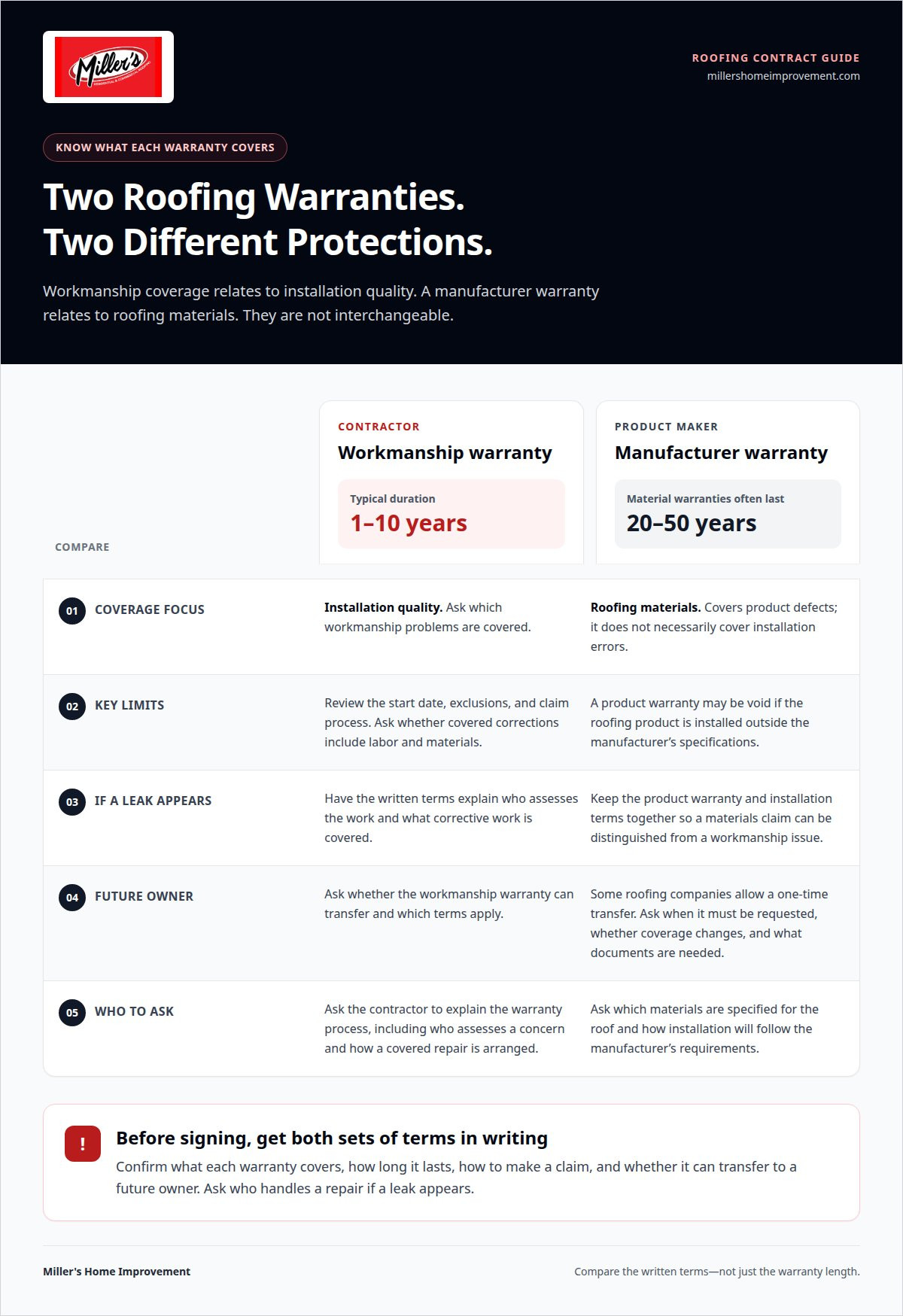
A roofing warranty can cover either installation quality or the roofing materials, and those protections are not interchangeable. Contractor workmanship warranties typically last 1-10 years, while material warranties often last 20-50 years, depending on the product. Ask for both terms in writing and have the contractor explain who handles a repair if a leak appears.
Review the workmanship warranty for its start date, covered installation errors, exclusions, and claim process. Ask whether it covers the labor and materials needed to correct a workmanship problem, and how to report one. If a leak appears after installation, for example, the written terms should explain whether the contractor will assess the work and what corrective work is covered.
Manufacturer warranties cover product defects, not necessarily installation errors. A product warranty may be void if the roofing product is installed outside the manufacturer’s specifications. Ask which materials are specified for your roof replacement and how the installation will follow those requirements. Keep the product warranty and installation terms together so you can distinguish a materials claim from a workmanship issue.
Ask whether the warranty can transfer to a future owner. Some roofing companies allow a one-time transfer, but the terms and process matter. Find out when the transfer must be requested, whether coverage changes, and which documents the new owner needs. The warranty’s practical value also depends on the contractor remaining available to honor its workmanship commitments.
Ask how the contractor handles complaints and whether references or reviews describe how workmanship concerns were resolved. Request a clear explanation of the warranty process, including who assesses the problem and how a covered repair is arranged. These are useful questions to ask before signing, not after a concern appears. For a roof issue that needs corrective work, learn about roof repair services.
Contract price, payment, and additional costs
Ask for a written proposal that identifies the work, materials, estimated start and completion dates, and payment terms. For example, a shingle replacement estimate should distinguish removal, installation, cleanup, and any specified work around roof openings. The price depends on roof size and condition, material selection, and the work required, and is provided after a quote request. Make sure the contract explains how changes to the original scope affect the total.
Payment terms should connect payments to clear project milestones. A 10-30% deposit is described as typical for residential roofing work, with the remaining balance not due before substantial completion. The agreement should explain what “substantial completion” means for the project and when each payment is due. Ask whether financing is available and, if so, request its terms in writing before making a decision.
Be cautious about large upfront payments before work begins, and don’t pay for a roof in advance. Warning signs include pressure to pay immediately, reluctance to provide a written agreement, or vague explanations of what a payment covers. The contractor should be able to explain the payment schedule, scope, and process for documenting additional work.
Ask how the contractor handles damage or concealed problems discovered after work starts. The issue should be documented, the necessary repair explained, and a written change order provided to show how the scope and payment will change before work proceeds. For instance, if removing shingles reveals damage to underlying material, the change order should describe the added work and revised terms.
- Confirm that the contract names the materials and workmanship covered by the agreed scope.
- Ask how progress updates and payment requests will be communicated.
- Keep signed proposals, receipts, and change orders together as project records.
Building codes, permits, and specified roofing materials
Ask how building-code and permit requirements apply to your property. Requirements vary by location, so the contractor should explain which local rules affect the replacement and who will handle any required permits. A licensed contractor is generally more likely to follow local codes, obtain proper permits, and meet city requirements. Ask how these steps are reflected in the project scope and schedule.
Get the roofing materials identified in writing before agreeing to the work. Ask for the product type and installation details, and have the contractor explain how the specified materials suit your roof. For example, the proposal should clarify whether it includes a full tear-off or considers leaving existing roofing layers in place. Since two layers can remain in some cases, ask what conditions inform that decision.
Make sure the contract’s description of the materials matches the planned installation. Ask how the crew will handle a substitution if a specified material cannot be used, and how approval and revised terms will be documented. This keeps the agreed scope clear if weather or another project condition affects installation. A written record also connects the selected materials with applicable manufacturer specifications and warranty terms.
- Ask which permits apply and who will arrange them.
- Ask how local code requirements affect the roof replacement scope.
- Confirm the proposed materials and installation details appear in writing.
- Clarify how the contractor documents substitutions or changes before workers install different materials.
References from local projects can show how a contractor communicates about permits and materials. Ask for an example of a completed replacement with a comparable roof type, then ask how its written scope addressed materials and local requirements. Clear answers connect the proposal to the work and keep important decisions from being left until installation begins.
For a roof replacement with code, permit, and material details to work through, discuss your roofing project.
Miller's Home Improvement
When you’re ready to discuss a roofing project in Detroit or elsewhere in Southeast Michigan, Miller's Home Improvement can explain the proposed scope, materials, and terms. Its residential and commercial roofing services include flat-roof systems such as PVC and EPDM. A project discussion can connect your roof’s needs with the work being considered, so you can understand the proposal before deciding how to proceed.
If you’re weighing repair or replacement options, bring your questions about materials, permits, payment terms, and workmanship into the conversation. Clear answers make it easier to review the scope and determine whether it fits your property and priorities. For a straightforward next step, contact Miller's Home Improvement to discuss your roofing project.
Move Forward With a Clear Roofing Plan
Questions to ask a roofing contractor before hiring should help you understand how the proposed work fits your property. Use the conversation to connect the scope, materials, and project process to your roof’s needs. The answers can also help you decide which details to clarify before approving the work.
If you’re ready to discuss a roofing project in Detroit or Southeast Michigan, Miller's Home Improvement can help you review the work and terms involved. Services include residential and commercial roofing, as well as PVC flat roofing. Bring your questions to the discussion and request a free in-home estimate to review the proposal and your priorities.
Contact Miller's Home Improvement to talk through your roofing project and take the next step with confidence.
Frequently Asked Questions
Are You Licensed and Insured in This Jurisdiction?
Yes. Miller's Home Improvement is licensed and fully insured. For a Detroit roofing project, make sure the proposal clearly identifies the contracting business and the project paperwork uses the same business name. Licensing requirements vary by location, so the applicable license depends on where the work takes place. Clear identification connects the agreement, insurance documents, and roofing work to the responsible contractor.
Will You Provide a Written Estimate With Itemized Scope of Work?
A written estimate should make the proposed work clear before you approve it. Look for distinct descriptions of the main tasks, materials, and any excluded work. For example, a roof replacement proposal should clarify whether removing the existing roofing is included. Miller's Home Improvement provides free in-home estimates, giving you an opportunity to discuss the project and proposed work.
Can I See Three References From Local Jobs Completed in the Last 12 Months?
Three local references can help you learn how a contractor handled work similar to yours. Focus on whether the reference’s project had a comparable roof type and scope, then ask about communication, site cleanup, and how the finished work matched the agreement. A Detroit homeowner considering a flat roof, for example, may find references for similar flat-roof projects more relevant than unrelated roofing work.
Have You Done This Specific Type of Job Recently?
Ask for examples that match your roof type, property, and project scope. Residential and commercial roofing address different property needs, while PVC and EPDM are distinct flat-roof systems. A useful response describes comparable work clearly instead of relying only on general roofing experience. For a Detroit property, matching the example to the proposed system can help you assess relevant experience.
How Long Have You Been in Business Under This Legal Name?
Miller's Home Improvement has been in business for 13 years. The name matters because it helps you connect the company’s history with the agreement, estimates, and project communications. For a Detroit roofing project, use the same business name when keeping your paperwork together. A clear record can make it easier to identify the contractor later if you need to refer to project documents.
How Long Is the Warranty, What Sets the Term, and Is It Transferable?
The warranty document sets out the term, coverage, exclusions, and transfer conditions. Ask whether a future owner can assume the remaining coverage, what paperwork the transfer requires, and whether the term changes. Keep the warranty with the final project documents, including product information. These records can help a future Detroit homeowner distinguish product coverage from commitments related to installation workmanship.


