
A single severe storm can compromise your home's integrity in minutes, but the real damage often happens during the months of confusing paperwork that follow. You likely worry that your insurance company will deny your claim or offer a settlement that barely covers a minor patch job. It's frustrating to feel like you're at the mercy of a complex system while hidden leaks threaten your property. We know that securing a full restoration requires more than just filing a form; it demands professional documentation and a firm grasp of state regulations. Our guide to the roofing insurance claim process Michigan homeowners need in 2026 will help you master these complexities with quiet confidence.
It's natural to feel overwhelmed by policy language that often favors the insurer over the homeowner. This roadmap promises to demystify confusing terms and provide an expert-led path to a high-quality roof replacement paid for by your insurance provider. We'll explore critical deadlines mandated by Michigan Compiled Laws, such as the 60-day payment requirement and the 12% interest penalty for late settlements. This guide leads you through the entire journey, from identifying hidden storm damage to successfully navigating the final restoration of your Southeast Michigan home amidst the rising material costs of 2026.
Key Takeaways
- Understand how Southeast Michigan’s unique weather patterns, including lake-effect winds and ice dams, impact your eligibility for a full roof restoration.
- Master the roofing insurance claim process Michigan homeowners follow by utilizing a contractor-led assessment to identify hidden damage before the adjuster arrives.
- Decode complex policy language regarding Actual Cash Value (ACV) and Replacement Cost Value (RCV) to secure the total funds needed for a high-quality replacement.
- Follow a structured evidence checklist to prepare for your adjuster meeting, ensuring all storm-related damage is documented and presented with professional authority.
- Learn the statutory protections available to you in 2026, such as the mandatory 60-day payment deadline and the interest penalties insurers face for late settlements.
Understanding the Michigan Storm Damage Landscape
Michigan's weather isn't just unpredictable; it's physically demanding on your home's exterior. Living in Southeast Michigan means your roof faces specific atmospheric pressures that standard national guides often overlook. The "Lake-Effect" isn't just for snow. It creates localized wind tunnels and rapid temperature shifts that cause materials to expand and contract violently. This unique climate is why the roofing insurance claim process Michigan residents face is often more complex than in other states.
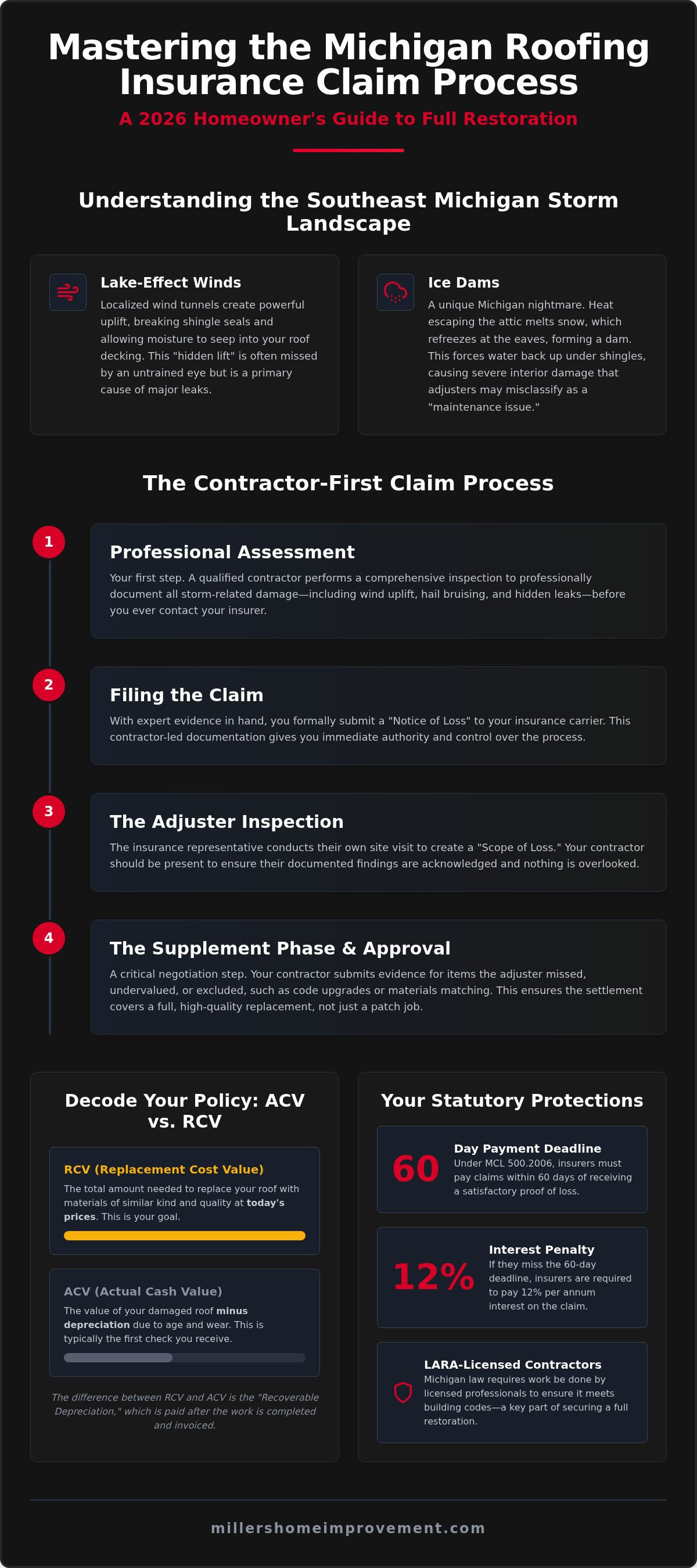
Ice dams represent a unique Michigan nightmare that often complicates the homeowners insurance claims process. When heat escapes from your attic, it melts snow on the roof, which then refreezes at the cold eaves. This creates a dam that forces water upward under your shingles. Insurance adjusters often try to classify this as a maintenance issue, but it's frequently the result of storm-related ventilation damage or sudden heavy accumulation that requires professional documentation to prove.
Common Damage Triggers in Metro Detroit
High-velocity wind gusts are a constant reality in Macomb and Wayne Counties. These aren't just gentle breezes; they're powerful enough to create wind uplift, where the shingle's seal is broken, allowing moisture to seep into the decking. While many homeowners look for missing shingles, the real danger is often the "hidden lift" that an untrained eye will miss. Hail is another significant factor. Even small stones can bruise the underlying mat of an asphalt shingle, shortening its lifespan by a decade. Acting before the harsh Michigan winter arrives is critical, as freezing temperatures make shingle replacement difficult and turn minor damage into catastrophic interior leaks.
Michigan Statutory Protections for Property Owners
You aren't alone when dealing with large carriers. The Michigan Department of Insurance and Financial Services (DIFS) sets strict rules to ensure fair treatment for homeowners. One of the most powerful tools in your arsenal is Michigan Compiled Law (MCL) 500.2006. This statute protects you from "bad faith" delays by requiring insurers to pay claims within 60 days of receiving a satisfactory proof of loss. If they fail to meet this deadline, they're required to pay 12% per annum interest on the claim. This law ensures that the roofing insurance claim process Michigan homeowners navigate stays on a predictable timeline.
Maintaining your home's value also requires adhering to local standards. Michigan law requires that all professional roofing work be performed by a LARA-licensed contractor. This isn't just a formality; it ensures that your roof meets current building codes, which is a vital component of securing a full restoration from your insurance provider. Hiring a licensed local expert ensures your documentation is accurate and your property remains protected under state law. We prioritize these standards to ensure every restoration meets the rigorous demands of our local climate.
The Step-by-Step Roofing Insurance Claim Process in Michigan
Successful restoration begins long before you pick up the phone to call your insurance carrier. The most effective roofing insurance claim process Michigan homeowners can follow starts with a professional contractor assessment rather than an adjuster's visit. This "contractor-first" approach ensures that all damage is documented by an expert who is looking out for your property's long-term health, not the insurer's bottom line. Understanding the fundamental steps for Filing a Homeowners Claim helps you maintain control over the situation from day one.
Once a qualified roofer identifies storm-related issues, the process moves through five distinct phases:
- Professional Assessment: A comprehensive inspection to document wind uplift, hail bruising, and potential leaks.
- Filing the Claim: Submitting the "Notice of Loss" to your carrier using the evidence gathered.
- The Adjuster Inspection: A site visit where the insurance representative creates their own "Scope of Loss."
- The Supplement Phase: A critical step where your contractor submits evidence for items the adjuster missed, such as local building code requirements.
- Professional Restoration: The physical replacement of the roof followed by a final inspection to release the remaining funds.
If you suspect damage after a recent storm, starting with a detailed roof inspection ensures your claim is built on a foundation of objective facts.
Filing the Claim: Timing is Everything
In Michigan, while the general statute of limitations for property damage is three years, many homeowners' policies contain a much stricter "one-year window" for filing. You shouldn't wait for a leak to appear, as storm damage often takes months to manifest as an interior problem. When you provide your "Notice of Loss," include specific weather data from the date of the event. We use specialized forensic weather reports to correlate the damage on your shingles with recorded wind speeds or hail sizes in your specific zip code. Once filed, Michigan law (MCL 500.2006) requires the insurer to specify exactly what they need for a "satisfactory proof of loss" within 30 days.
The Role of Your Contractor During the Inspection
It's vital to have your roofing partner present when the insurance adjuster arrives. Adjusters often focus on "visible damage," such as missing shingles, while a seasoned master craftsman identifies "structural integrity" issues like compromised underlayment or weakened fasteners. We act as your advocate, ensuring the adjuster sees the full extent of the impact. This includes pointing out necessary Michigan building code upgrades that must be included in the initial scope to meet LARA standards. This proactive collaboration prevents the common headache of mid-project funding shortages and ensures your home is restored to its full value.
Decoding Your Policy: ACV vs. RCV and the Supplement Strategy
Understanding the financial language of your policy is just as important as identifying the damage itself. Most homeowners in Southeast Michigan assume their insurance will cover the entire cost of a new roof, but the type of policy you hold dictates the final math. Whether you're dealing with wind uplift or hail bruising, the roofing insurance claim process Michigan carriers use relies heavily on whether your coverage is based on Actual Cash Value (ACV) or Replacement Cost Value (RCV).
Navigating ACV and RCV Settlements
ACV policies pay for the depreciated value of your roof based on its age. If your 20 year old shingles are damaged, the insurer only pays what those shingles are worth today, which often leaves a massive financial gap in high cost labor markets like Detroit. RCV policies are the preferred option because they cover the actual cost to replace the roof with new materials of similar quality. According to Michigan's Guide to Homeowners Insurance, understanding these distinctions is vital before you sign any repair contracts. With an RCV policy, you'll typically receive two checks. The first check covers the ACV. Once the work is completed and a final invoice is submitted, the insurer releases the "recoverable depreciation," which is the second half of your funding. This ensures you only pay your deductible out of pocket.
The Power of the Claim Supplement
Even with a good policy, the initial insurance estimate is rarely the final word. A "supplement" is a request for additional funds to cover items that were missed or hidden during the adjuster's first walk through. This is where the roofing insurance claim process Michigan homeowners experience often becomes a negotiation. Adjusters can't see through shingles to find rotted roof decking or damaged flashing until the old materials are removed during the tear off phase.
We specialize in documenting these mid project discoveries. When we find compromised plywood or outdated ventilation that doesn't meet current Michigan building codes, we provide photographic evidence and a line item justification to your adjuster. These "code upgrades" are among the most frequently missed claim items. Ensuring your roof meets LARA standards isn't just about safety; it's a requirement for many policies to pay out in full. By handling the supplement documentation, we ensure you aren't left paying for structural necessities out of your own savings. We act as your advocate to get these necessary changes approved quickly so the project stays on schedule.
Preparing for the Adjuster Meeting: A Homeowner’s Checklist
The adjuster meeting is the most critical hour of the roofing insurance claim process Michigan residents will experience. It's when the insurance company's field representative determines the scope of the damage and, ultimately, the size of your settlement. You shouldn't walk into this meeting blind. Reviewing your "Declarations Page" beforehand is essential to understanding your deductible and coverage limits. It's also the time to point out interior signs of failure, such as yellowing water stains on the ceiling or moisture in the attic, which often signal that the exterior roofing system has been breached by wind or hail. Being prepared to discuss these specific points demonstrates that you're an informed property owner who expects a meticulous evaluation.
Essential Documentation for Michigan Claims
Organization is your best defense against claim denial when navigating the roofing insurance claim process Michigan carriers utilize. We recommend creating a physical or digital "Damage Folder" to hand to the adjuster. This folder should contain high-resolution photos and videos taken immediately after the storm. If you have previous maintenance records or "pre-storm" photos of the roof, include those as well. They provide a baseline of the roof's condition before the weather event. Keep a log of every phone call, email, and letter sent to your carrier. This trail of communication becomes vital if there are delays in processing your claim beyond the 30-day window mandated by state law for insurers to specify proof of loss requirements.
What to Watch for During the Inspection
Not all inspections are thorough. Some adjusters may perform a "quick walkthrough" that ignores critical areas like valleys or chimney flashing. You should ask specific questions during the walkthrough: "Have you inspected the ridge vents for hail impact?" or "Will the settlement cover current Michigan code requirements for ice and water shields?" These components are vital for property safety in our climate. If an adjuster offers a partial repair for a roof with widespread hail bruising, ask them how they plan to "match" the existing shingles. Michigan homeowners often have a right to a uniform appearance, and a mismatched patch job can lower your property value. If you're feeling anxious about the upcoming meeting, we can provide a free in-home estimate for Southeast Michigan residents to ensure you have an expert's report in hand when the adjuster arrives.
Why Miller’s Home Improvement is Your Trusted Restoration Partner
Choosing a partner to manage the roofing insurance claim process Michigan homeowners face shouldn't be a gamble. Experience matters when your home's structural integrity is on the line. With over 25 years of owner experience, we've seen how Michigan winters can turn minor storm damage into major structural failures. We don't just install shingles; we rebuild systems designed to protect your family for decades. Our "Contractor-First" approach ensures that every piece of documentation we provide to your insurance carrier is grounded in technical reality, not guesswork.
Expertise in Detroit and Macomb County Roofing
Understanding local building codes from Detroit to Troy is a core part of our service. Every municipality has specific requirements for ventilation and ice protection that an out-of-state "storm chaser" might overlook. We've built our reputation on 13 years of business integrity right here in Southeast Michigan, focusing on complete roof tear-offs that meet or exceed LARA standards. We coordinate directly with your insurance carrier to minimize your stress. By providing the adjuster with precise, line-itemed documentation, we help ensure your claim is processed accurately the first time. This proactive advocacy is why so many neighbors in Macomb and Wayne Counties trust us to handle their restoration projects.
The Miller’s Quality Guarantee
We treat every roof like it's our own home. This means using premium materials specifically chosen to withstand the freeze-thaw cycles common in our region. We specialize in residential and commercial roofing, including PVC and EPDM flat roofing solutions for local businesses. Our commitment to meticulous workmanship ensures that your new roof isn't just a patch job but a long-term investment in your property's value. We believe in transparency and straightforward communication. That's why we offer a free, no-obligation in-home estimate for all Southeast Michigan residents. You'll receive a clear assessment of your roof's condition without any high-pressure sales tactics. Protect your home today with a professional storm damage assessment from Miller’s and experience the peace of mind that comes with working with a seasoned local master craftsman.
Securing Your Home’s Future Through Professional Advocacy
Navigating a property loss doesn't have to be a source of constant anxiety. By prioritizing a professional contractor assessment and understanding the nuances of your policy coverage, you can transform a complex situation into a successful home restoration. Michigan law provides specific protections for homeowners, including strict timelines for claim payments and the right to work with a licensed local contractor. Mastering the roofing insurance claim process Michigan carriers utilize ensures that your property is restored to its full value without unnecessary financial strain.
As a licensed and insured Michigan contractor with over 25 years of owner experience, we take pride in acting as your advocate from the initial inspection through the final installation. We are specialists in Detroit storm restoration who understand how to document damage accurately to meet the rigorous standards of insurance adjusters. You deserve a partner who values integrity and professional craftsmanship as much as you value your home. Get Your Free Storm Damage Assessment from Miller’s Home Improvement to begin your restoration journey with confidence. Your home is your most significant investment; let's work together to ensure it remains protected against whatever the Michigan climate brings next.
Frequently Asked Questions
How long do I have to file a roof insurance claim in Michigan?
You typically have one year from the date of the storm to file, though Michigan law allows up to three years for property damage lawsuits. Most insurance policies contain specific language that shortens this window to twelve months. It's vital to review your declarations page immediately after a storm. Filing early ensures that hidden leaks don't worsen and that your documentation remains fresh for the adjuster during the roofing insurance claim process Michigan residents follow.
Will my insurance rates go up if I file a claim for storm damage?
Filing a single claim for storm damage, which is considered an Act of God, usually won't result in an individual rate hike. Insurance companies typically raise premiums based on regional risk factors rather than a single weather-related event on one property. However, if a major storm hits the Detroit area, rates may increase for the entire zip code regardless of whether you personally file a claim for a full restoration or minor repair.
Can I choose my own roofing contractor, or does the insurance company pick?
You have the absolute right to choose any licensed Michigan contractor to perform your roof replacement. While insurance carriers may suggest preferred providers, you aren't obligated to use them. Selecting a local expert like Miller's Home Improvement ensures that the roofing insurance claim process Michigan homeowners undergo is managed by an advocate who understands Detroit building codes and specific regional weather challenges rather than a carrier's financial bottom line.
What happens if the insurance estimate is lower than the contractor’s estimate?
If the carrier's estimate is lower, we initiate the supplement process to bridge the financial gap. This involves providing the adjuster with photographic evidence of hidden damage or specific Michigan building code requirements that were omitted from the initial scope. We negotiate directly with the insurer to ensure all necessary materials and labor are covered. This ensures your home is restored correctly without you paying for structural necessities out of your own pocket.
Does homeowner’s insurance cover a roof that is just old?
Standard homeowners insurance does not cover roof replacement due to age or general wear and tear. Policies are designed to protect against sudden and accidental damage, such as wind uplift or hail impact. However, an old roof is often more susceptible to storm damage. We can provide a professional assessment to determine if your roof's current issues stem from a specific weather event or simply reaching the end of its functional lifespan.
Is hail damage always visible from the ground?
Hail damage is rarely visible from the ground and often requires a close-up inspection of the shingle mat. Small stones can cause bruising that compromises the shingle's integrity without knocking granules loose immediately. Over time, these bruises turn into leaks as the asphalt degrades. Our experts look for specific impact patterns on soft metals like gutters and vents to confirm hail strikes that an untrained eye would likely miss during a quick scan.
What is a "deductible," and do I have to pay it upfront?
A deductible is the specific amount you agreed to pay out of pocket before your insurance coverage applies. You don't typically pay this upfront to the insurance company; instead, it's subtracted from your total claim settlement. You are responsible for paying this amount directly to your contractor. It's illegal in Michigan for a contractor to waive your deductible, as this practice can be considered insurance fraud under state regulations and specific policy terms.
Can I use the insurance money for something other than the roof repair?
Using claim funds for anything other than the specified repairs is highly discouraged and can lead to legal complications. Most insurance checks are co-issued to your mortgage company, which requires proof of completion before releasing the final funds. Additionally, if you don't repair the damage and file a future claim, your insurer will likely deny coverage. Completing the restoration ensures your property value remains intact and your home stays protected from future Michigan storms.


