
A single drop of water on your warehouse floor isn't just a puddle. It's a quiet alarm for a failing system that could cost your business thousands in operational downtime. Facility managers across Detroit understand the anxiety of watching a ceiling leak during a heavy spring thaw. You're likely balancing the need for a dry workspace with the confusion of material-specific requirements and the search for a contractor who truly understands the 2021 Michigan Building Code. When it comes to commercial flat roof leak repair Michigan, a temporary fix often leads to a permanent headache.
We're here to provide the professional assurance you need. In this guide, you'll learn how to accurately identify leak sources, address repairs for PVC, EPDM, or Torch Down membranes, and determine when a repair offers better value than a full replacement. We'll also outline a documented maintenance plan to ensure your facility remains secure and compliant with the latest state energy codes. This methodical approach will help you protect your investment and maintain the long-term integrity of your property.
Key Takeaways
- Learn how Michigan's unique freeze-thaw cycles can hide moisture intrusion until it affects your building's structural integrity.
- Discover why professional commercial flat roof leak repair Michigan requires material-specific techniques for PVC, EPDM, and Torch Down membranes rather than generic patches.
- Understand the "25% Rule" and the importance of taking core samples to determine if a repair is viable or if a full replacement is more cost-effective.
- Find out how proper surface preparation and priming are essential to ensure repairs withstand the Great Lakes region's high humidity and temperature swings.
- Recognize the value of partnering with a licensed local expert who can navigate the 2021 Michigan Building Code to keep your facility dry and compliant.
Identifying Commercial Flat Roof Leaks in Michigan Facilities
A commercial flat roof leak is more than just a visible drip in a warehouse. It's formally defined as moisture intrusion that successfully bypasses the external membrane and begins to saturate the substrate, insulation, or decking beneath. In the Great Lakes region, these leaks often remain hidden for months. Michigan's heavy snow loads and rapid spring thaws create a "masking effect" where water is trapped under layers of ice or snow, only revealing itself once the moisture has caused structural degradation or mold growth in facility corners.
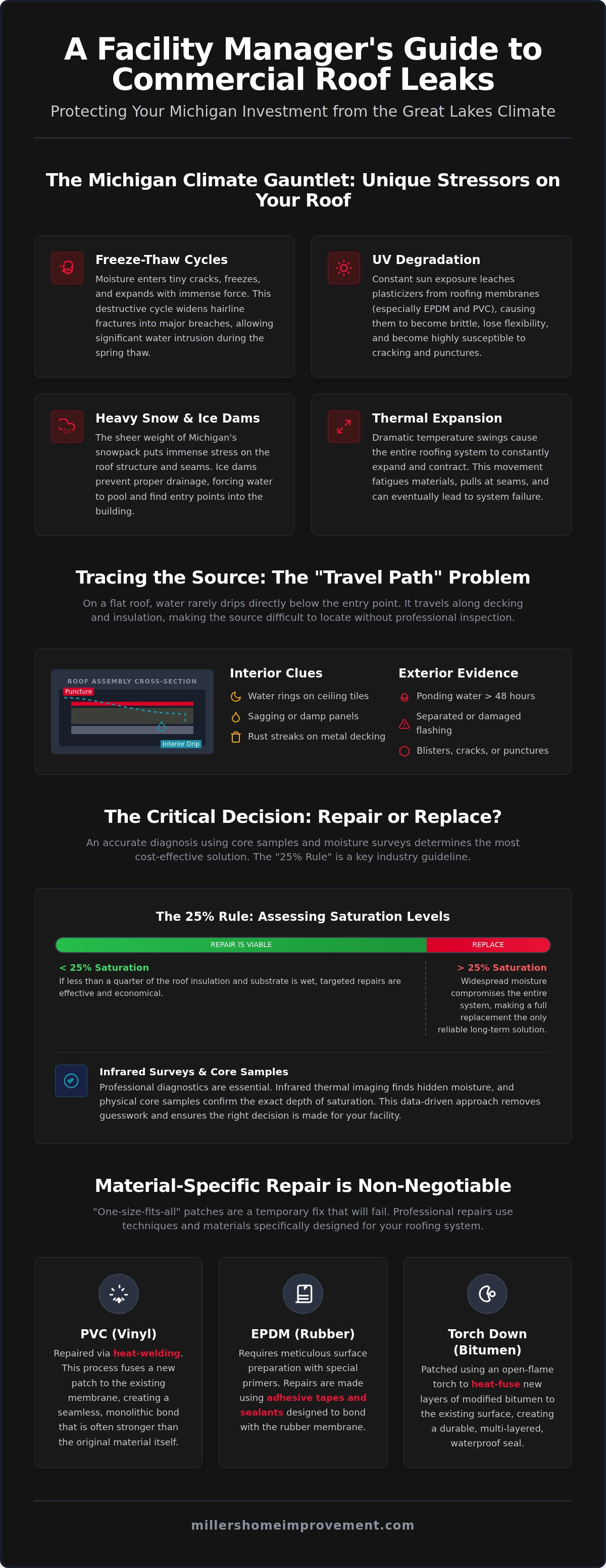
One of the most frustrating aspects of commercial flat roof leak repair Michigan is the "travel path" problem. Because of the slight pitch and internal drainage systems of commercial buildings, water rarely drips directly beneath the entry point. Gravity pulls moisture along the flutes of a metal deck or through the seams of insulation boards, meaning a puddle in your front office might be caused by a puncture fifty feet away. Understanding the Common Causes of Flat Roof Failure is the first step in diagnosing these complex issues. Effective repair depends on tracing this path back to the source rather than simply patching the area directly above the ceiling stain.
Interior vs. Exterior Leak Indicators
Facility managers should keep a consistent eye on both the interior and exterior of the building. Inside, look for classic water rings on ceiling tiles or sagging panels in office areas. In warehouse settings, look for rust streaks on metal decking or dampness in the corners where walls meet the ceiling. On the exterior, the 48-hour rule is your best diagnostic tool. If ponding water remains on the roof surface more than two days after a Michigan rainstorm, your drainage system is failing. You should also inspect wall flashings for separation; Michigan's high wind gusts can pull these metal components away from the masonry, creating a direct entry point for rain.
The Role of Professional Infrared Moisture Surveys
The naked eye can only see surface-level damage. Professional contractors often use infrared moisture surveys to identify "hot spots" where wet insulation retains heat differently than dry areas. This thermal imaging allows us to see exactly where moisture is trapped within the roofing assembly without performing invasive cuts. It's a critical step before committing to a repair strategy. These surveys provide the documented evidence needed for insurance claims in storm-hit areas like Detroit, ensuring that your commercial flat roof leak repair Michigan addresses the full scope of the damage rather than just the visible symptoms.
Common Causes of Flat Roof Failure in the Great Lakes State
Michigan's climate presents a unique set of challenges that can compromise even the most robust roofing systems. While aging is a factor, the primary drivers of failure in our region are environmental and structural. Understanding these stressors is the first step toward effective commercial flat roof leak repair Michigan. From the punishing winters to the humid summers, your roof is constantly in motion, reacting to external forces that test its integrity every day.
The Michigan freeze-thaw cycle is perhaps the most destructive force. When moisture enters a small crack in the membrane or a failing seam, it doesn't just sit there. As temperatures drop, that water turns to ice and expands. This physical expansion exerts massive pressure, widening hairline fractures into major breaches. By the time the spring thaw arrives, the damage is already done, allowing large volumes of water to bypass the membrane entirely.
UV degradation also plays a role, especially on older EPDM and PVC systems. Even in northern latitudes, prolonged sun exposure causes the chemical plasticizers in membranes to leach out. This results in a brittle surface that can't accommodate building movement. When combined with mechanical stress from heavy HVAC units and regular foot traffic for maintenance, the roof becomes susceptible to punctures and fatigue. Often, these issues stem from poor initial installation by contractors who aren't specialized in flat roof systems. Partnering with a Licensed Michigan Commercial Roofing Expert ensures that your system is installed and repaired according to modern standards, preventing premature failure.
Thermal Expansion and Contraction Stresses
In Southeast Michigan, it's common to see 40-degree temperature swings within a single 24-hour period. These rapid changes cause the roof membrane to expand and contract at different rates than the underlying deck. This often leads to "bridging," where the membrane pulls tight and lifts away from the roof edge or corners. Without flexible flashing and proper securement, these tension points will eventually tear. If you suspect your roof is under excessive thermal stress, getting a free estimate from a local professional can help identify these vulnerabilities before they lead to a total system failure.
Ponding Water and Drainage Obstructions
Standing water is a silent killer for flat roofs. During Michigan's autumn leaf fall, scuppers and internal drains frequently become clogged with debris. When water can't exit the roof, it creates "ponding," which adds thousands of pounds of dead weight to the structure. This weight compresses the insulation beneath the membrane, creating permanent low spots that collect even more water. Over time, this constant moisture weakens the adhesive at the seams and accelerates the degradation of the material, making professional intervention necessary to restore proper drainage.
Commercial Flat Roof Repair vs. Replacement: Making the Right Call
Choosing between a targeted patch and a total system overhaul is a high-stakes decision for any Michigan facility manager. It's a choice that impacts both your immediate operational budget and your building's long-term value. While some contractors might suggest a full replacement based solely on the age of the roof, a more disciplined approach involves evaluating the actual physical condition of the assembly. Making the right call requires a clear understanding of when a surgical repair provides a reliable solution and when it's simply a temporary fix for a terminal problem.
The "25% Rule" is a standard benchmark used by seasoned professionals to guide this decision. If a moisture survey reveals that less than a quarter of the roof's insulation is saturated, a professional commercial flat roof leak repair Michigan is often the most viable path. However, the surface condition is only half the story. We use core samples to assess the health of the roof deck and insulation. By extracting a small cylinder from the roof, we can see if the substrate is dry or if moisture has begun to rot the wood or rust the metal decking. If the deck is compromised, a repair won't hold because the foundation of the roof is no longer stable.
Financial ROI also plays a major role. A surgical repair on a PVC or EPDM system can be significantly more cost-effective than a complete tear-off, especially if the membrane still retains its original chemical properties. In cases where Michigan storm damage has occurred, insurance restoration might be the most logical path, allowing you to restore the facility to its original condition without absorbing the full cost of a capital improvement project.
Signs That Repair is the Best Option
Repair is typically the best choice when the damage is localized. Isolated seam failures or punctures caused by HVAC technicians are easily addressed with material-specific patches. If the overall membrane remains supple and hasn't become brittle from UV exposure, it can still accommodate the building's natural movement. In some cases, applying a professional coating to a sound membrane can extend its service life by 5 to 10 years, providing a dry facility while you plan for a future capital expenditure.
When Full Replacement is Unavoidable
Replacement becomes a necessity when the membrane exhibits systemic failure. Widespread "alligatoring," which looks like cracked skin across the surface, indicates that the material has reached the end of its life cycle. If previous commercial flat roof leak repair Michigan attempts have failed in multiple areas, it usually points to a breakdown of the entire system. Furthermore, if core samples show structural deck rot or severe rust, a full tear-off is required to ensure the safety of the facility and its occupants.
Specialized Repair Techniques for PVC, EPDM, and Torch Down Systems
Generic patches often fail because they don't account for the chemical differences between various roofing membranes. A patch that sticks to a rubber roof will peel right off a thermoplastic system within a single season. For commercial flat roof leak repair Michigan, we adhere to strict ASTM standards to ensure every adhesive and membrane patch meets industrial requirements for durability. Proper surface preparation is the foundation of this work; we meticulously clean and prime every repair area to combat the high humidity levels common in the Great Lakes region. Heat-welding is the molecular bonding of PVC sheets using 1000-degree air.
Repairing PVC and TPO Thermoplastic Roofs
Restoring a thermoplastic seam requires more than just industrial glue. We use robotic or hand-held heat welders to fuse new material to the existing sheet, creating a single, unbroken layer of protection. Aged PVC presents a challenge because environmental pollutants and UV exposure create a surface film that prevents a proper bond. We use specialized chemical cleaners to strip this layer back to the original polymer before welding. In high-wind zones like Macomb County, we pay extra attention to edge metal separation, reinforcing these perimeters to prevent the wind from getting beneath the membrane.
EPDM (Rubber) Roof Patching and Sealing
EPDM systems rely on chemical bonds rather than heat. For puncture repairs, we use high-grade EPDM primers and pressure-sensitive tapes that create a watertight seal upon contact. We also inspect and replace failing lap sealant at the seams to prevent moisture from wicking into the insulation. Older Michigan rubber roofs often suffer from "shrinkage," where the membrane pulls away from the walls. We address this by installing securement strips and new flashing to relieve the tension and stop leaks at the source. If your rubber roof is showing signs of seam failure, contact us for a professional assessment to determine the best material-specific repair path.
Torch Down (Modified Bitumen) Restoration
Modified bitumen requires a disciplined approach to address cracks in granulated surfaces. We utilize the "Three-Course" method, which involves layering professional-grade mastic and fabric reinforcement to bridge gaps. When seams fail, we carefully re-torch the area to melt the asphalt and create a watertight monolithic bond. This process requires a steady hand and extensive experience to ensure the material reaches the correct temperature without being damaged. To finish the job, we apply reflective coatings that protect the fresh asphalt from UV damage, ensuring the repair lasts as long as the rest of the system.
Partnering with a Licensed Michigan Commercial Roofing Expert
Selecting a contractor for your facility isn't just about finding the lowest bid. It's about finding a partner who understands that a single failure in your roofing system can halt your entire operation. At Miller’s Home Improvement, we approach every project with the quiet confidence that comes from 25+ years of owner experience. We don't use high-pressure sales tactics or generic templates. Instead, we provide technical solutions tailored to the specific needs of Detroit business owners. Our "Seasoned Master Craftsman" philosophy means we prioritize transparency, education, and the long-term safety of your property over a quick sale.
When you invest in commercial flat roof leak repair Michigan, you're also investing in compliance. The transition to the 2021 Michigan Building Code in April 2025 introduced stricter requirements for insulation and energy efficiency. We ensure that every repair meets these updated standards, alongside local codes specific to Detroit and Macomb County. This attention to detail protects you from future liability and ensures your facility remains an asset rather than a burden.
Why Local Expertise Matters for Commercial Repairs
Michigan’s climate is unique, and your contractor should be too. A national franchise might not account for the specific snow load requirements that Southeast Michigan structures must endure during a heavy lake-effect event. We understand how these loads stress older steel and wood decks. Because we are based in Detroit, we're available for consistent follow-up maintenance and warranty support long after the initial repair is complete. Every project is personally overseen by Eric Miller, ensuring that our reputation for meticulousness is upheld on every square foot of your roof. This local accountability is something a distant corporate entity simply cannot provide.
The Miller’s Process: From Estimate to Resolution
We’ve designed our process to be as thorough and non-intrusive as possible. It begins when you request a free, no-obligation commercial roof assessment. We don't just glance at the ceiling; we perform a comprehensive walk-through of the roof surface, checking flashings, drains, and membrane integrity. You’ll receive a detailed report including high-resolution photos and a clear breakdown of repair versus replacement options based on the physical data we collect.
Once a path is chosen, we schedule your commercial flat roof leak repair Michigan during hours that minimize disruption to your staff and customers. We maintain a clean, disciplined job site and conclude every project with a final inspection to verify that every seam and seal is watertight. Our goal is to move you from a state of concern to a state of informed resolution, knowing your investment is protected by a local expert who stands by their work.
Protect your facility today with a professional commercial roof repair estimate.
Securing Your Facility’s Long-Term Integrity
Maintaining a dry and efficient workspace in the Great Lakes region requires a disciplined approach to roofing health. We've explored how to identify hidden moisture travel paths and why Michigan’s extreme temperature swings demand material-specific solutions for PVC, EPDM, and Torch Down systems. By applying the 25% rule and utilizing core samples, you can make a data-driven choice between a targeted repair and a full system replacement.
Professional commercial flat roof leak repair Michigan is about more than stopping a drip; it's about protecting your investment through meticulous craftsmanship and strict code compliance. With 25+ years of local experience, our team provides the technical expertise and honest guidance needed to keep your operations running without interruption. Don't wait for a minor leak to become a structural failure. Get Your Free Commercial Roof Repair Estimate today to ensure your facility remains secure. Your property deserves the stability of a roof maintained by a seasoned master craftsman who understands the unique demands of our climate.
Frequently Asked Questions
How long does a commercial flat roof repair typically last?
A professional repair performed with material-specific patches can last between 5 and 10 years, provided the rest of the membrane remains sound. The longevity depends heavily on the condition of the substrate and how well the facility adheres to a regular maintenance schedule. While a patch is a reliable solution for localized damage, it cannot stop the natural degradation of an aging system that has reached its service life.
Can I use residential roofing materials to patch my commercial flat roof?
You should never use residential products like asphalt shingles or standard roofing cement on a commercial flat roof. These materials are chemically incompatible with membranes like PVC or EPDM and will cause the system to fail prematurely. Effective commercial flat roof leak repair Michigan requires industrial-grade thermoplastic sheets or rubber primers. Using the wrong material often creates a larger, more expensive problem that can compromise your building's structural integrity.
What is the most common cause of commercial roof leaks in Michigan?
The Michigan freeze-thaw cycle is the primary driver of flat roof failure in our region. Water enters small gaps in the seams or flashings and expands as it turns to ice, physically tearing the membrane apart. Over time, this mechanical stress, combined with the rapid thermal expansion of Detroit’s 40-degree temperature swings, creates breaches that allow moisture to saturate the insulation and eventually reach the interior of your facility.
How much does it cost to repair a commercial flat roof leak in Detroit?
The cost of a repair varies based on several factors, including the type of membrane, the extent of the moisture saturation, and the accessibility of the leak. A surgical patch on a PVC roof requires different labor and materials than restoring a large section of Torch Down roofing. Because every facility has unique structural needs, we provide free, no-obligation assessments to give you an accurate understanding of the project scope without any guesswork.
Will my insurance cover commercial flat roof leak repairs?
Insurance coverage typically depends on the cause of the leak rather than the age of the roof. If the damage resulted from a sudden, documented event like a hailstorm or high wind gusts in Southeast Michigan, it's often covered under a standard commercial policy. We specialize in insurance claim restoration and can help document the damage with professional reports. However, leaks caused by deferred maintenance or general wear are usually the owner's responsibility.
How often should I have my Michigan commercial roof inspected?
We recommend a professional inspection at least twice a year, specifically in the spring and fall. The spring inspection identifies damage caused by heavy winter snow loads and ice dams, while the fall inspection ensures scuppers and drains are clear of debris before the next freeze. Regular assessments allow you to address minor punctures or seam separations before they evolve into costly structural issues that disrupt your business operations.
What is the difference between a roof repair and a roof restoration coating?
A roof repair is a targeted fix designed to stop a specific leak by patching a puncture or resealing a failed seam. A restoration coating is a comprehensive, liquid-applied membrane that covers the entire roof surface. Coatings are an excellent option for systems that are still structurally sound but need an extra layer of UV protection and waterproofing. This approach can extend the life of your commercial flat roof leak repair Michigan by several years.
Can you repair a flat roof in the middle of a Michigan winter?
Yes, it's possible to perform repairs during the winter months, though the process requires specialized techniques. Thermoplastic membranes like PVC can still be heat-welded in cold temperatures, provided the surface is properly dried and prepped. For rubber systems, we use specific primers designed to work in lower temperatures. While winter work is more challenging, addressing a leak immediately is always better than allowing moisture to continue damaging your insulation and decking until spring.


