
Why do two identical houses on the same Detroit block often receive roofing quotes that differ by thousands of dollars? It is a question that leaves many homeowners feeling more confused than confident. You likely already know that Michigan's weather is unforgiving, and the fear of discovering hidden structural rot during a tear-off is enough to make anyone hesitate. It's completely natural to feel overwhelmed by conflicting information while you're simply trying to protect your family's biggest investment.
This guide provides a transparent breakdown of the variables that determine the true roof replacement cost Michigan residents should expect in 2026. We'll examine how local factors, such as Detroit's specific building permit structures and the technical demands of ice dam prevention, influence the final project scope. You'll gain a clear understanding of material performance in our unique climate and a methodical roadmap for the entire replacement process. My goal is to move you from a state of uncertainty to a position of informed resolution, ensuring your home remains secure for decades to come.
Key Takeaways
- Understand why a complete roof tear-off is the gold standard for protecting your home's structural integrity compared to a simple overlay.
- Learn how Detroit city building codes and specific roof pitch requirements directly impact the complexity and final budget of your project.
- Evaluate the long-term durability of architectural shingles and specialized flat-roof systems against the unique challenges of Michigan winters.
- Identify how to navigate insurance restoration for storm damage to manage the total roof replacement cost Michigan residents encounter.
- Discover the critical importance of hiring a licensed, LARA-compliant contractor with deep roots in the local Detroit community.
The Reality of Roof Replacement Cost in Detroit (2026)
Detroit's architectural landscape presents unique challenges for any contractor. When calculating the roof replacement cost Michigan homeowners face, we must look beyond the shingles themselves. In dense neighborhoods like those found in the Detroit metro area, logistical hurdles such as narrow lot lines and limited street access often require more precise planning for debris removal and material delivery. These urban density factors mean that a project in the city might require different equipment or staging than a suburban build.
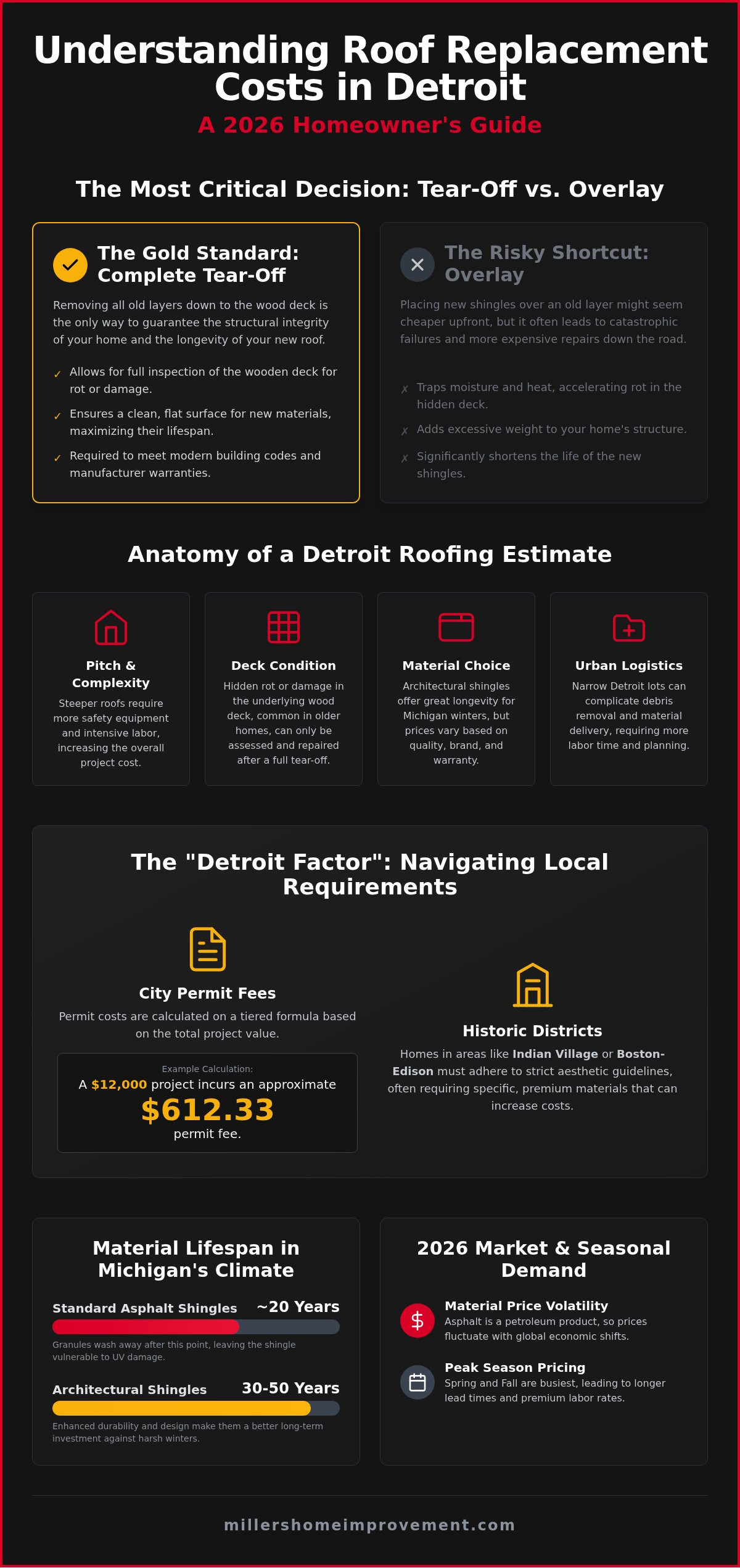
A true professional views a roof as a complete system, not just a surface. A complete roof tear off involves removing every layer down to the original wooden deck. This allows us to inspect for structural integrity and ensure the ventilation system is adequate for our harsh winters. While some might suggest an overlay to save money, this approach often traps moisture and significantly shortens the lifespan of common roofing materials. From a craftsman's perspective, the cheapest bid is often the most expensive. A low quote usually indicates that a contractor is cutting corners on ice and water shields or using sub-par underlayment, which leads to costly failures within just a few seasons.
Replacement vs. Repair: When is the Investment Necessary?
Most asphalt shingles in Michigan reach the end of their functional life around the 20-year mark. Beyond this point, the granules that protect the shingle from UV rays have likely washed away, leaving the fiberglass mat vulnerable. If you notice a spongy feel when walking on the surface or see daylight through the boards in your attic, these are clear signs of structural deck failure. Repeatedly patching an aged system is often a case of throwing good money after bad. The cumulative labor costs for multiple repairs can quickly approach the price of a total replacement while leaving your home's interior at risk.
Detroit Market Trends Affecting Estimates in 2026
In 2026, we've seen a stabilization in supply chains, yet petroleum-based products remain sensitive to global economic shifts. Since asphalt shingles rely heavily on oil, material prices can fluctuate month-to-month. Labor rates in Southeast Michigan also reflect the high demand for LARA-compliant, licensed professionals. Seasonal demand creates further fluctuations. Spring and autumn are the busiest times for Michigan contractors, which often leads to longer lead times and premium pricing compared to mid-summer projects. Choosing a contractor with deep local roots ensures they understand how to navigate these market shifts while maintaining a commitment to quality workmanship.
Key Factors Influencing Your Detroit Roofing Estimate
When you receive an estimate, the total square footage is only the starting point. The pitch, or steepness, of your roof significantly dictates labor intensity and safety requirements. A steep roof requires specialized harnesses and slower material handling, which naturally impacts the overall roof replacement cost Michigan homeowners see on their quotes. Additionally, the condition of your underlying decking, whether it's modern plywood or older tongue-and-groove boards, can only be fully assessed once the old materials are removed. Discovering rot at this stage is a common reality in older Detroit homes, as hidden moisture often compromises the wood over several decades.
Logistics play a major role in urban areas. Many Detroit lots are narrow, leaving little room for staging materials or placing a dumpster. If a crew has to carry bundles of shingles from the street to the back of a house, the increased labor time will be reflected in the price. We also must consider the number of existing layers. Detroit building codes generally restrict the weight on a residential structure. While some codes allow a second layer, a full tear-off is the only way to ensure your home meets current safety standards and provides a clean surface for new materials.
The Detroit Factor: Codes, Permits, and Historic Districts
Detroit has specific regulatory hurdles that suburban projects might avoid. For instance, the city calculates building permit fees using a tiered formula. A project valued at $12,000 might incur a permit fee of approximately $612.33 based on the city's requirement of $271.43 for the first $2,000 and $34.09 for every additional $1,000. If your home is located in a designated Historic District, such as Indian Village or Boston-Edison, you must comply with strict aesthetic guidelines. These often mandate specific materials that match the neighborhood’s original character, which can be more expensive than standard asphalt. Staying compliant with Michigan’s energy codes also requires specific insulation and ventilation upgrades during a replacement.
Roof Complexity: Chimneys, Skylights, and Valleys
Complexity is the "hidden" cost in many estimates. Every chimney, skylight, and valley represents a potential leak point if not flashed correctly. In Michigan, where ice damming is a constant threat, meticulous flashing work is a non-negotiable expense. Proper ventilation is equally critical. Whether we install ridge vents or box vents, the goal is to balance the temperature of your attic with the outside air. This prevents the freeze-thaw cycles that destroy shingles prematurely. If you are unsure about the current state of your roof's complexity, you can schedule a detailed in-home estimate to get a professional assessment of your home's unique needs.
Comparing Materials: Cost vs. Longevity for Michigan Homes
Choosing the right material is a balance of upfront investment and long-term performance. In Detroit, our winters demand more than just aesthetics. The roof replacement cost Michigan homeowners plan for must account for specific material grades that can withstand heavy snow loads and rapid freeze-thaw cycles. I often tell clients that a material warranty is only as good as the labor behind it. While manufacturers offer 30-year or lifetime limited warranties on shingles, these rarely cover the full cost of labor if the installation was faulty. A seasoned master craftsman prioritizes the labor warranty because it reflects the contractor's confidence in their own meticulousness.
In our climate, an Ice and Water Shield is not an optional add-on. It is a necessity. This waterproof membrane seals the most vulnerable areas of your roof, such as valleys and eaves, against the backup caused by ice damming. Skipping this step to save on initial costs almost always leads to interior water damage. A proactive approach involves selecting materials that work in harmony with the structural needs of your specific property.
Residential Standards: Asphalt Shingle Options
Standard 3-tab shingles are becoming less common in Detroit as homeowners opt for architectural shingles. Architectural options provide superior wind resistance and a thicker profile that handles Michigan's heavy winds. Luxury shingles offer a slate-like appearance but require a higher initial investment. If you choose impact-resistant shingles, check with your provider; these can sometimes lower your Michigan insurance premiums by demonstrating a commitment to durability. Shingle color also plays a role in energy efficiency. Lighter shades can help manage summer cooling costs by reflecting heat, while darker colors are traditional in many historic Detroit neighborhoods.
Specialized Systems: PVC, EPDM, and Torch Down Flat Roofing
Many Detroit properties, especially those with urban additions or commercial footprints, require flat-roof solutions. EPDM is the rubber roof standard for many local commercial buildings due to its durability and ease of repair. PVC flat roofing is an excellent alternative for those seeking high reflectivity to combat the urban heat island effect. For residential additions or porch roofs, Torch Down systems provide a robust, multi-layered bitumen surface that handles standing water better than traditional shingles. Each of these systems requires specialized installation techniques to ensure they remain watertight through the decades.
Financial Strategies: Insurance, Financing, and ROI
Viewing a new roof solely as an expense overlooks its role as a strategic financial asset. In the Detroit market, a high-quality roof replacement is one of the most reliable ways to preserve home equity and increase resale value. Buyers in Southeast Michigan are rightfully wary of older homes with questionable roofing history. A documented, full tear-off provides immediate peace of mind during our heavy spring thaws, when melting snow often reveals the failures of a poorly maintained system. Beyond aesthetics, this investment protects your home's structural integrity and prevents the secondary costs associated with mold or attic insulation damage.
Storm damage is a common catalyst for these projects. High winds and hail frequently impact the roof replacement cost Michigan homeowners must manage. When a storm compromises your shingles, your insurance policy may cover a significant portion of the replacement. However, navigating this process requires a contractor who understands the technical language of insurance restoration. They serve as a professional set of eyes, identifying subtle damage that a standard adjuster might overlook during a brief inspection.
Navigating Insurance Claims in Michigan
Spotting hail damage isn't always as simple as looking for holes. It often appears as small "bruises" or localized granule loss that weakens the shingle's water-shedding ability. It's vital to have a professional assessment before you call your insurance company. A seasoned contractor can document the damage thoroughly, providing the evidence needed to support your claim. You must also understand the difference between Actual Cash Value (ACV) and Replacement Cost Value (RCV). Many Michigan insurers are moving toward ACV for roofs over 15 years old, which means they only pay the depreciated value. Knowing your policy's specifics helps you plan for potential out-of-pocket gaps.
Financing Your Investment
If insurance doesn't cover the full project, several financing avenues exist to bridge the gap. As of late 2026, some Michigan credit unions offer home improvement loans with rates as low as 11.19% APR for 36-month terms. When you evaluate a free estimate, ensure it's a comprehensive breakdown. A low-ball quote often omits essential components like ridge vents or high-quality underlayment. Investing in a full tear-off rather than a cheap nail-over offers a far better return on investment. A nail-over traps heat and moisture, which voids material warranties and leads to a premature failure that costs more in the long run. To get a transparent look at your options, you can request a free in-home estimate to discuss a plan that fits your budget and protection needs.
Choosing a Licensed Detroit Contractor: Ensuring Your Investment
Selecting a contractor is the most significant variable in the total roof replacement cost Michigan residents manage. While it's tempting to focus solely on the bottom line, the credentials of the crew performing the work determine the long-term value of your investment. A licensed and insured professional provides a layer of protection that an unlicensed crew simply cannot offer. In Michigan, the law is clear: any roofing project valued at $600 or more requires a licensed Residential Builder or Maintenance and Alteration contractor. This ensures the work meets state safety standards and protects you from personal liability if an accident occurs on your property.
Local roots offer a level of accountability that out-of-state firms lack. A contractor with a physical presence in the Detroit metro area understands the specific stresses our climate places on a structure. They've seen how ice dams behave on historic estates and how wind affects shingles in the suburbs. This local expertise translates into a more accurate estimate and a project that's built to last. When you review a contract, look for meticulous detail regarding materials, timelines, and debris removal. A transparent agreement is the hallmark of a professional who values their reputation as much as your home's safety.
Red Flags: Avoiding Storm Chasers and Unlicensed Crews
Protecting yourself starts with verification. You should always check a contractor's status through the Michigan Department of Licensing and Regulatory Affairs (LARA) before signing a contract. Be wary of any individual who demands the full project cost before the first shingle is delivered. A reputable business typically operates on a structured payment schedule tied to project milestones. You should also watch out for tailgate warranties. These are promises made by non-local crews who disappear once the storm season ends, leaving you with no recourse if a leak develops during the next spring thaw.
The Miller’s Home Improvement Process
At Miller’s Home Improvement, we approach every project with the discipline of a seasoned master craftsman. With over 25 years of owner experience and 13 years as a stable Michigan entity, we've refined a process that prioritizes transparency and quality. Our work begins with a thorough assessment and ends only after a meticulous cleanup of your property. We specialize in complete roof tear offs because we believe the only way to guarantee a roof is to see what's underneath it. Every project receives owner-supervised quality control to ensure our high standards are met at every stage. We invite you to schedule your free Detroit roofing estimate today.
Securing Your Detroit Home for the Decade Ahead
A new roof is more than just a structural necessity. It's a long-term investment in your family's safety and your property's value. By understanding the variables that influence the roof replacement cost Michigan residents encounter, you're now equipped to distinguish between a temporary fix and a permanent solution. Prioritizing a full tear-off and selecting climate-resilient materials like architectural shingles or specialized flat-roof systems will prevent the recurring expenses of premature failure caused by our harsh winters.
Success in this process comes down to transparency and professional integrity. With over 25 years of roofing expertise, Miller’s Home Improvement provides the stability and meticulousness your home deserves. We're fully licensed and insured in Michigan, specializing in expert insurance claim restoration to help you navigate the financial complexities of storm damage. You don't have to face these decisions alone. We invite you to Request Your Free In-Home Roofing Estimate today. Let’s work together to ensure your home remains a secure, leak-free sanctuary for many years to come.
Frequently Asked Questions
How much does a typical roof replacement cost in Detroit?
The roof replacement cost Michigan homeowners experience is determined by several specific variables rather than a single flat rate. Your investment depends on the total square footage, the steepness of the roof pitch, and the choice between architectural shingles or specialized flat-roof systems. Additionally, Detroit’s urban density and specific city permit fees play a role. We provide a transparent breakdown during our free in-home estimates to ensure you understand every factor involved.
Does insurance cover roof replacement for age or just storm damage?
Standard homeowners insurance in Michigan is designed to cover sudden, accidental events like wind or hail damage. It generally doesn't cover roof replacement for issues related to age or lack of maintenance. It's essential to review your policy to see if you have Replacement Cost Value (RCV) or Actual Cash Value (ACV) coverage. An expert assessment can help identify if a storm qualifies for a restoration claim and how it impacts the roof replacement cost Michigan residents face.
How long does a full roof tear-off take for a standard Detroit home?
A standard project typically takes between one and three days to complete, depending on the size of the home and the weather. A complete roof tear off involves removing old materials, inspecting the decking for rot, and installing a new, high-quality system. We maintain a methodical pace to ensure the property is protected and that the final cleanup is meticulous, leaving your yard free of nails and debris.
What is the best time of year to replace a roof in Michigan?
Late spring, summer, and early autumn are the most effective times to schedule a project in Southeast Michigan. These months provide the consistent warmth needed for asphalt shingle adhesives to bond and create a watertight seal. While we perform installations year-round, planning for the warmer months helps avoid delays caused by snow or extreme cold, ensuring the project moves forward on a steady, disciplined schedule that respects your time.
Can I install a new roof over my existing shingles in Detroit?
While some local codes allow for a second layer of shingles, we strongly recommend a full tear-off for every project. Installing new shingles over old ones traps heat and moisture, which leads to premature decay and often voids the manufacturer's warranty. A full removal allows us to inspect the wooden deck for structural integrity, ensuring your new roof has a solid, reliable foundation that meets Detroit’s strict safety standards.
What are the most durable roofing materials for the Michigan climate?
Architectural asphalt shingles are the preferred choice for most Michigan homes because of their superior durability and wind resistance. For urban Detroit properties with flat or low-slope sections, materials like PVC and EPDM provide excellent waterproof protection and reflectivity. These systems are specifically chosen for their ability to withstand heavy snow loads and the rapid freeze-thaw cycles that are common in our local climate throughout the winter months.
How do I know if I need a full replacement or just a repair?
If you notice widespread shingle curling, significant granule loss, or if the roof is over 20 years old, a replacement is often the most cost-effective path. Minor leaks or missing shingles from a recent storm can frequently be addressed with localized roof repairs. However, if the underlying deck shows signs of soft spots or rot, a full replacement is necessary to protect the structural integrity and long-term value of your home.
Are there specific permits required for roofing in Detroit?
Detroit requires building permits for all roof replacements to ensure the structure meets current Michigan Residential Code standards. The city uses a tiered fee system, which includes a base cost of $271.43 for the first $2,000 of project value. A licensed contractor will handle the application process, ensuring that all inspections are completed and that your property remains compliant with local municipal regulations throughout the duration of the project.


