
What if that persistent drip in your warehouse isn't a sign that you need a six-figure roof replacement, but rather an opportunity to double your roof's remaining lifespan through strategic commercial flat roof repair? Most facility managers in Detroit live with the constant anxiety of a major leak disrupting operations or a sudden, unbudgeted capital expense landing on their desk. You've likely dealt with contractors who promise a quick fix only to have the same "band-aid" fail after the first Michigan freeze-thaw cycle. It is frustrating to invest in repairs that don't hold up against our local climate.
This guide empowers you to master the technical process of restoration, allowing you to protect your facility and extend your current roof's life by five to ten years without the chaos of a full tear-off. You'll learn how to identify the root cause of failures and ensure every fix complies with the updated 2026 Michigan Building Code requirements for insulation and wind uplift. We will walk through the professional five-step restoration process, giving you the documentation and technical clarity needed to satisfy both insurance adjusters and company stakeholders.
Key Takeaways
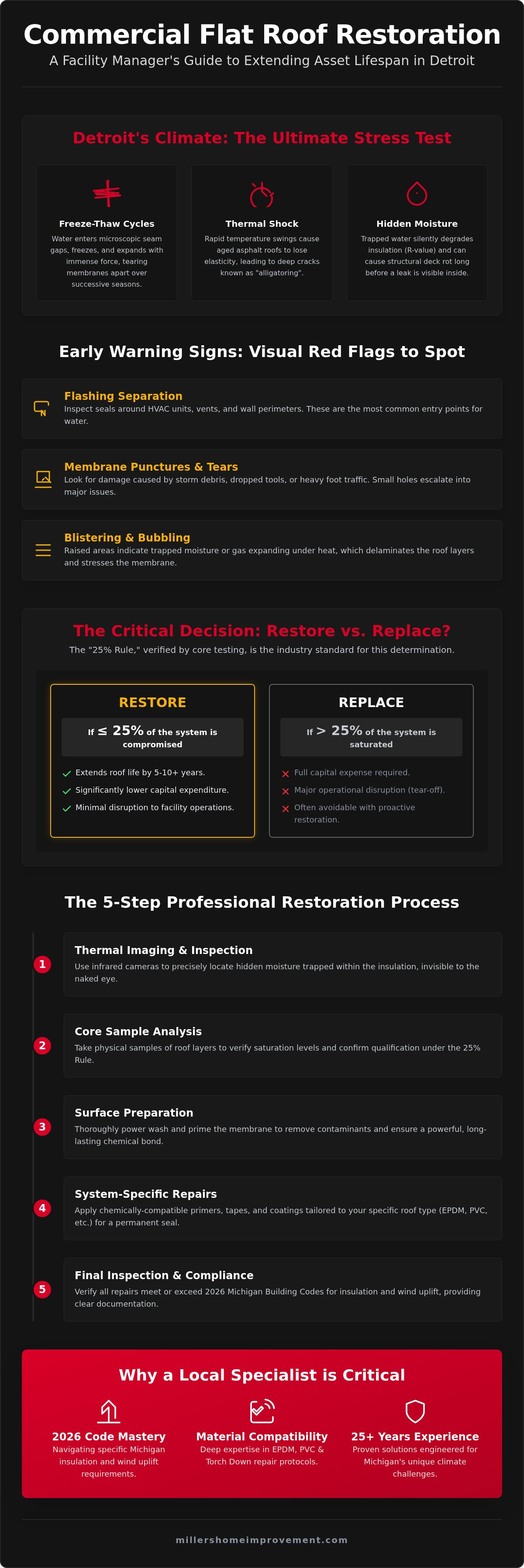
- Learn how Detroit's extreme freeze-thaw cycles impact membrane seams and why thermal shock causes "alligatoring" in aging asphalt systems.
- Understand the technical nuances of commercial flat roof repair for PVC, EPDM, and Torch Down systems to ensure long-term material adhesion.
- Apply the "25% Rule" and professional core testing to determine if your facility qualifies for a cost-effective restoration or requires a full tear-off.
- Master a five-step professional repair process that utilizes thermal imaging to identify hidden moisture before it compromises your building's structural integrity.
- Discover why partnering with a local specialist with 25 years of experience is essential for navigating specific 2026 Michigan building codes and wind uplift requirements.
Identifying Commercial Flat Roof Failure in Michigan's Climate
Detroit's climate acts as a relentless stress test for industrial buildings. The constant transition between sub-zero winters and humid summers creates a cycle of expansion and contraction that most materials aren't designed to handle indefinitely. For facility managers, understanding these environmental pressures is the first step toward effective commercial flat roof repair. It isn't just about stopping a leak; it's about understanding why the system failed in the first place.
In Michigan, the freeze-thaw cycle is particularly destructive to membrane seams. When moisture enters a microscopic gap in a seam and freezes, it expands with enough force to pull the membrane apart. This isn't just a surface issue. Over time, these gaps allow water to migrate into the insulation, where it remains trapped. This "hidden moisture" is the primary enemy of flat roofs. It degrades R-value and can lead to expensive deck rot long before a leak is visible inside the building. Older asphalt-based systems often suffer from "alligatoring" due to thermal shock. This occurs when the bitumen loses its elasticity and cracks under rapid temperature changes, resembling the skin of a reptile. While different flat roof construction methods offer varying levels of resistance to this, no system is entirely immune to the physical laws of Michigan's weather.
Visual Red Flags for Facility Managers
Identifying a problem early can save thousands in emergency costs. You should walk your roof regularly and look for these specific indicators of distress:
- Flashing Separation: Check the seals around HVAC units and vents. These are the most common points of entry for water.
- Membrane Punctures: Look for tears caused by fallen debris or heavy foot traffic after Michigan storms.
- Blistering and Bubbling: These raised areas indicate trapped gas or moisture that is expanding under the sun's heat, pressing upward against the membrane.
The Role of Clogged Drainage Systems
Standing water is a 2026 priority for any facility manager looking to avoid structural issues. There's a critical distinction between surface ponding, which should evaporate within 48 hours, and structural deflection, where the roof deck itself begins to sag under the weight of the water. Clogged scuppers and internal drains are often the culprits. During a heavy snowmelt, if the water cannot escape, it creates a "pond-to-leak" pipeline. This can even lead to ice damming on low-slope structures. This happens when ice blocks the drainage path and forces water upward under the roof's protective layers. Regular inspection of these drainage points is a simple but vital part of maintaining your facility's integrity and ensuring your commercial flat roof repair efforts are focused on long-term stability rather than temporary fixes.
Technical Analysis of Flat Roof Systems: PVC, EPDM, and Torch Down
Successful commercial flat roof repair depends entirely on chemical compatibility. You cannot treat a thermoplastic membrane the same way you treat a thermoset rubber. Mixing incompatible materials, such as applying asphalt-based mastic to a PVC membrane, causes a chemical reaction that liquefies the materials and destroys the seal. A disciplined approach requires identifying the specific polymer of your existing roof before any tools touch the surface. This technical precision ensures the repair lasts as long as the original installation.
EPDM Rubber: The Durability Standard
EPDM is a "thermoset" material. This means it is chemically cross-linked during manufacturing and will not melt or fuse back together once it has aged. This is why traditional "peel-and-stick" patches often fail on older Detroit roofs. As the rubber stays on your facility for decades, it undergoes UV shrinkage, which pulls the membrane away from the edges. This creates "bridging" at wall transitions, where the membrane lifts and creates a hollow pocket. To fix this, a master craftsman uses specialized primers and seam tapes to create a chemical bond rather than a mechanical one. If you suspect your rubber roof is shrinking, getting a professional assessment is the most reliable way to prevent catastrophic seam failure.
PVC and Torch Down: High-Performance Solutions
PVC membranes are the gold standard for Detroit's industrial zones. They provide superior resistance to chemicals, oils, and greases that often exhaust from manufacturing vents. Unlike EPDM, PVC is a thermoplastic. This allows us to use high-speed heat welders to fuse new material directly to the old, creating a monolithic seal. However, matching the mil-thickness is critical for a high-quality commercial flat roof repair. If your existing roof is a 60-mil system, using a thinner 40-mil patch creates a weak point that cannot handle thermal expansion at the same rate as the surrounding field.
For Torch Down or Modified Bitumen systems, the challenges typically involve granule loss and seam delamination. These roofs suffer when the protective granules wear away, exposing the underlying bitumen to UV damage. We address these issues by carefully reheating the laps or using modern cold-process adhesives. Cold-process options are becoming the preferred method in 2026 for high-density areas where open flames pose a safety risk. Whether we are welding PVC or resealing a Torch Down seam, the focus remains on restoring the membrane's original integrity through meticulous surface preparation and material matching.
The Decision Framework: Repair vs. Full Roof Replacement
Choosing between commercial flat roof repair and a total replacement is a high-stakes decision for any facility manager. It isn't just about stopping the current leak. You have to consider the long-term structural health of the building and the specific mandates of the Michigan Building Code. This decision requires a disciplined analysis of the roof's current condition versus its projected performance over the next decade.
One of the most critical regulatory factors is the "25% Rule." Under current Michigan building standards, if the required repairs exceed 25% of the total roof area, the code often mandates a full tear-off and replacement. This regulation prevents the dangerous accumulation of weight from multiple roof layers, which can compromise the structural integrity of the building. Beyond the code, we use core testing to look beneath the surface. By extracting a small cross-section of the roof, we can see if the insulation boards are saturated. If the insulation is wet, it loses its thermal resistance and can cause the metal deck to rust or wood decks to rot. At that point, a repair is no longer a viable option because you would be sealing moisture inside the building envelope.
Storm damage and insurance claims also influence this framework. If a recent Michigan storm caused significant punctures or wind uplift, your insurance policy might cover a significant portion of a replacement. It is often more cost-effective to leverage these claims for a new system rather than paying out-of-pocket for extensive repairs that only offer a short-term fix.
Evaluating Structural Integrity
A roof is only as good as the deck supporting it. During a professional assessment, we check for signs of structural compromise like deck rot or rust in metal-deck buildings. If the insulation is dry and the deck is sound, a high-performance roof coating might serve as a middle-ground restoration. This approach can add a decade of life to the system at a fraction of the cost of a full replacement, provided the underlying materials are still functional.
Financial Considerations for Business Owners
The decision also carries significant tax and operational implications. Repairs are typically categorized as an operating expense, which allows for an immediate deduction in the current tax year. A full replacement is a capital expenditure that must be depreciated over time. However, you must weigh this against the energy efficiency gains of a new "Cool Roof" PVC system. These systems can drastically reduce cooling costs for your Detroit facility. Budgeting for proactive commercial flat roof repair and maintenance is the only way to avoid the sudden, unbudgeted capital hit of an emergency failure.
How-To: The 5-Step Professional Repair Process
A successful commercial flat roof repair is a disciplined engineering task that leaves no room for guesswork. We follow a methodical five-step sequence to ensure that every restoration meets our standards for durability and weather resistance. This process moves logically from forensic analysis to final quality verification. It's the difference between a temporary patch and a permanent solution for your Detroit facility.
- Step 1: Moisture Detection. We use infrared thermography to identify trapped water that isn't visible to the naked eye.
- Step 2: Surface Preparation. The existing membrane is scrubbed and chemically cleaned; adhesion fails on dirty or oxidized surfaces.
- Step 3: Material Matching. We select a patch that matches the chemical composition and mil-thickness of your current system.
- Step 4: Permanent Bonding. Depending on the system, we use robotic heat-welders for thermoplastics or specialized primers and seam tapes for rubber.
- Step 5: Final Testing. Every inch of the new seam is probed and water-tested to ensure a monolithic, leak-free seal.
Professional Moisture Detection
Infrared thermography is an essential component of high-quality commercial flat roof repair. At night, wet insulation retains heat longer than dry areas, allowing us to see exactly where the damage stops. Any "wet" insulation board is a liability; it must be removed and replaced with new, dry material before the repair continues. Moisture detection prevents 'trapping' rot by ensuring the substrate is completely dry before a new seal is applied. This proactive approach saves your roof deck from the silent destruction of internal rust or decay.
Execution and Quality Control
Precision execution defines the "Master Craftsman" approach. Once a repair is complete, we "probe" the seams using a specialized metal tool to check for any microscopic voids in the weld or bond. For high-stress areas like corners or HVAC flashings, we often apply secondary seals or liquid-applied membranes for redundant protection. If you've noticed recurring leaks despite previous attempts to fix them, the first step is to request a professional roof assessment to locate the exact source of the failure. We document every step of this process with high-resolution photos. This clear documentation is vital for your records, providing stakeholders and insurance carriers with proof that the work was done to code and will stand up to Michigan's harsh winters.
Choosing a Detroit Specialist for Your Commercial Facility
Selecting the right partner for your facility's infrastructure is a decision that impacts your operational stability for years. In the competitive world of commercial flat roof repair, there is a distinct difference between a temporary fix and a solution built on 25 years of local mastery. Miller's Home Improvement operates with the quiet confidence that only comes from decades of navigating Southeast Michigan's unique roofing challenges. We don't rely on high-pressure sales. Instead, we focus on technical transparency and the long-term integrity of your property.
Out-of-town "storm chasers" often appear after a major Michigan weather event, offering quick repairs at prices that seem attractive. However, these entities rarely understand the nuances of the updated Michigan Building Code or the specific 2026 amendments regarding insulation and wind uplift. They might overlook critical wind uplift ratings or fail to install the mandated R-49 insulation. Working with a contractor licensed by the Michigan Department of Licensing and Regulatory Affairs (LARA) ensures that your project is handled by professionals who are accountable to local standards. It also protects your business from the massive liability risks associated with uninsured labor.
The Local Advantage in Southeast Michigan
Our deep roots in Detroit give us a specialized understanding of the city's industrial and commercial architecture. We have spent over two decades working on everything from historic flat-roofed warehouses to modern manufacturing plants. This familiarity allows us to identify potential failure points before they lead to significant inventory loss or business disruption. When a storm hits, our local presence means we can provide rapid response times that out-of-state companies simply cannot match. We also take the burden of the insurance process off your desk. Our team is experienced in documenting damage and coordinating with adjusters to ensure your claim reflects the true scope of the necessary restoration.
Long-Term Maintenance Partnerships
The most effective way to manage a facility is to move from a reactive mindset to a proactive one. A disciplined maintenance schedule can extend the life of your roof by another 10 years, delaying the need for a capital-intensive replacement. We recommend bi-annual inspections, specifically in the Spring to assess winter damage and in the Fall to prepare for the coming freeze. These checks allow us to clear drainage systems, inspect high-stress flashings, and perform minor commercial flat roof repair tasks that prevent small issues from becoming structural emergencies. Your roof is a significant investment. Protecting it requires a partner who values craftsmanship and straightforward communication as much as you do. You can take the first step toward a more secure facility by reaching out for a professional assessment.
Schedule your free commercial flat roof estimate today to receive a comprehensive evaluation of your system's current health and a clear roadmap for its preservation.
Securing Your Facility’s Future with Professional Restoration
Managing a commercial property in Southeast Michigan requires more than just reactive maintenance. It demands a disciplined understanding of how local weather patterns and building codes impact your infrastructure. By mastering the 25% rule and utilizing forensic tools like infrared moisture detection, you can transform a leaking roof into a stable, long-term asset. Whether you are dealing with aged EPDM shrinkage or the specific repair needs of a PVC system, the goal is always to restore structural integrity without the disruption of a premature replacement.
Miller’s Home Improvement brings over 25 years of expert roofing experience to every project. As a fully licensed and insured Michigan contractor, we specialize in the technical nuances of PVC, EPDM, and Torch Down systems. We understand the pressure of facility management and the need for clear, documented solutions that satisfy both stakeholders and insurance carriers. Proactive commercial flat roof repair is the most reliable way to protect your inventory and extend your roof's life by a decade or more.
Don’t wait for the next major storm to test your facility's limits. Request Your Free Commercial Roof Evaluation today to ensure your building remains watertight and energy efficient. We are here to provide the professional assurance you need for a leak-free 2026 and beyond.
Frequently Asked Questions
How much does commercial flat roof repair typically cost in Detroit?
The investment required for repairs depends on several technical factors rather than a single flat rate. We evaluate the type of membrane, the accessibility of the facility, and whether the underlying insulation is saturated. A localized fix for a single puncture is handled differently than extensive seam restoration across a large industrial complex. We provide a detailed assessment to ensure you receive a clear scope of work tailored to your building's specific needs.
Can you patch a flat roof that has standing water on it?
No, you cannot effectively patch a flat roof while standing water is present. Proper adhesion for any commercial flat roof repair requires a surface that is completely dry and free of debris. If water is pooling, it must be removed to inspect the underlying membrane for damage, and the root cause of the ponding should be corrected to prevent the new patch from being undermined by constant moisture.
How long does a professional flat roof repair last?
A professional repair can extend the life of your roof by 5 to 10 years when executed with precision. The longevity depends on matching the material chemistry correctly and ensuring the substrate is dry. Regular maintenance and biannual inspections further protect this investment, helping you avoid the high cost of a full replacement until it is truly necessary.
What is the most common cause of commercial flat roof leaks in Michigan?
The most frequent cause of leaks in Michigan is the combination of extreme temperature swings and seam failure. As the building expands and contracts during our freeze-thaw cycles, the stress on membrane laps increases. If the seams weren't perfectly welded or sealed during installation, they eventually pull apart, allowing moisture to enter the building envelope.
Will my commercial property insurance cover flat roof repairs after a storm?
Most commercial policies cover damage that is sudden and accidental, such as punctures from hail or membrane displacement from high winds. However, insurance carriers typically deny claims related to gradual wear, poor maintenance, or age-related deterioration. It's vital to have professional documentation of the damage to support your claim during the adjustment process.
Is it possible to repair a PVC roof that was installed over 15 years ago?
Yes, it is often possible to repair a PVC roof of that age because the material is thermoplastic. Unlike rubber, PVC can be heat-welded years after the initial installation. We perform a test weld to ensure the old membrane still has the integrity to fuse with new material. If the membrane passes this test, a heat-welded patch provides a permanent, monolithic seal.
What is the difference between a roof repair and a roof restoration coating?
A roof repair is a targeted fix for a specific problem area, such as a puncture or a failing flashing. A restoration coating is a liquid-applied system that covers the entire roof surface. Restoration is a proactive measure used to add a new waterproof layer and UV protection to a roof that is still structurally sound but nearing the end of its service life.
How often should I have my commercial flat roof inspected?
We recommend scheduling a professional inspection twice a year, ideally in the Spring and Fall. The Spring inspection identifies damage caused by heavy snow loads and ice damming, while the Fall inspection ensures the drainage systems are clear before the winter freeze. These regular checks are the most effective way to identify the need for commercial flat roof repair before a minor leak becomes a major operational disruption.


