
A flat roof in the Great Lakes State has to do more than just shed water; it must survive a brutal cycle of thermal shock that can tear rigid materials apart. If you've spent another winter worrying about ice dams or watching your energy bills climb, you aren't alone. It's exhausting to deal with a roof that feels like a temporary patch rather than a permanent shield. When evaluating the best epdm roofing Michigan has to offer, you're looking for a solution that stands up to heavy snow loads and the relentless freeze-thaw cycles of a local January.
You deserve a system that provides quiet confidence regardless of the forecast. In this guide, you'll discover why EPDM rubber is the most resilient and cost-effective flat roofing solution for our extreme climate. We'll show you how to choose a system that delivers a leak-free 20 to 30-year lifespan while meeting the latest 2026 state building codes. We'll cover everything from R-30 insulation requirements to the critical importance of a properly installed ice and water shield, giving you the expert guidance needed to protect your investment for decades.
Key Takeaways
- Learn how the extreme elasticity of EPDM rubber protects your structure from thermal shock and Michigan’s -40°F winter temperatures.
- Understand why epdm roofing Michigan property owners choose is often the most cost-effective long-term investment due to its superior repairability and lifecycle value.
- Discover the technical installation methods, like proper flashing and termination bar placement, that ensure your rubber roof remains leak-free for up to 30 years.
- Compare EPDM against alternatives like TPO and PVC to see how rubber membranes offer easier maintenance and better performance in cold climates.
- Identify the essential licensing and insurance standards a contractor must meet to handle the unique challenges of Michigan’s commercial flat roofing projects.
Understanding EPDM Roofing: Why Michigan Property Owners Choose Rubber
Property owners across the state often face a common dilemma when dealing with low-slope structures. Traditional built-up roofing, while familiar, often fails to keep up with the rapid temperature shifts we experience here. This is why EPDM rubber has become the primary choice for epdm roofing Michigan projects. EPDM stands for Ethylene Propylene Diene Terpolymer. It is a synthetic rubber membrane that has protected North American buildings for over half a century.
While earlier systems relied on multiple layers of asphalt and gravel, modern single-ply membranes offer a lighter, more durable alternative that doesn't crack under pressure. This shift began in earnest during the 1970s when rising oil prices made asphalt-based roofing less economical. Since then, rubber has proven its worth from the large industrial warehouses of Detroit to residential garage flats in Macomb County. It’s a versatile material that provides a seamless look and superior protection for local properties.
The Anatomy of an EPDM Membrane
The secret to the longevity of epdm roofing Michigan contractors install lies in its chemical makeup. These sheets are composed of high-quality rubber compounds blended with carbon black. This additive isn't just for color; it acts as a powerful UV stabilizer that prevents the sun from breaking down the material over time. This is why you'll see rubber roofs still performing well after decades of exposure to the elements.
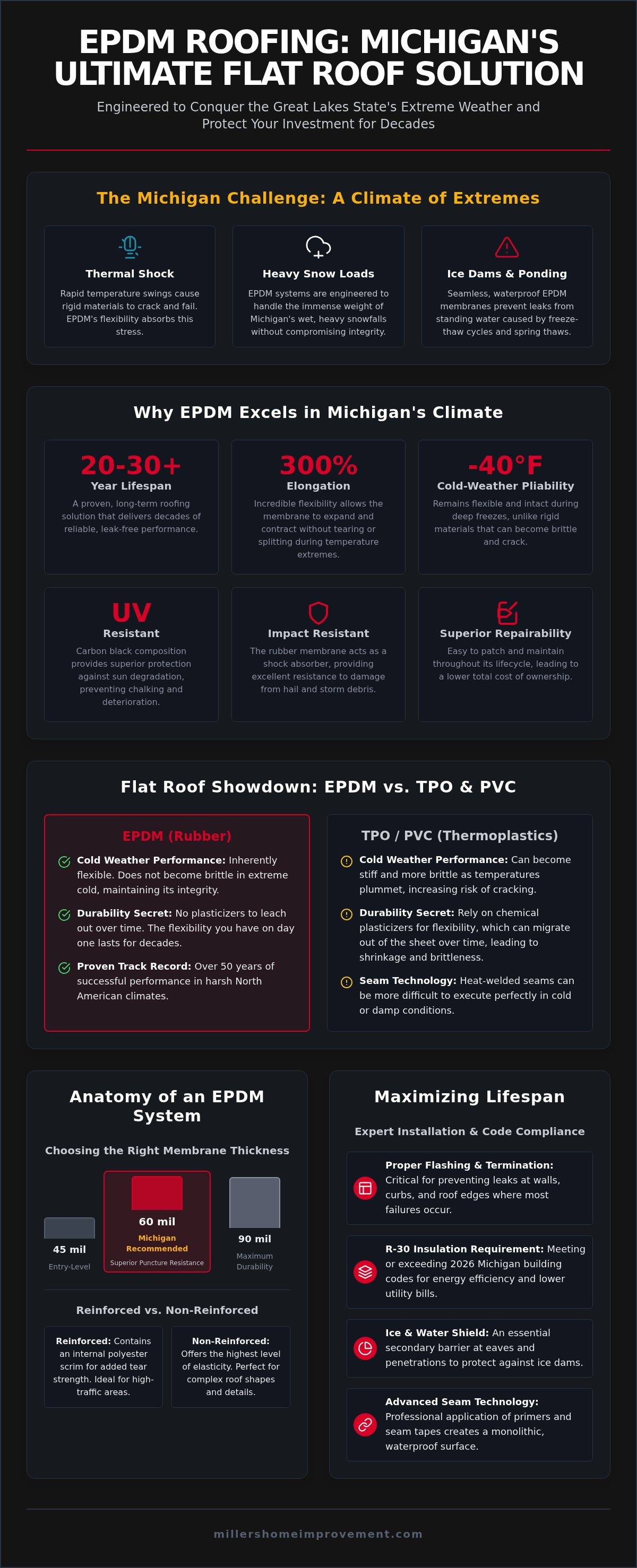
Thickness is a critical consideration for any property owner. Most systems utilize 45 mil, 60 mil, or 90 mil membranes. For our local climate, we typically recommend a minimum of 60 mil. It provides a significant increase in puncture resistance compared to the entry-level 45 mil option. You can also choose between reinforced sheets, which contain an internal polyester scrim for added tear strength, or non-reinforced sheets that offer the highest level of elasticity for complex roof shapes.
Common Flat Roof Challenges in Southeast Michigan
Many older neighborhoods in Detroit and Macomb County are home to flat-roofed garages and commercial buildings that have suffered from years of neglect. The "leaky flat roof" stigma exists because many older systems weren't designed to handle Michigan’s heavy snow loads or the standing water that accumulates during spring thaws. When water sits on a roof, it eventually finds the smallest imperfections in seams or flashing.
EPDM addresses these concerns through its incredible seam technology and natural flexibility. Unlike rigid materials that might crack when the ground shifts or temperatures plummet, rubber remains pliable. It’s a staple in modern commercial restoration because it handles the weight of heavy snow and remains stable even when temperatures drop to -40°F. This reliability is why it remains the gold standard for protecting Southeast Michigan properties against the unpredictable weather cycles we face every year.
The Benefits of EPDM for Michigan’s Extreme Weather Cycles
Michigan weather is notoriously hard on structures. One day it's 50 degrees and raining; the next, it's 10 below zero. This volatility is why epdm roofing Michigan installations are so prevalent. Unlike thermoplastic membranes that can become brittle as they age, rubber remains inherently flexible. It doesn't rely on plasticizers that leach out over time, meaning the protection you have on day one is the same protection you'll have two decades later.
The material excels during the summer months as well. High UV and ozone resistance prevent the surface degradation often seen in asphalt-based products. Additionally, rubber acts as a natural shock absorber. During severe Michigan storms, EPDM's ability to absorb hail impact without fracturing gives it a distinct advantage over more rigid TPO or PVC alternatives. It's a stable, reliable material that handles 150°F rooftop temperatures just as easily as it handles a deep freeze.
Surviving the Michigan Freeze-Thaw Cycle
Rigid materials often fail in the Midwest because they can't handle "thermal shock." This occurs when a sudden drop in temperature causes a material to contract too quickly, leading to cracks or seam separation. Thermal expansion is the physical tendency of matter to change its shape, area, and volume in response to a change in temperature, which puts immense stress on roof seams. According to technical data from the EPDM Roofing Association, high-quality rubber can achieve 300% elongation. This means the membrane stretches and contracts without losing its structural integrity. It won't pull away from the edges of your building even when the thermometer hits -40°F.
Energy Efficiency: Black vs. White EPDM
Choosing the right membrane color is a strategic decision for any Michigan owner. In urban centers like Detroit, the "Heat Island" effect can make rooftops significantly hotter than the surrounding air. White EPDM, often achieved via reflective coatings or ballasted systems, helps lower cooling costs by reflecting solar radiation. However, many local property owners still prefer traditional black EPDM. It absorbs heat during our long, gray winters, which assists in melting snow and reducing ice accumulation on the roof surface. Finding the right balance between these factors requires a deep understanding of local building physics. If you're ready to upgrade your protection, getting a professional flat roof estimate is the first step toward a worry-free winter.
Comparing Flat Roof Membranes: EPDM vs. TPO vs. PVC
Choosing a flat roof system in Southeast Michigan involves weighing more than just the initial price tag. While TPO and PVC are popular thermoplastic options, epdm roofing Michigan property owners select is often chosen for its superior lifecycle value. Cost-effectiveness is a balance between the installation bid and the total cost of ownership over thirty years. Rubber membranes typically require less specialized equipment to install, which can keep labor costs manageable compared to the heat-welding requirements of plastic-based systems.
Repairability is where the distinction between rubber and plastic becomes most apparent to a building owner. As TPO and PVC age, they lose their ability to be heat-welded, making repairs on a ten-year-old roof difficult and expensive. In contrast, EPDM remains chemically stable. A veteran roofer can clean, prime, and patch an aged rubber membrane with high success rates. This reliability is backed by research into the long-term performance of EPDM roofing, which shows that rubber maintains its integrity far better than many newer, unproven materials. This makes epdm roofing Michigan's most reliable option for aging commercial structures where structural movement is expected.
Chemical resistance also plays a role in material selection. EPDM is highly resistant to acids and alkalis, making it ideal for most industrial environments. However, if your property is a restaurant in Detroit or Macomb County where grease and oils are vented onto the roof, PVC might be a better fit. Rubber can swell and degrade when exposed to animal fats or petroleum products. For standard office buildings, warehouses, and residential flats, the resilience of EPDM is hard to beat.
EPDM vs. TPO: The Michigan Showdown
The primary difference between these two systems is how they handle structural movement. Michigan’s clay-heavy soils and extreme seasons cause buildings to shift. EPDM is a thermoset material, meaning it’s cured during manufacturing and behaves like a giant rubber band. It handles building vibration and expansion better than TPO, which is more rigid. Over a 20-year period, EPDM requires fewer seam touch-ups in environments with high structural movement. While TPO offers high reflectivity, EPDM offers peace of mind through its proven track record and easier maintenance schedule.
Installation Methods: Adhered, Ballasted, and Mechanically Attached
The way your roof is secured to the deck determines its wind resistance and cost. Fully Adhered systems are the gold standard for Michigan. The membrane is glued directly to the insulation, providing the highest level of protection against the heavy wind gusts we see during lake-effect storms. Ballasted systems use large river rocks to hold the membrane in place. This is often the most budget-friendly method and provides excellent fire protection, though it makes finding leaks more labor-intensive. Mechanically attached systems use screws and plates to secure the rubber. This method is fast and efficient for large-scale Macomb County warehouses where speed is a priority, though it’s generally less resistant to wind uplift than a fully adhered system.
Maximizing the Lifespan of Your Michigan Rubber Roof
A rubber roof is designed to be a long-term asset, not a recurring expense. While most manufacturers offer a 25 to 30-year promise, reaching that milestone requires attention to the details that others might overlook. Integrity starts at the edges. Flashing and termination bars act as the mechanical anchors for your system, ensuring the membrane stays secured during high-wind events. If these components are neglected, the membrane can pull away, exposing the substrate to the elements and leading to costly interior damage.
Seasonal transitions are particularly taxing on epdm roofing Michigan systems. After a heavy winter, it's vital to check for "ponding" water. This is defined as water that remains on the roof surface for more than 48 hours after a rain or snowmelt event. In older industrial buildings across Southeast Michigan, sagging roof decks can create low spots where water collects. This standing water isn't just a leak risk; it adds significant weight that can compromise the structural integrity of your decking over time.
Solving Flat Roof Ponding in Detroit Properties
Many historic flat roofs in Detroit weren't built with the slight pitch required for modern drainage. When we encounter these issues, we don't just put a patch over the problem. Miller's Home Improvement uses tapered insulation systems to create a custom slope that directs water toward drains or scuppers. This proactive approach eliminates standing water and extends the life of the entire assembly. If you're noticing large puddles that won't disappear, it's time to look into Flat Roof Ponding Repair Detroit to prevent permanent deck rot.
Maintaining Seams and Penetrations
Seams have historically been the most common point of failure for rubber roofs. Older systems relied on liquid adhesives that could break down after years of freeze-thaw cycles. Modern epdm roofing Michigan installations utilize advanced seam tapes that create a chemical bond far stronger than old glues. However, you must still keep a close eye on penetrations like HVAC curbs, skylights, and pipe boots. These areas experience the most movement and are often the first to show signs of degradation or "bridging" where the membrane pulls tight.
To inspect your roof safely, always wear soft-soled shoes to avoid puncturing the membrane. Walk the perimeter first to check the termination bars, then move toward the center while looking for any debris that might have blown onto the surface. Don't drag heavy equipment across the rubber, as even a small tear can lead to a significant leak during the next spring thaw. If you aren't comfortable climbing a ladder, you should schedule a professional roof inspection to ensure your system remains in peak condition for another decade.
Selecting an Experienced EPDM Roofing Contractor in Michigan
Flat roofing is a distinct trade that demands a specialized skillset. While many residential contractors are comfortable with steep-slope shingles, the technical requirements of an EPDM system are entirely different. Installing epdm roofing Michigan properties require involves managing complex seam transitions and termination points that simply don't exist on a standard pitched roof. A single error in adhesive application or corner flashing can lead to a failure that compromises an entire commercial inventory or residential living space. You need a team that views a flat roof as a precision engineered system rather than just a waterproof cover.
In Michigan, ensuring your contractor is fully licensed and insured is a non-negotiable step. As of 2026, the state continues to enforce strict building codes that require professional oversight for low-slope installations. Working with an uninsured team exposes you to immense liability, especially on larger commercial projects. Miller’s Home Improvement brings over 25 years of owner-led experience to every jobsite. This longevity ensures that every technician understands the local codes and the specific wind-uplift requirements of Southeast Michigan. We take pride in doing the job correctly the first time, protecting both your property and our local reputation.
When severe weather strikes, navigating the restoration process can be overwhelming. We act as a proactive guide during storm damage claims, helping owners document wind or hail impact for their insurance providers. Our familiarity with the claims process ensures that your property is restored to its original condition without the stress of managing the paperwork alone. We provide the quiet confidence you need during a major restoration project, focusing on stability and long-term quality.
What to Look for in a Commercial Estimate
A professional estimate should be transparent and detailed. It must specify the membrane thickness, typically 60 mil for our climate, and the exact brand of materials being used. You should also pay close attention to the warranty structure. A "Material-only" warranty is common but limited; an NDL (No Dollar Limit) warranty provides much more robust protection because it covers both labor and materials for the duration of the term. Always ask for local references in Detroit or Macomb County to verify the contractor’s long-term reliability and workmanship.
Get Started with a Free Flat Roof Assessment
Our evaluation process is designed to be thorough and educational. We perform an on-site assessment to check for deck integrity, proper drainage, and the condition of existing flashings. This isn't a high-pressure sales pitch. It's a professional consultation aimed at giving you a clear picture of your roof's health. Whether you need a complete tear-off or a strategic repair, we provide the seasoned expertise needed to make an informed decision. Schedule your free EPDM roofing estimate today to secure your property with a system built for the Michigan environment.
Secure Your Property with Michigan’s Most Resilient Flat Roof
Choosing a roofing system is an investment in the long-term stability of your building. We've explored how EPDM’s unmatched elasticity survives the brutal thermal shock of a Great Lakes winter and why its ease of repair makes it a superior choice over thermoplastic alternatives. By focusing on precision installation and proactive maintenance, you can ensure your structure remains dry and efficient for up to three decades. When you invest in professional epdm roofing Michigan property owners gain a level of durability that rigid materials simply can't match.
Miller’s Home Improvement brings 25+ years of owner experience to every Southeast Michigan project. As a fully licensed and insured team, we specialize in the specific demands of local flat roof systems. We’re here to provide the transparency and technical skill your property deserves. You don't have to settle for temporary patches when a permanent solution is available. Request Your Free EPDM Roofing Estimate from Miller's Home Improvement to take the first step toward a worry-free roof. Let’s build something that stands the test of time and weather together.
Frequently Asked Questions
How long does an EPDM roof last in Michigan?
A typical rubber roof lasts between 20 and 30 years in Michigan's climate. Its longevity is primarily due to its ability to withstand extreme temperature fluctuations without cracking or becoming brittle. Proper installation and annual inspections are the most significant factors in reaching the three-decade mark. While the membrane itself is incredibly durable, the consistent maintenance of edge metal and seam seals determines the actual service life of the system.
Is EPDM roofing cheaper than TPO or PVC?
EPDM is generally more cost-effective than TPO or PVC when you consider both the initial installation and long-term maintenance. The material costs for rubber are often lower, and the installation process doesn't require expensive heat-welding equipment. Additionally, repairing aged rubber is simpler and less labor-intensive than patching thermoplastic membranes. This makes it a preferred choice for property owners looking for the best lifecycle value for their epdm roofing Michigan projects.
Can EPDM be installed over an existing flat roof?
Michigan building codes generally allow for a maximum of two roofing layers before a complete tear-off is required. If your current roof is a single layer and the underlying deck is structurally sound and dry, an EPDM recover may be an option. We always recommend a thorough inspection to ensure no moisture is trapped in the existing insulation. Trapped water can lead to deck rot and the premature failure of your new membrane.
What is the best thickness for a rubber roof in Michigan (45 vs 60 mil)?
We recommend a minimum thickness of 60 mil for all Michigan rubber roof installations. While 45 mil is a budget-friendly option, the 60 mil membrane provides significantly better puncture resistance against falling branches and heavy hail impact. For high-traffic commercial roofs or areas with extreme weather exposure, a 90 mil membrane offers the highest level of durability and long-term peace of mind for the building owner.
How do you find a leak in an EPDM rubber roof?
Finding a leak involves inspecting the seams, flashing, and penetrations first, as these are the most common failure points. We look for signs of "bridging" where the membrane has pulled away from a corner or "alligatoring" on older systems. If a visual inspection doesn't reveal the source, we may perform a moisture scan or a professional flood test. These methods help us pinpoint exactly where water is entering the building envelope.
Can you walk on an EPDM roof for maintenance?
Yes, you can walk on an EPDM roof, but you must take specific precautions to avoid accidental damage. It's essential to wear soft-soled shoes and ensure the surface is clear of sharp debris like screws or metal shards. For areas with frequent foot traffic, such as around HVAC units, we install dedicated walkway pads. These reinforced sections protect the membrane from the mechanical wear and tear of regular maintenance cycles.
Is EPDM roofing energy efficient for Michigan buildings?
EPDM is highly energy efficient when paired with the R-30 continuous insulation levels required by the 2026 Michigan Building Code. Traditional black rubber helps reduce heating costs by absorbing solar energy during our long, cold winters. If cooling costs are a bigger concern for your property, white EPDM or reflective coatings can be applied to meet "cool roof" standards. The right insulation strategy is the real key to maximizing year-round efficiency.
What causes EPDM seams to fail and how can it be prevented?
Seam failures are usually caused by improper cleaning during installation or the use of outdated liquid adhesives. Modern epdm roofing Michigan installations prevent this by using advanced, factory-applied seam tapes that create a permanent chemical bond. Ensuring the surface is completely dry and primed before the tape is applied is the best way to prevent future separation. Regular inspections help identify any minor seam issues before they turn into major leaks.


