
What if your building's roof was a strategic asset rather than just an unavoidable overhead expense? In the Motor City, a failing roof can halt production or damage sensitive inventory overnight. Planning a commercial roof replacement Detroit requires a cold, analytical look at how your facility interacts with Michigan’s volatile weather. You likely understand the anxiety of balancing construction costs against the risk of unexpected leaks during a heavy lake-effect snowstorm.
This guide simplifies the complexities of a commercial roof replacement Detroit by providing professional assurance on materials, costs, and local logistics. We'll explore the technical differences between PVC and EPDM, explain when a full tear-off is mandatory, and show you how to navigate insurance claims after a major storm. By the end, you’ll have a clear roadmap for your commercial roof replacement Detroit to ensure your property remains a stable foundation for your long-term business success.
Key Takeaways
- Learn why Detroit's extreme freeze-thaw cycles and heavy snow loads make a strategic commercial roof replacement in Detroit essential for long-term structural integrity.
- Identify the critical signs of core moisture and apply the "25% Rule" to determine if a repair is a viable fix or a waste of capital.
- Compare the specific benefits of PVC and EPDM systems to select a membrane that offers the best energy efficiency and chemical resistance for your facility.
- Discover how meticulous pre-construction planning and professional tear-off methods prevent construction delays and minimize daily business disruption.
- Understand how to leverage professional expertise to navigate the complexities of insurance claims for storm restoration and property protection.
The Reality of Commercial Roofing in Detroit’s Extreme Climate
Detroit's climate presents a unique set of challenges that can compromise even the most robust industrial structures. For facility managers, understanding these environmental stressors is the first step in planning a commercial roof replacement Detroit. Our weather isn't just cold; it's volatile, and that volatility is exactly what destroys roofing membranes over time. We see roofs that look fine in October but fail by February because they couldn't handle the rapid transition into the deep freeze.
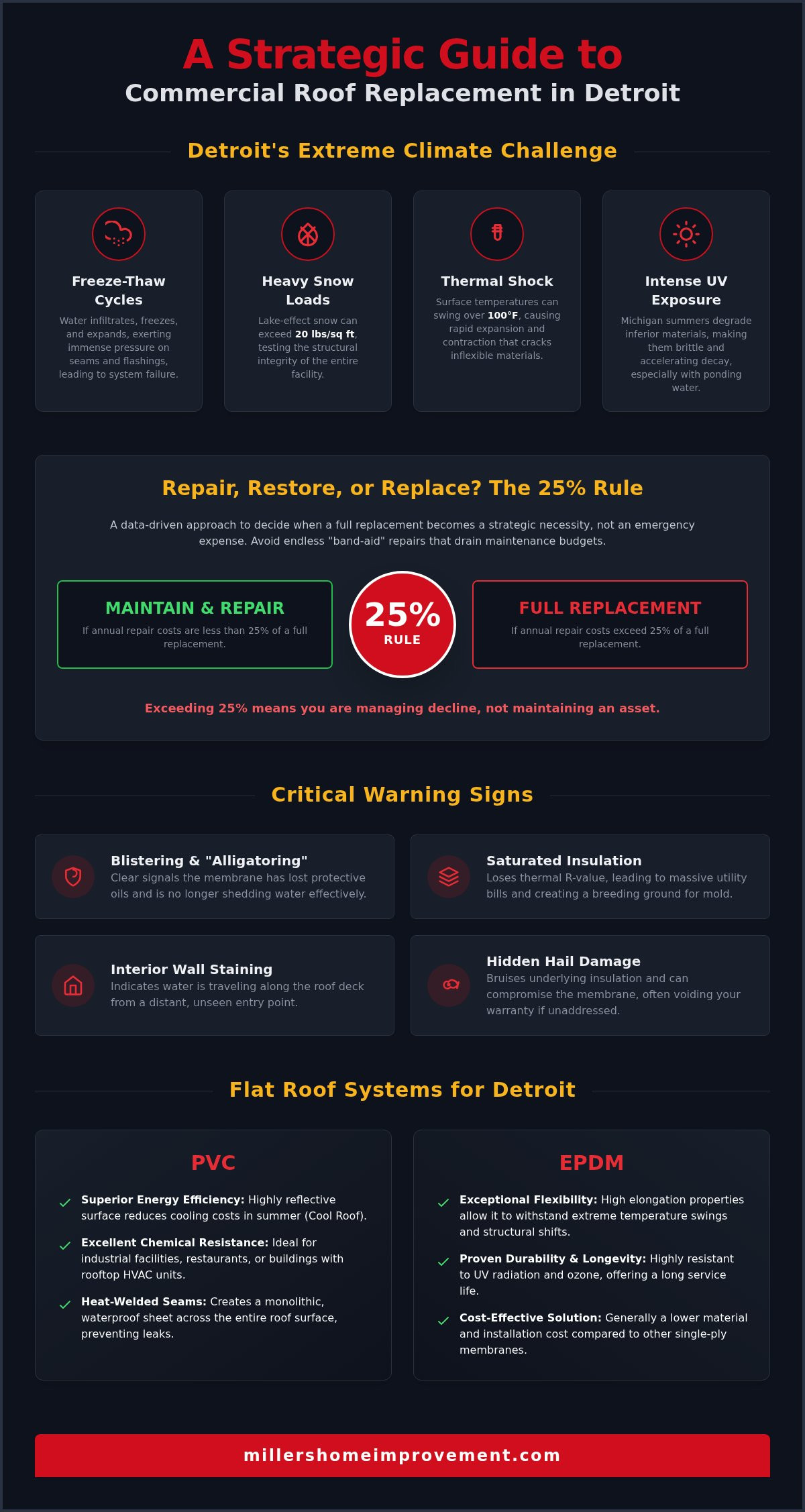
The freeze-thaw cycle remains the primary antagonist for local flat roofing systems. Water infiltrates small fissures during the day and expands as it freezes overnight. This repetitive cycle exerts immense pressure on seams and flashings, eventually leading to failures that allow moisture to reach the building's interior. When you add the weight of lake-effect snow, which can exceed 20 pounds per square foot depending on moisture content, the structural integrity of the entire facility is put to the test. A well-engineered commercial roof replacement Detroit must prioritize membranes with high elongation properties to survive these cycles without tearing.
Thermal shock is another silent killer. In Southeast Michigan, roof surface temperatures can swing over 100 degrees between a frigid January night and a humid July afternoon. This causes rapid expansion and contraction. If a roof lacks the flexibility to handle these movements, it will develop cracks and tears. Ignoring minor ponding water during our humid summers only accelerates this decay, as standing water acts as a magnifying glass for UV rays and provides a constant source of moisture for potential leaks.
Detroit Weather Patterns and Roof Longevity
Michigan summers bring intense UV exposure that degrades inferior materials, making them brittle before their time. During the winter, ponding water transforms into ice dams, creating structural stress that can lead to deck deflection. We often see common types of membrane roofing, such as PVC or EPDM, perform better in this region because they maintain their physical properties despite extreme temperature swings. Choosing a material that can't handle a 100-degree shift is a recipe for a premature replacement.
Signs Your Detroit Facility Needs Immediate Attention
You don't always need a direct drip from the ceiling to know there's a problem. Interior wall staining often indicates that water is traveling along the roof deck from a distant entry point. On the roof surface itself, "blistering" or "alligatoring" are clear signals that the membrane has lost its protective oils and is no longer shedding water effectively. After a major Michigan hail storm, a professional assessment is vital. Hail damage isn't always obvious, but it can bruise the underlying insulation and void your warranty. A timely commercial roof replacement Detroit prevents these manageable issues from evolving into expensive structural liabilities.
Evaluating Your Options: Repair, Restore, or Full Replacement?
Deciding between patching a persistent leak and committing to a full commercial roof replacement Detroit requires a cold, analytical look at your building’s long-term health. Many facility managers fall into the trap of endless "Band-Aid" repairs that drain maintenance budgets without solving the root cause. We advocate for the 25% Rule: if the projected cost of repairs over a twelve-month period exceeds 25% of the cost of a total replacement, you’re no longer maintaining an asset; you’re managing its decline. This data-driven approach removes the emotional stress from the decision and ensures that your commercial roof replacement Detroit happens as a planned capital improvement rather than an emergency expense.
A roof is more than just its top membrane. When moisture breaches the surface and reaches the underlying insulation, a commercial roof replacement Detroit becomes the only way to restore the R-value of the building enclosure. Saturated insulation loses its thermal efficiency, leading to astronomical utility bills during Michigan's winter months. It also creates a breeding ground for mold and can eventually cause the metal or wood deck to rot from the inside out. Delaying a necessary replacement in these cases creates significant liability and safety risks for your employees, inventory, and equipment.
Modern roofing systems offer a return on investment that older roofs simply cannot match. High-reflectivity membranes, often verified by the Cool Roof Rating Council, significantly reduce the "heat island" effect and lower cooling costs during our humid summers. These energy gains, combined with drastically reduced maintenance requirements, mean a new roof often pays for itself over its operational lifespan. If you're seeing signs of systemic failure, a professional roof assessment is the most reliable way to identify these hidden risks before they become emergencies.
The Limitations of Commercial Roof Repairs
Patching is an effective temporary solution for localized damage, such as a puncture from a fallen branch or a single failed seam. However, it’s ineffective against systemic membrane failure. If you’re seeing multiple leaks appearing across different sections of the building, the material has likely reached the end of its chemical life. Frequent minor repairs don't just cost money; they disrupt business operations and pull your facility staff away from other critical tasks. When the patches themselves begin to fail, it's a clear signal that the substrate can no longer support a reliable bond.
When a Full Roof Tear-Off is Mandatory
Under Michigan building codes, most commercial structures are limited to two roofing layers. If your building already has two layers in place, a full tear-off is mandatory by law before any new system can be installed. Beyond legal compliance, a complete tear-off is the only way to inspect the structural deck for rust, rot, or deflection. It provides a clean slate, ensuring that your new membrane adheres perfectly to the substrate and qualifies for the maximum manufacturer warranty protection. Removing saturated insulation is also the only way to restore the thermal efficiency of your building enclosure.
Flat Roof Systems for Detroit: PVC, EPDM, and Torch Down
Selecting the right membrane is the most consequential decision in a commercial roof replacement in Detroit. While aesthetic choices matter for residential properties, commercial systems must adhere to the rigorous standards of the International Building Code to ensure fire safety, wind uplift resistance, and structural load capacity. The choice between PVC, EPDM, and Torch Down depends entirely on your facility's specific operations and the physical demands of its environment.
Every industrial building in Southeast Michigan has a unique footprint. A manufacturing plant exhausting chemical vapors requires a different solution than a retail center focused on customer comfort and energy overhead. By matching the material to the industry, you ensure the roof doesn't just sit there; it actively contributes to the building's performance. Whether you're managing a logistics hub or a downtown storefront, the goal is a system that handles thermal shock without compromise.
PVC Flat Roofing: Performance for Michigan Facilities
PVC (polyvinyl chloride) is often considered the premier choice for Detroit’s industrial and retail sectors. Its primary strength lies in its heat-welded seams. Unlike systems that rely on adhesives or tapes, PVC seams are fused together using hot air to create a single, monolithic sheet. This bond is actually stronger than the membrane itself, making it virtually impervious to leaks. For facilities in the manufacturing sector, PVC offers exceptional resistance to animal fats, grease, and industrial chemicals that would otherwise degrade standard rubber membranes. Additionally, the high solar reflectivity of white PVC helps mitigate cooling costs during Michigan's humid summer months, providing a tangible boost to your operational budget.
EPDM and Torch Down: Versatile Alternatives
EPDM (ethylene propylene diene monomer) remains a staple for large-scale warehouses and distribution centers. This synthetic rubber membrane is prized for its long-term durability and cost-effectiveness over vast surface areas. In our region, EPDM offers a unique "Black Roof" advantage; the dark surface absorbs solar heat during the winter months. This helps melt snow and ice more quickly than reflective systems, reducing the weight load on your structural deck. When selecting EPDM, we recommend choosing a 60-mil or 90-mil thickness to ensure the membrane can withstand the mechanical stress of Detroit's freeze-thaw cycles without becoming brittle or prone to punctures.
For buildings with high-traffic roof areas or complex mechanical layouts, Torch Down (Modified Bitumen) provides a rugged, multi-layered defense. It combines the flexibility of rubber with the strength of asphalt. This system is particularly effective for facilities that require frequent rooftop maintenance access, as the reinforced layers resist physical damage better than single-ply membranes. Ensuring the correct material is chosen during your commercial roof replacement in Detroit is what separates a temporary fix from a 30-year asset. We always aim to educate clients on these nuances so the final choice reflects the actual needs of the property.
The Replacement Process: Minimizing Business Disruption
Executing a commercial roof replacement in Detroit requires more than technical skill; it demands a logistical strategy that respects your business's operational rhythm. We understand that construction noise and equipment can be intrusive. Pre-construction planning is the foundation of our approach. We coordinate scheduling around your peak hours to ensure that our presence doesn't compromise your productivity or customer experience. This disciplined coordination allows us to maintain a steady pace without creating unnecessary chaos on your property.
The tear-off phase is where our 25 years of experience truly benefits the client. We don't just rip up old materials; we manage the safe removal and disposal of every layer with meticulous care. This phase is critical for identifying underlying issues that a simple overlay would hide. Once the deck is exposed, we perform a thorough structural inspection. Identifying and repairing rust in metal decks or rot in wood substrates is a non-negotiable step for a "Seasoned Master Craftsman." We ensure the foundation is sound before the new membrane goes down, providing you with long-term stability rather than a temporary fix. The process concludes with a final inspection and a comprehensive warranty walkthrough to confirm every detail meets our high standards for protection.
Logistics and Safety in Urban Detroit
Managing heavy equipment and bulky materials in tight commercial corridors requires precision and local knowledge. We are well-versed in the unique challenges of the Detroit landscape, from navigating narrow access points to maintaining strict OSHA compliance on large-scale industrial projects. Safety isn't just a checkbox; it's a commitment to protecting your staff and our crew throughout the build. Staging is the process of organizing materials to prevent site congestion. By carefully managing our footprint, we keep your parking lots and loading docks functional while work progresses overhead.
Timeline and Communication Expectations
While the duration of a project depends on the square footage and complexity of the structure, a typical commercial roof replacement in Detroit can range from a few days to several weeks. We prioritize transparency through every stage of this timeline. Miller’s Home Improvement provides daily progress updates to facility managers, ensuring you're fully informed of our milestones and any weather-related adjustments. Our commitment to your property extends to the final cleanup. We take pride in leaving your facility in better condition than we found it, with all debris removed and the site completely secured. If you're ready to plan your facility's upgrade, you can schedule a professional consultation to discuss your specific timeline and logistical needs.
The Miller’s Advantage: Expert Restoration and Insurance Support
Choosing a partner for your commercial roof replacement in Detroit is a decision that impacts your facility for decades. At Miller’s Home Improvement, we bring over 25 years of owner experience to every project. This isn't just about laying down a membrane; it's about the "Master Craftsman" approach that ensures every seam and flashing is executed with precision. When you work with a local fixture rather than a distant corporate entity, you gain a level of accountability that is often missing in large-scale construction. We’re protective of our reputation because we live and work in the same community as our clients.
Being a proactive guide means more than just performing a task. It involves helping you navigate the complexities of property ownership, especially after a severe Michigan storm. Storm restoration is one of our core specialties. Many business owners are unaware that their insurance policy may cover a significant portion of a replacement if damage is properly documented. We act as your technical advocate, ensuring that adjusters see the full scope of the impact on your roof's integrity. This transparency is vital for securing the funds necessary to restore your property to its optimal condition.
Commercial Storm Damage and Insurance Claims
Identifying hail and wind damage on flat roof systems requires a trained eye. Unlike residential shingles, where damage is often obvious, flat membranes like EPDM or PVC may show subtle bruising or seam uplift that eventually leads to systemic failure. We provide professional assessments that give insurance adjusters the technical data they need to process your claim fairly. It is critical to act quickly. Michigan has specific filing deadlines for storm-related claims, and waiting until a leak appears often means the window for coverage has already closed. A timely inspection after a storm can save your business tens of thousands of dollars in out-of-pocket expenses.
A Commitment to Southeast Michigan Businesses
Our roots are firmly planted in Southeast Michigan. We proudly serve Detroit, Macomb County, and the entire Metro area with a focus on stability and long-term quality. As a family-owned business, we don't hide behind a corporate switchboard. You have direct access to our expertise and a guarantee that we’ll be here to stand behind our work for years to come. This local presence is your best defense against future leaks and poor workmanship. If you’re ready to secure your facility’s future, request your free commercial roofing estimate today. We’re here to help you move from a state of concern to a state of informed resolution.
Securing Your Facility’s Future in Southeast Michigan
Choosing the right material for our unique climate and understanding exactly when to stop patching are the most critical steps in property management. A strategic replacement isn't merely a repair; it's a long-term investment that enhances energy efficiency and protects your structural deck for the next two decades. Investing in a commercial roof replacement in Detroit requires a partner who understands both the local building codes and the technical nuances of high-performance flat-roof membranes.
Miller's Home Improvement brings over 25 years of owner experience to every project in Southeast Michigan. As a fully licensed and insured Michigan contractor, we provide specialized expertise in PVC, EPDM, and Torch Down systems designed to withstand our region’s extreme freeze-thaw cycles. We take pride in our "Master Craftsman" approach, ensuring that your facility remains dry, safe, and efficient regardless of the weather. Secure your facility with a free commercial roofing estimate from Miller's. We look forward to helping you protect your property with the meticulous care and professional integrity it deserves.
Frequently Asked Questions
How much does commercial roof replacement cost in Detroit?
The cost for a commercial roof replacement Detroit depends on variables like total square footage, membrane choice, and structural complexity. Factors such as the number of roof penetrations, building height, and the need for a full tear-off vs. a recover will influence the final investment. Every facility has unique technical requirements, so a professional on-site assessment is the only way to establish an accurate and reliable scope of work.
How long does a typical commercial roof last in Michigan?
Most high-quality flat roofing systems in Michigan last between 20 and 30 years when installed correctly and maintained regularly. Our local climate, characterized by extreme temperature fluctuations and heavy snow loads, puts significant stress on roofing membranes. Systems like PVC and EPDM are specifically engineered to handle these conditions. Regular inspections and clearing debris from drainage points can help extend the life of your investment.
Can I install a new roof over my existing commercial roof?
You can often install a recover system if the existing roof has only one layer and the underlying insulation is dry. However, Michigan building codes generally limit commercial structures to two roofing layers. If your building already has two layers, a complete tear-off is mandatory. We typically recommend a full tear-off even when a recover is legal, as it allows us to inspect the structural deck for hidden rot.
What is the best flat roof material for Detroit's cold winters?
EPDM is often considered one of the best materials for Detroit's cold winters due to its ability to remain flexible in sub-zero temperatures. The dark surface of EPDM also absorbs solar heat, which helps melt snow and ice accumulation more efficiently. Alternatively, PVC is excellent for its heat-welded seams, which remain watertight even during the heavy weight of lake-effect snow. The best choice ultimately depends on your building's specific use.
How do I know if my commercial roof has storm damage?
Storm damage isn't always visible from the ground or immediately obvious to the untrained eye. Look for signs such as localized ponding water, uplifted seams, or cracks in the membrane surface. Inside the building, staining on the walls or ceiling often indicates a breach. After a significant hail event or windstorm, a professional inspection is necessary to identify compromised fasteners or bruised insulation that could lead to systemic failure if left unaddressed.
Does Miller's Home Improvement handle commercial insurance claims?
Yes, we specialize in helping businesses navigate the insurance claim process for storm-related restoration. Our team provides the detailed technical assessments and documentation that insurance adjusters require to process a claim fairly. We act as your proactive guide, ensuring the full extent of the damage is represented. This support is a key part of a commercial roof replacement Detroit when the project is funded through an insurance settlement following severe weather.
What is the difference between PVC and EPDM roofing?
The main difference lies in the material composition and how the seams are joined. PVC is a thermoplastic membrane with seams that are fused together using hot-air welding, creating a permanent, watertight bond. EPDM is a synthetic rubber membrane that typically uses adhesive tape to seal seams. While PVC offers superior resistance to chemicals and grease, EPDM is often prized for its durability and cost-effectiveness on large-scale warehouses where chemical exposure is not a concern.
How long will my business be disrupted during a roof replacement?
We prioritize minimizing disruption by coordinating our work around your peak operational hours. While the total duration of a project depends on the building size, most replacements are completed within one to three weeks. We manage equipment staging and material delivery to keep your loading docks and parking areas accessible. Daily progress updates ensure you stay informed of our timeline, allowing you to maintain business continuity with confidence.


