
A flat roof in Detroit has to survive more than just heavy snow. It must withstand the chemical fallout of an industrial city and the intense heat of a July afternoon without cracking or leaking. For many building owners, the roof is a constant source of anxiety rather than a reliable asset.
You likely feel the weight of every storm, wondering if your older roofing system will hold up or if you'll find new puddles in the warehouse Monday morning. Between recurring leaks and energy bills that spike during Michigan summers, maintaining a commercial property is a constant challenge. It's a cycle that drains your budget and your patience. You deserve a solution that lets you focus on your business instead of your ceiling.
Choosing commercial PVC roofing Detroit provides a permanent shift from reactive repairs to long term stability. This guide explores how this specific membrane offers chemical resistance and superior reflectivity to keep your building dry and cool for decades. We'll examine the technical advantages of heat-welded seams and why this material is the premier choice for Detroit’s demanding commercial environment.
Key Takeaways
- Learn why PVC's high reflectivity is a critical defense against the urban heat island effect, helping you lower cooling costs during humid Detroit summers.
- Understand how heat-welded seams create a monolithic, watertight barrier that eliminates the common failure points found in glued or taped systems.
- Compare the long-term value of commercial PVC roofing Detroit against EPDM and TPO to determine which membrane best survives Michigan’s intense freeze-thaw cycles.
- Identify the specific warning signs to look for after a severe wind or hail storm to prevent minor issues from becoming costly structural repairs.
- Discover how a master craftsman's approach to installation and maintenance can protect your property investment for 20 to 30 years.
Why PVC is the Gold Standard for Detroit’s Commercial Flat Roofs
PVC, or Polyvinyl Chloride, is a high-performance, single-ply thermoplastic membrane reinforced with a polyester or fiberglass scrim. Unlike basic materials that rely on adhesives, this system uses heat-welded seams to create a permanent, molecular bond. When discussing PVC membrane roofing, it's vital to recognize its role as a chemically stable shield for your property. For property owners investing in commercial PVC roofing Detroit, this material provides a level of protection that older, asphalt-based systems simply cannot match.
Combating the Detroit Urban Heat Island
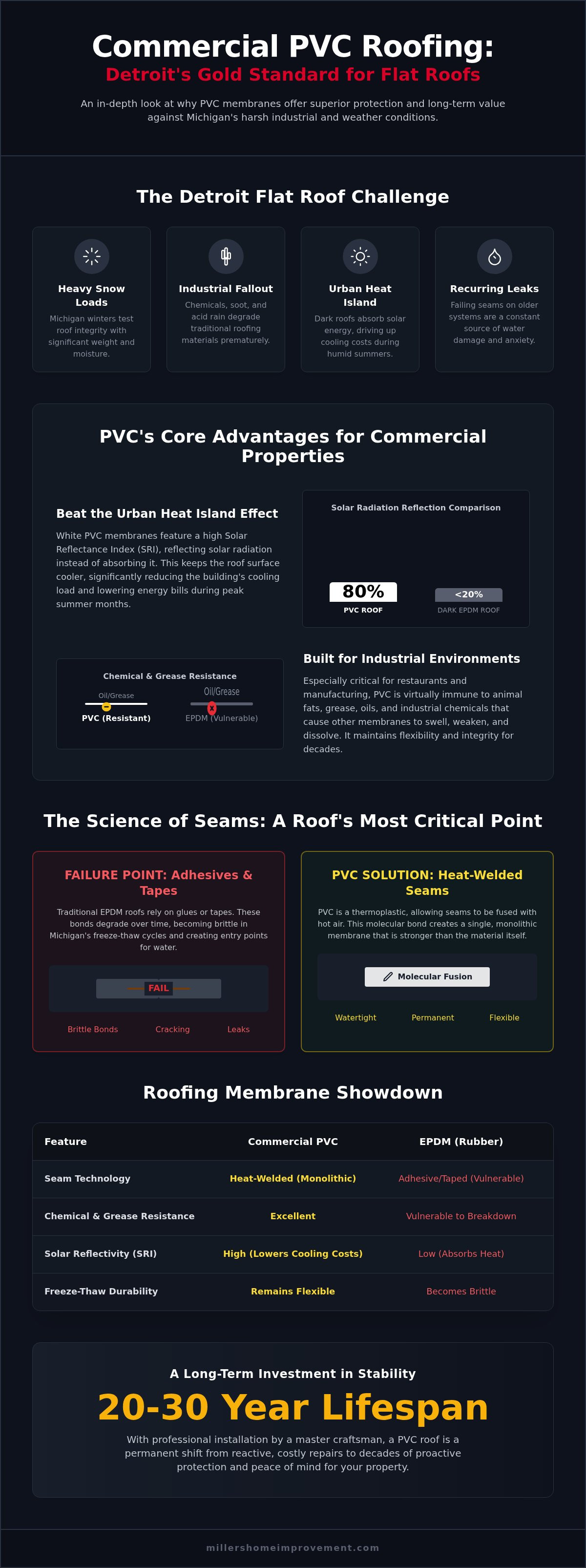
Detroit’s dense urban core and industrial zones suffer from the urban heat island effect, where concrete and dark surfaces trap heat. This drives up ambient temperatures and forces your HVAC system to work overtime. White PVC membranes are a direct solution because they reflect up to 80% of solar radiation. By keeping the roof surface significantly cooler, you can reduce the "peak demand" energy charges that often hit Detroit businesses during the humid summer months.
The Solar Reflectance Index (SRI) is a value that measures a roof's ability to reject solar heat; a higher SRI helps buildings comply with the Michigan Energy Code requirements for Climate Zone 5. It’s a practical way to lower your overhead while maintaining a stable indoor environment. We've seen buildings significantly cut their cooling strain just by switching from a dark EPDM membrane to a highly reflective PVC system.
Industrial Resilience: Beyond Standard Weathering
Detroit’s history as an industrial powerhouse means our air contains higher levels of pollutants, soot, and acid rain. These elements can cause traditional rubber roofs to degrade prematurely. PVC is uniquely resistant to these environmental stressors. It doesn't become brittle when exposed to the industrial fallout common near our manufacturing corridors. It remains flexible and maintains its integrity through decades of Michigan's volatile weather cycles.
This resilience is especially critical for restaurants and manufacturing plants. Standard EPDM roofing is susceptible to damage from animal fats, grease, and industrial oils, which cause the rubber to swell and eventually dissolve. PVC thrives in these environments. It's essentially immune to the oils exhausted from rooftop vents, making it the only logical choice for food service facilities. Additionally, the reinforced nature of the membrane provides the structural strength needed to support Detroit's heavy snow loads without risking a breach in the watertight layer.
The Science of Seams: How Heat-Welding Protects Your Facility
The integrity of a flat roof isn't determined by the membrane alone. It lives and dies by the quality of its seams. When we install commercial PVC roofing Detroit, we prioritize a process called molecular fusion. Because PVC is a thermoplastic material, it can be softened with heat and then reformed. This allows us to create a monolithic, watertight layer that covers your entire building without relying on temporary fixes.
Molecular Fusion vs. Adhesives
Most flat roofing failures start at the seams. Traditional EPDM systems rely on specialized tapes or liquid adhesives to hold the sheets together. While these work initially, the chemical bonds are prone to drying out, especially during the extreme freeze-thaw cycles we experience in Southeast Michigan. Once an adhesive bond becomes brittle, it's only a matter of time before moisture finds its way underneath the membrane.
Heat-welding is fundamentally different. We use specialized hot-air welding equipment to melt the top and bottom layers of the PVC sheets together. As the material cools, the two pieces become one single, continuous sheet. This bond is permanent and often stronger than the membrane itself. To ensure long-term performance, every technician must strictly follow installation and maintenance standards. This involves precisely calibrating the welder's temperature and speed to account for the day's specific weather conditions, whether it's a humid morning or a crisp autumn afternoon.
Precision Installation Standards at Miller's
A PVC roof is only as good as the technician operating the welder. It's a technical discipline that requires patience and a meticulous eye for detail. Eric Miller brings over 25 years of industry experience to every project, overseeing the critical details that others might overlook. We don't just hope the weld is secure; we verify it through rigorous physical testing.
- The Probe Test: We manually run a specialized metal tool along every inch of the welded seam. This identifies any "cold welds" or microscopic voids that could lead to future leaks.
- Termination Bars: These heavy-duty metal strips secure the membrane at the edges and walls, preventing wind uplift during Detroit's frequent storms.
- Custom Flashing: We create reinforced seals around every roof penetration, including HVAC units, vents, and pipes, ensuring these vulnerable areas are as tough as the rest of the roof.
By focusing on these technical details, we provide a roofing system that stays watertight for decades. If you're currently dealing with recurring leaks in an older system, a professional roofing assessment can help you determine if a heat-welded PVC system is the right upgrade for your facility.
PVC vs. EPDM and TPO: Choosing the Right Membrane for SE Michigan
Selecting the right material for a commercial facility in Detroit often involves comparing the three primary single-ply options: PVC, EPDM, and TPO. While each system has its specific use cases, the long term reliability of commercial PVC roofing Detroit frequently makes it the most stable investment for local property owners. The decision shouldn't just be based on the initial quote; it requires a hard look at how these materials perform under the unique stresses of the Great Lakes climate.
Durability in Extreme Freeze-Thaw Cycles
Detroit winters are defined by rapid temperature swings that force roofing membranes to expand and contract repeatedly. PVC remains exceptionally flexible even in sub-zero temperatures, which prevents the material from becoming brittle or cracking. In contrast, EPDM systems often experience significant stress at the seams during these shifts. Because EPDM relies on adhesives rather than molecular fusion, the constant movement can eventually pull those seams apart. TPO, while a common choice, has historically been more susceptible to "crazing," which are microscopic surface cracks that develop after years of exposure to intense UV rays and temperature fluctuations.
The Lifecycle Cost Analysis
It's a fact that PVC carries a higher upfront cost than EPDM. However, a professional lifecycle analysis usually tells a different story for Detroit businesses. When you factor in the reduced need for repairs and the significant energy savings from its reflective surface, the return on investment becomes clear. Adhering to recognized PVC roofing installation standards ensures that you aren't just buying a material; you're securing a decades-long performance guarantee. For facility managers who want to avoid the headache of recurring maintenance, PVC is often the most cost-effective solution over a 20-year span.
Over two decades, PVC requires the least amount of intervention. While EPDM may need seam touch-ups every 7 to 10 years, a properly heat-welded PVC roof remains watertight. PVC is the clear winner for specific building types in our region:
- Food Service: Restaurants and processing plants need PVC’s resistance to animal fats and grease.
- Industrial Hubs: Facilities near Detroit's manufacturing corridors benefit from its immunity to chemical pollutants.
- High-Efficiency Retail: Buildings looking to minimize HVAC strain during humid summers rely on PVC's high solar reflectivity.
We don't believe in one-size-fits-all roofing. We focus on providing the stability and peace of mind that comes from choosing the right material for your specific environment.
Maximizing Your Investment: Maintenance and Installation Standards
A high-quality installation is the foundation, but long-term durability depends on consistent care. For commercial PVC roofing Detroit systems, we recommend a semi-annual inspection schedule. The best times are early spring, after the final thaw, and late autumn, before the first significant snowfall. This proactive approach allows you to identify minor stresses caused by the previous season before they escalate into structural problems.
Maintaining clear drainage is the most critical task for any flat roof owner. In Detroit’s older industrial buildings, scuppers and internal drains often become clogged with leaves or urban debris. When water can't exit the roof, it creates "ponding," which adds thousands of pounds of unnecessary weight to your building's structure. Additionally, you must ensure your attic or plenum space is properly ventilated. Poor airflow can cause heat and moisture to build up beneath the roof deck, leading to premature membrane degradation from the inside out.
The Post-Winter Inspection Checklist
Michigan winters are particularly brutal on building envelopes. Once the snow clears, perform a walk-through to look for these specific issues:
- Ponding Water: Identify areas where water sits for more than 48 hours after a rain event.
- Flashing Integrity: Check the seals around HVAC units and skylights; these are common points for physical damage from ice sliding or heavy snow loads.
- Debris Accumulation: Remove any organic material that can trap moisture against the membrane and promote mold growth.
Professional Maintenance vs. DIY Repairs
It's tempting to send a general maintenance worker up with a tube of caulk to fix a small leak, but this often does more harm than good. PVC is a specialized thermoplastic that is chemically incompatible with many standard asphalt-based mastics or "wet patch" products. Using the wrong material can actually dissolve the membrane or prevent a proper professional repair later.
Maintaining your warranty requires repairs to be performed by a licensed contractor who understands the specific chemistry of PVC. At Miller's Home Improvement, we don't just patch holes. We provide comprehensive commercial PVC roofing Detroit services, including meticulous storm damage repair and insurance claim assistance. If a Michigan hail storm or high-wind event has compromised your roof, we ensure the restoration meets original installation standards to protect your long-term investment.
Partnering with Miller’s Home Improvement for Your Detroit Project
Choosing a roofing partner for a large scale facility is a decision that impacts your operations for decades. At Miller’s Home Improvement, we approach every project with the quiet confidence that comes from over 25 years of owner experience in the local market. We understand that a new roof is a significant investment. That’s why we prioritize a no-pressure, educational approach over aggressive sales tactics. Our reputation is built on transparency and a commitment to doing things correctly the first time.
When you invest in commercial PVC roofing Detroit, you aren't just buying a membrane; you're hiring a team of craftsmen who respect your property. We use high-performance materials and meticulous installation techniques to ensure your building remains watertight through the most demanding Michigan winters. Our local roots mean we're a stable fixture in the community, not a distant corporate entity. We take pride in our workmanship and our long term commitment to quality. We don't believe in shortcuts.
The Miller’s Process: From Estimate to Completion
Our process is designed to be thorough and disciplined, mirroring the precision required for a successful construction project. It begins with a comprehensive site visit where we conduct a detailed roof health assessment. We don't just look at the surface. We examine the insulation, the drainage systems, and the structural integrity of the deck to ensure a PVC system is the right fit for your specific building. This methodical approach allows us to provide an accurate, transparent estimate without hidden surprises.
We understand that your business doesn't stop just because the roof needs work. Our team coordinates closely with facility managers to minimize disruption to your daily operations. We manage the logistics of the project carefully, from material delivery to the final walkthrough. Once the installation is complete, we perform a rigorous inspection of every seam and flashing detail. We also maintain a clean job site, ensuring that all debris is removed and your property is left in professional condition. It’s a process built on mutual respect and clear communication.
Start Your Commercial Roofing Assessment Today
Don't wait for a major storm season to reveal the weaknesses in your current flat roof. A proactive assessment can identify risks before they lead to expensive interior damage or operational downtime. A professionally installed PVC system offers a level of security that allows you to focus on your business rather than your ceiling. You deserve the peace of mind that comes from a roof built to last for 20 to 30 years.
We invite you to reach out for a professional assessment of your facility’s needs. We provide honest, straightforward communication and a detailed plan for securing your building’s future. Schedule your free commercial roofing estimate today and discover the difference that 25 years of master craftsmanship can make for your Detroit property.
Securing Your Facility’s Future with Professional PVC Solutions
Investing in a high-performance roof is about more than just preventing leaks; it's about establishing a foundation of stability for your business operations. As we've explored, the chemical resistance and thermal reflectivity of a modern membrane make commercial PVC roofing Detroit the most reliable choice for our region’s unique industrial and climate challenges. By prioritizing molecularly fused seams over temporary adhesives, you ensure your building remains protected for decades. We don't believe in shortcuts.
At Miller’s Home Improvement, we bring 25+ years of owner experience to every project. As a fully licensed and insured Michigan contractor, we specialize in industrial flat roof systems that stand up to the most demanding environments. We provide the meticulous attention to detail that only a seasoned master craftsman can offer; this ensures your investment is sound from the first weld to the final inspection. You deserve a partner who understands local building codes and the specific stresses of the Detroit climate.
Take the first step toward a worry-free facility by scheduling a professional assessment of your property. Get Your Free Commercial PVC Roofing Estimate and gain the peace of mind that comes with a roof built to endure.
Frequently Asked Questions
How long does a PVC roof typically last on a commercial building in Detroit?
A professionally installed PVC roof typically lasts between 20 and 30 years in the Michigan climate. Its longevity is largely due to the heat-welded seams that create a permanent, watertight bond. Unlike other systems that rely on adhesives which can dry out over time, PVC remains flexible and stable. Regular maintenance and semi-annual inspections help ensure you reach the full life expectancy of your investment while protecting your building’s interior.
Is PVC roofing more expensive than TPO or EPDM?
PVC often has a higher upfront installation cost compared to EPDM or TPO membranes. This initial investment covers the superior chemical resistance and the specialized labor required for heat-welding the seams. When you calculate the total lifecycle cost, including energy savings and reduced repair frequency, PVC frequently emerges as the most cost-effective long-term solution. It’s a stable choice for facility managers who prioritize durability over the lowest initial bid.
Can a PVC roof be installed over an existing flat roof in Michigan?
A PVC membrane can sometimes be installed over an existing flat roof if the current structure is sound and dry. This process, known as a roof recover, must comply with the Michigan Building Code, which generally limits the number of roofing layers allowed on a building. We perform a thorough assessment to check for trapped moisture or structural fatigue before recommending this path. A recover can save on tear-off costs while still providing a high-performance shield.
How does PVC roofing perform during heavy Michigan snow loads?
PVC membranes are reinforced with a polyester or fiberglass scrim, giving them the tensile strength necessary to handle heavy Michigan snow loads. The heat-welded seams are specifically designed to remain watertight under the pressure of sitting snow and ice. Because the material stays flexible in sub-zero temperatures, it won't become brittle or crack during the winter. This structural integrity is vital for protecting your building's interior during a standard Detroit winter.
What kind of maintenance does a commercial PVC roof require?
Maintaining a commercial PVC roofing Detroit system is relatively straightforward but essential for longevity. We recommend semi-annual inspections in the spring and fall to clear debris from scuppers and internal drains. You should also check the flashing around HVAC units and skylights for any physical damage after severe storms. Keeping the surface clean of organic material prevents mold growth and ensures the membrane continues to reflect solar heat efficiently.
Is PVC roofing fire-resistant for industrial applications?
PVC is inherently fire-resistant and is often the preferred choice for industrial facilities with high safety standards. The material is self-extinguishing; once the heat source is removed, it stops burning. This characteristic provides an extra layer of protection for manufacturing plants and warehouses. Most PVC systems meet Class A fire ratings, which is a critical consideration for complying with local building codes and insurance requirements in the Detroit area.
How does PVC help reduce energy costs for Detroit businesses?
PVC membranes act as "cool roofs" by reflecting up to 80% of solar radiation away from your building. This reflectivity significantly reduces the amount of heat absorbed through the roof deck, lowering the strain on your HVAC system. During Detroit’s humid summer months, this can lead to substantial savings on cooling costs and peak demand energy charges. It’s a practical way to improve your building’s efficiency while maintaining a comfortable indoor environment for your employees.
Can PVC roofing withstand chemicals and grease from restaurant vents?
PVC is exceptionally resistant to animal fats, greases, and industrial oils that typically exhaust from restaurant and manufacturing vents. While these substances can cause EPDM rubber to swell and degrade, PVC maintains its integrity and remains watertight. This chemical stability makes it the only logical choice for food service facilities. It ensures that routine kitchen exhaust doesn't lead to premature roof failure or recurring leaks around ventilation equipment on your property.


