
A roof that survives a Detroit winter must do more than shed water; it has to withstand a punishing cycle of expansion and contraction that tears lesser materials apart. You likely know the stress of watching a small seam leak turn into a major operational headache during a sudden January thaw. It's a common struggle for facility managers who are tired of temporary patches and rising utility costs. Investing in commercial EPDM roofing Detroit systems offers a level of durability that most traditional materials simply can't match in our specific Climate Zone 5 environment.
We understand that your primary goal is a stable, leak-free facility that doesn't drain your maintenance budget every spring. In this guide, you'll discover why EPDM is the most resilient and cost-effective flat roofing solution for our extreme local climate. We will walk through the technical advantages of this synthetic membrane, including how it helps meet R-30 insulation standards and withstands heavy Michigan snow loads. You'll also learn how to ensure a professional installation that secures your building for 30 years or more. This is about moving from constant repairs to a state of informed, long-term resolution.
Key Takeaways
- Understand why EPDM’s synthetic rubber composition is uniquely suited to handle Detroit’s rapid temperature swings and sub-zero winters without cracking.
- Compare the lifecycle costs and performance of commercial EPDM roofing Detroit systems against PVC and TPO alternatives.
- Discover the specific installation methods, such as fully adhered and ballasted systems, that ensure maximum wind resistance and structural integrity.
- Identify the bi-annual maintenance steps and inspection routines required to extend your flat roof's lifespan to 30 years or more.
- Learn how local Michigan building codes and energy requirements influence your choice of insulation and membrane thickness for a compliant facility.
What is Commercial EPDM Roofing and Why Does It Matter for Detroit?
Ethylene Propylene Diene Monomer, commonly known as EPDM, is a high-performance synthetic rubber membrane that has anchored the commercial roofing industry since the 1960s. For over half a century, it has proven its reliability on low-slope and flat roofs across the United States. To understand What is EPDM rubber, one must look at its unique chemical stability. This stability allows the material to remain flexible and functional even after decades of exposure to harsh environments. In our region, facility managers often specify commercial EPDM roofing Detroit systems because they need a material that can handle the city's notorious 100-degree temperature swings without failing at the seams. This material's legacy of performance makes it a staple for those who value long-term stability over temporary fixes.
A complete EPDM system consists of three primary elements that work together to ensure a watertight seal for your facility:
- The membrane: This is the main rubber sheet, available in various thicknesses, with 60 mil being a common standard for commercial durability.
- Adhesives and tapes: These materials bond the large sheets together and secure the membrane to the roof deck or insulation boards.
- Flashings: These are specialized rubber components used to seal critical penetrations like vents, pipes, and heavy HVAC units.
The Science of Synthetic Rubber Membranes
The molecular structure of EPDM is specifically engineered to resist the degrading effects of UV radiation and ozone. While some materials become brittle and chalky when exposed to the sun, EPDM retains its internal integrity. You can choose between reinforced sheets, which contain a polyester scrim for added tear resistance, and non-reinforced sheets, which offer superior elongation. EPDM's inherent elasticity allows the membrane to stretch and return to its original shape, preventing the stress cracks that often plague rigid roofing materials during Michigan's freeze-thaw cycles.
Common Applications in Southeast Michigan
Because of its versatility and long-term performance, EPDM is the standard choice for many of Detroit's most demanding structures. We see it utilized extensively on large-scale warehouses in the industrial corridors and retail centers throughout Macomb County. These buildings often have expansive flat surfaces where a seamless, durable barrier is critical to protecting inventory and equipment. When it's time for a complete roof tear-off or a new installation, the efficiency of laying large EPDM sheets makes it an attractive option for facility managers looking to minimize operational downtime and secure their property for the long haul.
Why EPDM is the Superior Choice for Michigan's Extreme Climate
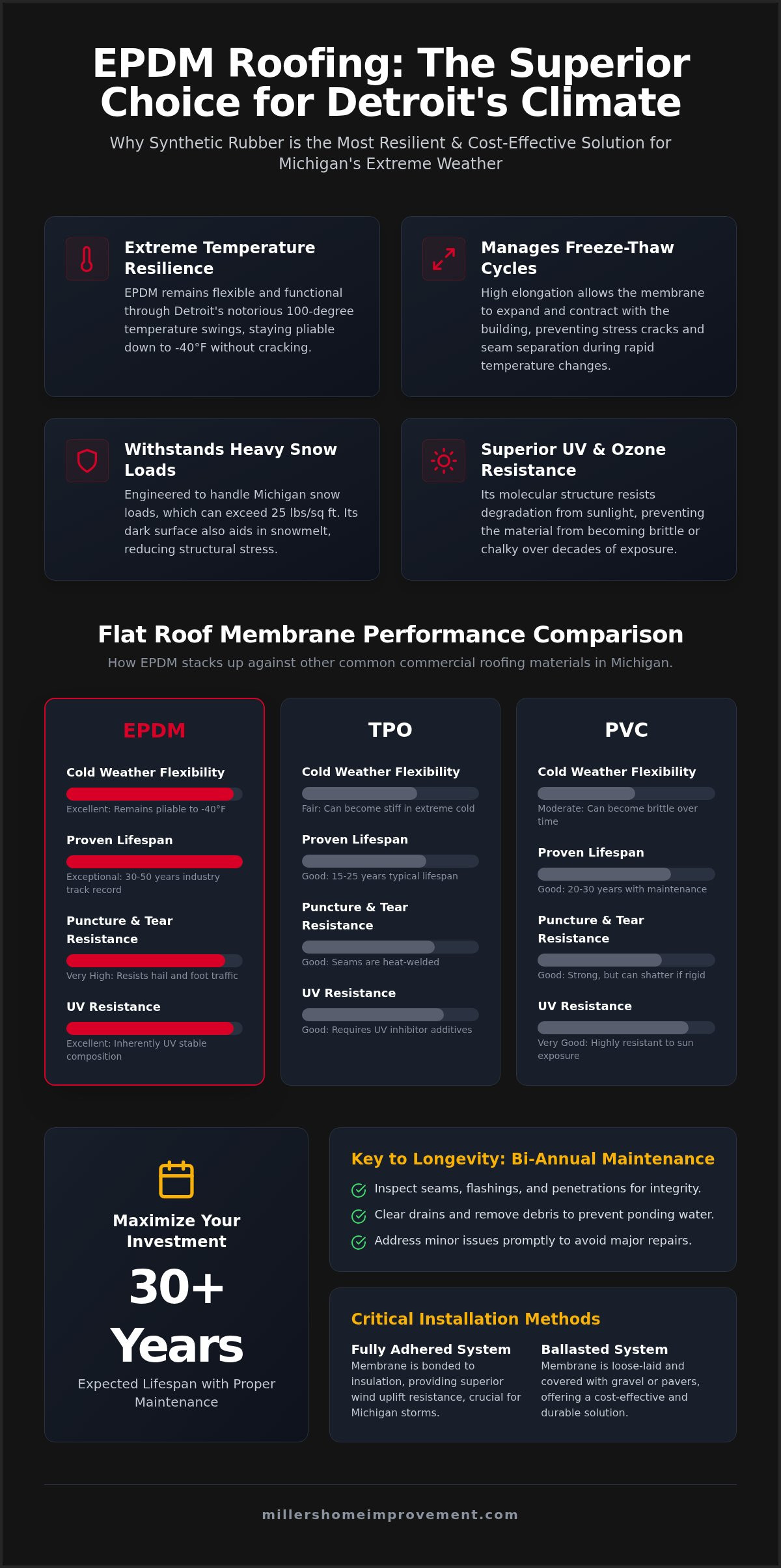
Detroit's weather isn't just a challenge; it's a test of material science. For facility managers, the choice of a roofing system can be the difference between a secure asset and a liability. Selecting a commercial EPDM roofing Detroit system ensures your building is protected by a material that remains pliable at temperatures as low as -40 degrees Fahrenheit. While rigid membranes might crack under the strain of a Michigan winter, EPDM's rubber composition allows it to stretch. This flexibility is vital when you consider that ground snow loads in our region can reach 25 pounds per square foot or higher in severe winters.
Managing the Freeze-Thaw Cycle
The most dangerous time for a flat roof in Southeast Michigan is the transition between winter and spring. Rapid temperature swings cause materials to expand and contract multiple times in a single day. This thermal shock often causes seams to separate in inferior systems. However, high-quality EPDM roofing systems are engineered for high elongation, meaning they move with the building's structure. Professional installation is mandatory to ensure proper drainage, as ponding water that freezes can create ice dams. These dams put immense pressure on the roof deck, but EPDM's high puncture resistance helps mitigate the risk of leaks during these critical periods.
UV Resistance and Heat Absorption
There is a common misconception that black roofing is always a disadvantage. In Detroit, the dark surface of a standard EPDM membrane actually assists with snow melt during the sunny but cold winter months. This can reduce the weight of snow accumulation on your facility's structure. For buildings in Macomb County that face intense summer sun, EPDM's resistance to UV radiation prevents the membrane from becoming brittle. You might also consider ballasted systems, where a layer of river rock protects the membrane from direct exposure and physical damage. This added layer of defense is particularly useful for Michigan storm restoration, as it provides a buffer against hail and wind-blown debris. Investing in a commercial EPDM roofing Detroit solution provides the peace of mind that your facility can handle whatever the Great Lakes throw at it.
If you're concerned about how your current roof will handle the next season, getting a free professional estimate can help you identify potential vulnerabilities before they become expensive failures.
EPDM vs. PVC and TPO: Selecting the Right Membrane
Facility managers in Southeast Michigan typically choose between three single-ply membranes: EPDM, TPO, and PVC. Each material has its place, but the long-term performance data often favors rubber for our local climate. When you evaluate a commercial EPDM roofing Detroit project, you must consider how the system is secured to your building. There are three primary installation methods. Fully adhered systems involve bonding the membrane directly to the insulation using specialized adhesives. This is the most wind-resistant option. Ballasted systems use large river rocks to hold the membrane in place, which is cost-effective and provides a natural fire barrier. Mechanically attached systems use heavy-duty fasteners and plates to secure the rubber to the structural deck.
According to the EPDM Roofing Association (ERA), the material's ability to withstand environmental stress is one of its most significant advantages. While PVC is often praised for its chemical resistance, it typically requires a higher initial investment than EPDM. TPO has gained market share recently, yet it lacks the proven track record of synthetic rubber which has been in use since the 1960s. In northern climates, EPDM's ability to absorb solar heat can be a distinct advantage for snow management, as the dark surface helps accelerate melting during the winter months.
Durability and Puncture Resistance
EPDM membranes are available in various thicknesses, typically ranging from 45 mil to 90 mil. These sheets are exceptionally resilient against rooftop foot traffic, which is common during HVAC maintenance or equipment inspections. Thermoplastic membranes like PVC can become brittle over time as plasticizers leach out, making them prone to cracking under physical stress. In contrast, EPDM's molecular structure remains stable. While heat-welded PVC seams provide immediate strength, the chemical bonding of modern EPDM seam tapes ensures that the joints remain as flexible and durable as the membrane itself throughout its entire service life.
Lifecycle Cost Analysis for Detroit Owners
A smart investment looks past the installation date to the total cost of ownership. EPDM systems are famously easy to maintain. If a puncture occurs, a simple primer and patch kit can resolve the issue without the need for expensive heat-welding equipment. This simplicity reduces long-term operational costs significantly over the system's 20 to 30 year lifespan. Most EPDM membranes are also 100% recyclable at the end of their service life, which helps your facility meet modern sustainability goals. For a standard warehouse or industrial facility in Detroit, the combination of a lower entry price and long-term reliability makes EPDM a logical financial choice.
Maximizing the Lifespan of Your Detroit Commercial Roof
A 30-year lifespan for a flat roof is not a guarantee; it's the result of a disciplined maintenance strategy. As a facility manager, you're responsible for an asset that faces constant environmental pressure. The 'Seasoned Master Craftsman' approach to commercial EPDM roofing Detroit projects prioritizes prevention over reaction. By identifying minor issues like seam stress or perimeter shrinkage early, you avoid the cascading costs of structural water damage. In Southeast Michigan, bi-annual inspections are non-negotiable. These checks should occur in late spring to assess winter damage and in late fall to prepare for the coming snow loads.
Early warning signs on a rubber roof are often subtle. You might notice "bridging," where the membrane pulls away from the base of a wall, or slight gaps in the seam tape. These issues are easy to resolve if caught during a routine walk-through. However, if left unaddressed, they become entry points for moisture that can saturate your insulation and compromise the building's energy efficiency. We focus on transparency, helping you understand which issues require immediate attention and which can be monitored over time.
The Proactive Maintenance Checklist
Maintaining a commercial facility requires a methodical eye. To keep your system functional, follow these specific steps during your seasonal inspections:
- Clear all drains and scuppers: Ponding water is the primary enemy of any flat roof. Debris like leaves and urban grit can clog drainage points, leading to thousands of pounds of unnecessary weight on your structure.
- Inspect HVAC and skylight flashings: Most leaks don't occur in the field of the roof but at the penetrations. Check that the seals around heavy rooftop units remain tight and pliable.
- Check for perimeter shrinkage: Over decades, EPDM can experience minor shrinkage. Ensure the membrane is still securely fastened at the roof edges to prevent wind uplift.
Handling Insurance Claims and Restoration
Michigan storms can be unpredictable, bringing high winds and hail that test even the most durable systems. When damage occurs, prompt action is critical to protect your interior assets and equipment. Miller's Home Improvement assists facility managers by providing detailed storm damage assessments that satisfy the requirements of commercial insurance adjusters. Professional documentation, including clear photos and technical descriptions of material failure, is essential for securing an insurance-funded replacement. You should never wait for a visible ceiling leak to call a professional. By then, the internal damage is often already extensive.
If you suspect your facility has sustained damage from recent weather events, we can provide a free professional estimate to document the condition of your membrane and help you navigate the restoration process.
Professional EPDM Installation with Miller's Home Improvement
Choosing the right material is only half the battle; the success of your facility's roof depends entirely on the skill of the installers. Miller's Home Improvement brings over 25 years of owner experience to every commercial EPDM roofing Detroit project. We understand that a commercial installation is a significant investment that requires a disciplined, methodical approach. Our team focuses on meticulousness at every stage, ensuring that each seam is sealed and every flashing is secured to withstand Michigan's volatile weather. We prioritize the safety of your property and the integrity of our reputation above all else.
Our process is designed to lead you from a state of concern to a state of informed resolution. It begins with a comprehensive site assessment and moves through a transparent estimation phase where we explain the practical benefits of different system configurations. During the installation, we maintain a clean and organized job site to minimize disruption to your daily operations. We conclude every project with a rigorous final inspection to verify that the work meets our high standards for durability and craftsmanship. Being a fully licensed and insured local contractor means we carry the responsibility for the project's safety, protecting you from the liabilities often associated with unseasoned or uninsured crews.
The Miller's Difference: Local Expertise
Eric Miller's hands-on ownership ensures that project integrity is never sacrificed for speed. We operate as a "Seasoned Master Craftsman," providing a level of personal attention that distant corporate entities cannot match. Serving Detroit, Macomb County, and the surrounding communities for over 13 years has given us a deep understanding of local building codes and environmental challenges. We believe in straightforward communication and realistic timelines. You'll always know exactly where your project stands, as we prioritize transparency and steady progress over high-pressure sales tactics.
Getting Started with Your Commercial Estimate
Preparing for a professional roof assessment is the first step toward long-term peace of mind. When we arrive for an on-site consultation, we look beyond the surface of the membrane to evaluate the condition of the underlying deck and insulation. This thoroughness allows us to provide an accurate estimate that accounts for all necessary repairs and code requirements. We encourage facility managers to provide access to maintenance records or previous repair history, which helps us identify recurring problem areas. Taking a proactive stance today prevents the emergency repairs of tomorrow. You can request your free commercial roofing estimate today to begin the process of securing your facility with a reliable, high-performance EPDM system.
Securing Your Facility for the Decades Ahead
Choosing a roofing system for a Detroit facility is about more than just covering a building; it's about ensuring your operations remain uninterrupted through every polar vortex and summer heatwave. EPDM's synthetic rubber composition offers the specific flexibility needed to handle Michigan's extreme thermal swings while remaining one of the most budget-friendly options over its long lifecycle. By prioritizing bi-annual inspections and choosing a partner with deep local roots, you can successfully extend your roof's service life beyond 30 years.
Investing in a commercial EPDM roofing Detroit system requires a contractor who understands the unique building codes and weather patterns of Southeast Michigan. Miller's Home Improvement brings over 25 years of owner experience to every project. We are fully licensed and insured, specializing in both meticulous new installations and expert storm damage restoration. Our goal is to provide the stability and transparency you need to manage your property with confidence. Schedule Your Free Commercial EPDM Roofing Estimate today to protect your building's future. We look forward to serving as your trusted local partner.
Frequently Asked Questions
How long does a commercial EPDM roof typically last in Detroit?
EPDM roofing systems have an expected lifespan of 20 to 30 years in the Michigan climate. This longevity depends heavily on the quality of the initial installation and the consistency of seasonal maintenance. Because the material remains flexible during extreme temperature swings, it avoids the brittleness that causes other membranes to fail. Regular inspections help identify minor seam issues before they compromise the underlying structure, ensuring the roof reaches its full potential.
Is EPDM roofing more expensive than TPO or PVC?
EPDM typically offers a lower initial investment compared to PVC membranes. While TPO is often priced competitively, EPDM remains a cost-effective choice for many facility managers due to its long-term durability and lower maintenance requirements. When you evaluate a commercial EPDM roofing Detroit project, you should consider the total lifecycle cost. The simplicity of rubber roof repairs often results in lower operational expenses over several decades compared to thermoplastic alternatives.
Can EPDM roofing be installed during the Michigan winter?
Yes, installation is possible during the winter, though it requires specific technical adjustments. Solvent-based adhesives used in fully adhered systems have temperature limitations, so contractors often use ballasted or mechanically attached methods when temperatures drop below freezing. A seasoned craftsman understands how to manage material storage and application techniques to ensure the membrane bonds correctly. We take extra care during cold-weather projects to maintain the integrity of every seam and seal.
What is the difference between a ballasted and a fully adhered EPDM system?
A ballasted system uses large river rocks or pavers to hold the membrane in place without fasteners or glue. This method is fast to install and provides excellent fire resistance. A fully adhered system involves bonding the rubber sheet directly to the insulation using specialized adhesives. This creates a highly wind-resistant surface that is ideal for buildings in open areas. Both systems are effective, but the choice depends on your building's structural load capacity.
How do I know if my flat roof needs a repair or a full replacement?
The decision usually depends on the age of the membrane and the condition of the underlying insulation. If your roof is over 20 years old and experiencing frequent leaks in multiple areas, a replacement is likely more cost-effective. However, isolated punctures or minor seam separations can often be resolved with a professional repair. We look for signs of saturated insulation or widespread membrane shrinkage during our assessments to provide an honest recommendation.
Does EPDM roofing come in colors other than black?
While black is the traditional choice for its heat-absorption benefits in northern climates, white EPDM is also available. These reflective membranes are designed to reduce cooling costs during the summer by reflecting UV radiation. In Detroit, many facility managers stick with black membranes because they assist with snow melt during the winter. We can help you weigh the energy-efficiency benefits of each color based on your building's specific heating and cooling needs.
What kind of maintenance does a rubber roof require in Southeast Michigan?
Proactive maintenance focuses on keeping the drainage system clear and inspecting critical transition points. You should clear debris from drains and scuppers at least twice a year to prevent ponding water. It's also important to check the sealants around HVAC units, pipes, and perimeter flashings. These areas are prone to stress during Michigan's freeze-thaw cycles. Small investments in routine maintenance prevent the large-scale water damage that often follows a neglected roof.
How does EPDM handle the heavy snow loads common in Detroit?
EPDM is exceptionally well-suited for heavy snow because it remains pliable in sub-zero temperatures. Michigan snow loads can reach 25 pounds per square foot, putting immense pressure on flat surfaces. The material's elasticity allows it to distribute this weight without cracking or tearing. Additionally, the dark surface of standard EPDM helps absorb solar heat. This heat transfer facilitates faster snow melt, which reduces the duration of heavy loads on your facility's structural deck.


