
In Michigan, a flat roof isn't just a building component; it's a structural shield against five months of relentless ice and heavy snow. If you're managing a property in Detroit or the surrounding areas, you've likely felt the frustration of recurring leaks or the sting of high cooling bills in July. Choosing between EPDM vs PVC roofing Michigan is one of the most critical decisions you'll make for your building's long-term health. While both systems have their merits, the most common choice isn't always the right one when you're facing the extreme freeze-thaw cycles of our local climate.
We understand that a new roof is a major investment. You deserve the peace of mind that comes with a system designed to last 20 plus years without constant repairs or premature failure. This guide examines the critical differences between these two materials, focusing on seam integrity, maintenance costs, and weather resistance. We'll look at how each system handles ice damming and which one provides the best thermal performance for our region. By the end, you'll have a clear, expert perspective on which flat roof system truly wins for Michigan property owners.
Key Takeaways
- Understand why standard roofing materials fail on low-slope Michigan buildings and how single-ply membranes provide the necessary protection against heavy snow.
- Learn about the long-term reliability of EPDM synthetic rubber and why it remains a durable, time-tested choice for residential flat roofs and garages.
- Compare the installation methods of EPDM vs PVC roofing Michigan to see how heat-welded seams create a monolithic, leak-proof barrier for commercial properties.
- Discover the specific maintenance requirements and expected lifespans for both systems to ensure your roof protects your investment for over 20 years.
- Get expert recommendations on which material best suits your specific building type, from Detroit home additions to large-scale industrial facilities.
The Flat Roof Challenge: Why Southeast Michigan Demands Better Materials
Southeast Michigan presents a unique set of challenges for any building structure. While traditional asphalt shingles work well for the pitched roofs of suburban homes, they're fundamentally ill-suited for the low-slope or flat surfaces common in Detroit's commercial districts and residential additions. On a flat surface, shingles can't shed water effectively. This leads to moisture infiltration, rot, and eventual structural failure. This is where Membrane roofing systems become essential for property protection. When evaluating EPDM vs PVC roofing Michigan property owners must look beyond the surface to understand how these "single-ply" materials function. EPDM is a synthetic rubber, while PVC is a reinforced thermoplastic. Both are designed to create a continuous waterproof barrier, but their performance varies significantly under our local weather conditions.
Seam integrity is the primary metric we use to judge a flat roof's success. Whether it's the adhesive-bonded edges of a rubber roof or the heat-welded joints of a plastic system, the point where two sheets meet is where most leaks originate. In our climate, these seams are under constant assault. If the seams fail, the entire system fails, regardless of how durable the rest of the membrane remains.
Understanding the Freeze-Thaw Cycle in Detroit
In areas like Macomb County, the freeze-thaw cycle is a roof's greatest enemy. During a typical Michigan winter, snow melts during the day and refreezes at night. If water becomes trapped in a roof's seams, it expands as it turns to ice. This expansion exerts immense pressure, literally tearing membranes apart at their weakest points. Heavy snow loads add another layer of stress, pushing down on the structure and potentially creating "ponding" water areas where the roof deck has slightly settled. If your roofing material lacks superior seam integrity, these small pools of water eventually find a way into your building interior, causing hidden damage that's expensive to remediate.
The Role of UV Exposure and Thermal Shock
Michigan weather is famous for its volatility. It isn't uncommon to see a 40-degree temperature swing within a single 24-hour period. This creates "thermal shock," where the roofing material must rapidly expand and contract. We call this the roof's ability to "breathe." If a material is too rigid or has aged poorly, it'll crack under this stress. Material flexibility is non-negotiable for longevity in our region. A roof that can't handle the stretch and pull of a Detroit July and a sub-zero January won't last the 20 years you expect.
The choice of color also plays a role in how the system manages heat and energy efficiency:
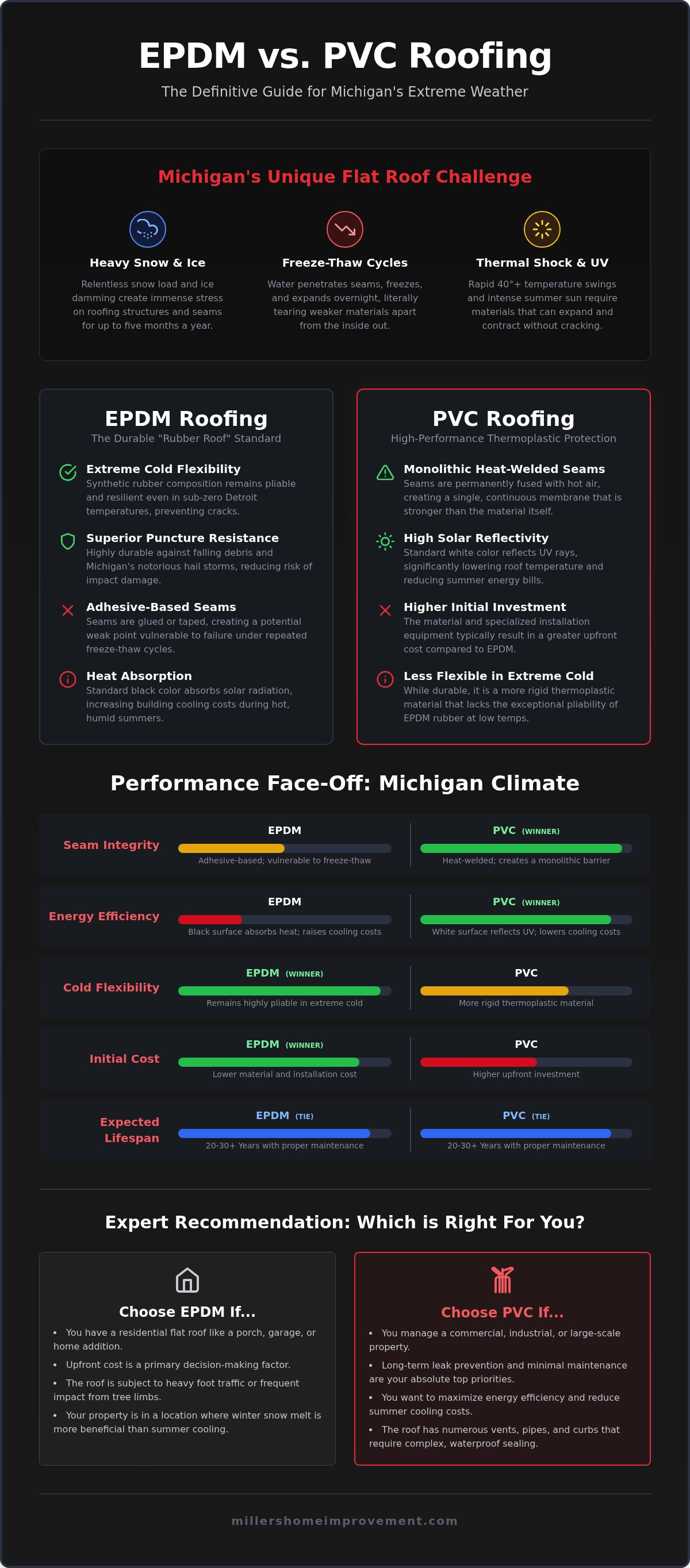
- Black EPDM: These membranes absorb solar heat. This helps melt snow in winter but can lead to higher cooling costs during our humid 100-degree summer days.
- White PVC: These systems reflect UV rays. This keeps the building cooler and reduces the physical strain caused by extreme thermal expansion.
EPDM Roofing: The Durable "Rubber Roof" Standard
EPDM, technically known as Ethylene Propylene Diene Terpolymer, is a synthetic rubber membrane that's protected Midwest buildings for over 40 years. It's often referred to simply as a "rubber roof." This material is prized for its extreme durability and its ability to withstand the heavy impact of Michigan hail storms without puncturing. Unlike other materials that might crack under pressure, EPDM remains pliable and resilient. When weighing EPDM vs PVC roofing Michigan contractors often point to EPDM’s long history of reliable performance in the harsh Great Lakes environment.
The installation process typically involves large, continuous rolls of rubber. These rolls can be up to 50 feet wide, which allows us to cover many residential porches or small commercial additions with very few seams. Fewer seams generally mean fewer opportunities for water to find its way inside. However, these membranes rely on specialized adhesives and seam tapes rather than heat welding. This makes the skill of the installer the most important factor in the roof's eventual success.
The Pros of EPDM for Michigan Homeowners
For many property owners, EPDM is the most cost-effective solution for a flat roof replacement. It offers a lower initial price point than thermoplastic options while still providing decades of protection. One of its standout features is extreme cold flexibility. Even when Detroit temperatures drop well below zero, the rubber stays pliable. It won't become brittle or shatter like older built-up roofs might. Additionally, repairs are straightforward. If a fallen branch causes a minor puncture, a master craftsman can often patch the area without needing specialized heat-induction tools, making maintenance relatively simple and affordable.
The Seam Vulnerability: A Master Craftsman’s Warning
While the rubber itself is nearly indestructible, the seams are the "weakest link" in any EPDM system. These joints are held together by chemical bonds or heavy-duty tapes. In the high humidity of a Michigan summer, meticulous surface preparation is mandatory. If the installer doesn't clean and prime the edges perfectly, the adhesive will eventually fail. We also watch closely for "bridging," which occurs when the membrane isn't properly tucked into corners. Over time, the rubber pulls tight, creating a hollow gap that's easily punctured or torn. While EPDM is durable, it lacks the reflective properties of white membranes. The EPA provides extensive research on Cool Roofs to Reduce Heat Islands, noting that reflective surfaces can significantly lower building temperatures. If you're worried about your current roof's integrity, scheduling an expert flat roof inspection is the best way to catch seam issues before they turn into indoor floods.
PVC Roofing: High-Performance Protection and Efficiency
While EPDM is a reliable standard for many residential projects, PVC (Polyvinyl Chloride) represents the high-performance tier of the single-ply roofing market. It's a reinforced thermoplastic membrane that combines extreme durability with modern energy efficiency. The core of its strength lies in the internal reinforcement scrim. This woven polyester fabric is embedded between the top and bottom layers of the material, providing exceptional dimensional stability. This means the roof won't stretch or tear when subjected to the weight of several feet of Michigan snow or the high winds that frequently sweep across the Detroit River. When comparing EPDM vs PVC roofing Michigan, the most striking physical difference is how the sheets are joined together to form a waterproof barrier.
The Power of Heat-Welded Seams
In the previous sections, we discussed how rubber systems rely on adhesives that can eventually degrade. PVC takes a completely different approach. Using specialized hot-air welding equipment, we fuse the sheets together at approximately 1,000 degrees Fahrenheit. This process creates a molecular bond, essentially turning individual rolls of material into one single, monolithic sheet. A properly welded seam is actually stronger than the membrane itself. For Detroit building owners, this eliminates the risk of "glue failure" or tape peeling, which are the most common causes of flat roof leaks in our region. It's a permanent solution that doesn't rely on the long-term integrity of a chemical bond.
Energy Efficiency and Cool Roof Technology
PVC is naturally white, which makes it a "cool roof" by design. In a typical Michigan summer, a black rubber roof can reach temperatures exceeding 160 degrees. In contrast, a white PVC membrane reflects up to 80% of solar radiation, staying significantly cooler to the touch. This drastically reduces the thermal load on your HVAC system, keeping commercial interiors comfortable while lowering monthly energy bills. It's a proactive way to manage overhead costs for businesses in Macomb County and beyond.
Beyond energy savings, PVC offers a specific advantage that rubber cannot match: chemical resistance. This is a critical factor for Detroit’s restaurant owners and industrial facility managers. Standard rubber membranes will swell and degrade when exposed to animal fats or petroleum-based chemicals. PVC remains stable, making it the ideal choice for several specific applications:
- Commercial Kitchens: Resists damage from grease and oil exhaust vents.
- Manufacturing Plants: Stands up to industrial chemical exposure and airborne pollutants.
- Hospitality Venues: Provides a clean, professional aesthetic that stays bright over time.
This chemical immunity ensures that your roof won't fail prematurely just because of the nature of your business operations.
The Head-to-Head: EPDM vs. PVC for Michigan Weather
When we look at the raw data for EPDM vs PVC roofing Michigan, the decision often comes down to a trade-off between initial longevity and ongoing maintenance. EPDM is a marathon runner, with a material lifespan that can stretch to 35 years. PVC typically serves a building for 20 to 30 years. However, those extra years with EPDM come with a caveat: you must be diligent about seam inspections. Because rubber relies on adhesives, the freeze-thaw cycles of Southeast Michigan will eventually test those bonds. PVC is more of a "set and forget" system due to its fused seams, which don't require the same level of periodic re-gluing.
Installation timing is another factor. Michigan's humidity and sudden rain showers can ruin an EPDM adhesive bond if the installer isn't careful. PVC welding is slightly more versatile in varying conditions, but both systems require a craftsman who knows how to work within our state's narrow weather windows. From an aesthetic standpoint, black EPDM is often preferred for residential porches to match traditional architecture, while white PVC offers a clean, industrial look that's becoming the standard for modern Macomb County facilities.
Snow Removal and Puncture Resistance
If you're clearing heavy snow from a flat roof in Detroit, the material under your feet matters. PVC’s reinforced scrim provides a level of puncture resistance that makes it much safer to use a plastic snow shovel. Older EPDM membranes can lose their elasticity after a decade of UV exposure. In sub-zero temperatures, an old rubber roof can actually "shatter" or develop star-shaped cracks if struck by a heavy ice chunk or a shovel blade. Ponding water is another local reality. While both materials are waterproof, standing water eventually finds the path of least resistance. In EPDM systems, that path is usually a microscopic gap in a seam adhesive that has been weakened by years of ice expansion.
The Environmental Impact in the Great Lakes Region
Sustainability is a growing concern for Detroit property owners. PVC is frequently recyclable at the end of its service life, whereas EPDM often ends up in landfills. White "Cool Roofs" also help mitigate the urban heat island effect in downtown areas, keeping the entire neighborhood slightly cooler during the peak of summer. Thermal bridging is the process where heat bypasses your insulation through conductive components like metal fasteners, leading to significantly higher heating bills during our sub-zero winters. If you're unsure which system fits your building's structural needs, you can request a professional roof assessment to identify potential vulnerabilities before winter arrives.
Making the Right Choice for Your Property
Deciding between EPDM vs PVC roofing Michigan property owners often find themselves weighing immediate costs against long-term performance. There isn't a universal best material. Instead, there's a best material for your specific building, usage, and budget. At Miller's Home Improvement, we utilize a disciplined assessment process we call the Miller's Methodology. We don't just look at the surface of your roof. Our process includes a complete roof tear-off to inspect the underlying wood deck for rot or structural weaknesses. We also evaluate your current drainage patterns to ensure that ponding water won't compromise your new investment before the next Detroit winter arrives.
When to Choose EPDM
EPDM is often the superior choice for residential applications where the roof isn't the primary focal point of the home. If you're looking to protect a detached garage or a small porch addition on a budget, synthetic rubber provides excellent value. It's particularly useful for structures with complex shapes or numerous penetrations that aren't easily heat-welded. If your primary goal is a durable, waterproof barrier that stays flexible in the cold without a premium price tag, EPDM remains the industry standard for residential flat surfaces.
When PVC Is the Essential Choice
PVC is the standard for Macomb County businesses that prioritize energy efficiency and low maintenance. If you own a restaurant or an industrial facility, the chemical resistance of PVC is non-negotiable. It's the "set it and forget it" solution for owners who want to avoid the periodic seam maintenance associated with rubber systems. While the upfront investment is higher, the reduction in cooling costs and the peace of mind provided by monolithic, heat-welded seams result in a lower total cost of ownership over 20 years.
Why Miller’s Home Improvement Is Detroit’s Flat Roof Expert
Choosing the right material is only half the battle; the installation determines the outcome. Eric Miller brings over 25 years of hands-on skill to every project, ensuring that your roof is installed with the meticulousness of a master craftsman. Our team has spent 13 years serving Southeast Michigan, developing a deep understanding of how our local weather impacts different membranes. We take pride in doing the job correctly the first time, protecting your property's integrity and your peace of mind. Before making your final decision, consider this checklist:
- Longevity: Do you need 20 years or 30 plus years of service?
- Energy Goals: Is summer cooling a significant expense for your building?
- Maintenance: Are you willing to perform periodic seam inspections?
- Budget: Are you prioritizing the lowest initial cost or the lowest lifetime cost?
Schedule your free flat roof estimate in Southeast Michigan today!
Securing Your Michigan Property for the Decades Ahead
Choosing between EPDM vs PVC roofing Michigan requires a clear understanding of your building's specific needs and your long-term maintenance goals. While EPDM provides a time-tested and budget-friendly shield for residential structures, PVC offers the monolithic protection of heat-welded seams and high-performance energy savings for commercial facilities. Both systems are capable of withstanding our state's brutal winters if they're installed with precision. The right choice will ultimately provide you with a leak-free roof that lowers your maintenance costs and protects your property's value for over 20 years.
Miller’s Home Improvement brings over 25 years of owner experience to every project. As a fully licensed and insured Michigan contractor with an A+ rated local reputation, we focus on providing stable, leak-free results that protect your investment. We don't just install a membrane; we ensure your entire roof deck is prepared to handle the weight of the coming snow. You can move forward with confidence knowing your property is in expert hands. Get Your Free Flat Roof Estimate from Miller’s Home Improvement and take the first step toward a more durable, weather-resistant building.
Frequently Asked Questions
How long does an EPDM roof last in Michigan?
An EPDM roof typically lasts between 25 and 30 years in Michigan's climate. Its synthetic rubber composition allows it to remain flexible during extreme temperature swings, which is vital for Detroit winters. However, the actual longevity depends heavily on the quality of the seam installation and regular maintenance. Over time, UV exposure can cause the material to lose elasticity, so periodic inspections are necessary to ensure the adhesive bonds remain secure against snow and ice.
Is PVC roofing more expensive than rubber roofing?
PVC roofing generally requires a higher initial investment than EPDM rubber roofing. This is due to the reinforced thermoplastic membrane and the specialized heat-welding equipment needed for installation. While the upfront cost is greater, many Macomb County property owners find that the long-term value is higher. The fused seams and superior energy efficiency often lead to lower maintenance costs and reduced cooling bills over the system's 20 to 30 year lifespan.
Can you install a new flat roof over an old one in Detroit?
Michigan building codes permit a maximum of two roofing layers on a single structure. If your building already has two layers, a complete roof tear-off is mandatory before a new system can be installed. We typically recommend a full tear-off regardless of the layer count. This allows us to inspect the underlying wood deck for rot or structural damage that could compromise the integrity of your new EPDM vs PVC roofing Michigan installation.
What is the best color for a flat roof in Michigan?
The best color depends on your property's primary energy needs. Black EPDM helps melt snow and ice during harsh Michigan winters by absorbing solar heat. Conversely, white PVC is a "cool roof" material that reflects up to 80 percent of UV rays, significantly reducing cooling loads in the summer. For commercial buildings in downtown Detroit with high HVAC costs, white is often the preferred choice to mitigate the urban heat island effect.
Does a flat roof need special insulation for Michigan winters?
Flat roofs in Michigan must meet specific R-value requirements for thermal resistance under current building codes. We often install rigid polyisocyanurate insulation boards beneath the membrane to prevent heat loss. Proper insulation is critical for preventing ice damming and reducing "thermal bridging," where heat escapes through the structural components. This layer ensures your building stays warm during sub-zero January nights while protecting the roof membrane from internal temperature fluctuations that cause cracking.
How do I know if my flat roof seams are failing?
You can identify failing seams by looking for visible lifting, peeling, or "fish-mouthing" at the edges where membrane sheets meet. In EPDM systems, the adhesive may become brittle or crack, allowing moisture to seep underneath. You might also notice bubbling or soft spots in the membrane, which indicate that water is trapped between the layers. If you see ponding water sitting directly over a seam for extended periods, it's time for a professional assessment.
Which material is better for a roof that has ponding water?
PVC is the superior choice for roofs prone to ponding water because of its heat-welded seams. These seams create a permanent, molecular bond that is essentially waterproof and stronger than the membrane itself. While EPDM is also waterproof, its adhesive-based seams are more vulnerable to the constant pressure and freeze-thaw cycles of standing water. Regardless of the material, we prioritize repairing the underlying roof deck to improve drainage and eliminate ponding altogether during installation.
Are there tax credits for installing a PVC "Cool Roof" in Michigan?
Federal tax credits and local utility rebates are frequently available for energy-efficient "cool roof" installations like white PVC. These incentives are designed to encourage property owners to reduce their carbon footprint and lower energy consumption. While specific programs change, many Detroit businesses qualify for deductions under Section 179D for energy-efficient commercial buildings. You should consult with a tax professional to verify current eligibility for your specific Southeast Michigan property and your chosen roofing system.


