
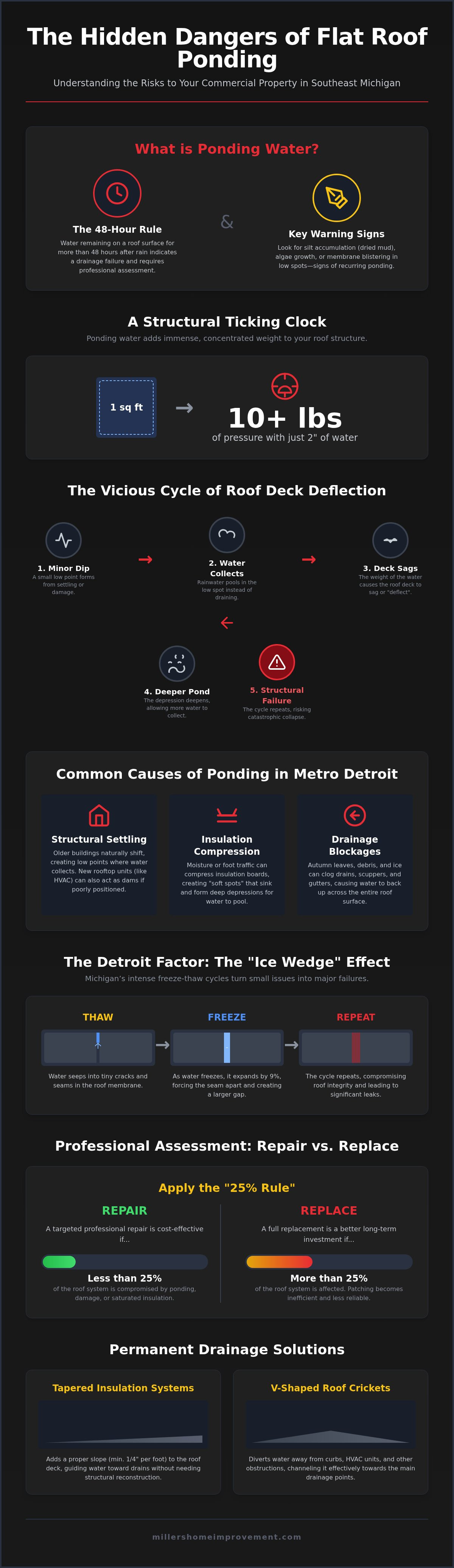
Did you know that just two inches of ponding water adds over 10 pounds of pressure per square foot to your roof structure? For a building owner in Southeast Michigan, this isn't just a maintenance oversight; it's a structural ticking clock that accelerates during our intense freeze-thaw cycles. When you're searching for flat roof ponding repair Detroit, you aren't just looking to clear a puddle. You're looking to protect your property from the cumulative weight of winter snow and heavy spring rains that can turn a minor dip into a serious safety risk.
It's exhausting to deal with recurring leaks or receive conflicting advice on whether to patch a spot or replace the entire system. You deserve the peace of mind that comes from a dry, properly sloped roof that actually sheds water as intended. This guide will help you identify the root causes of standing water and understand why professional flat roof ponding repair Detroit offers a better return on investment than temporary fixes. We'll examine the risks of structural sagging, the requirements of the Michigan Building Code, and the long-term benefits of high-performance membranes like PVC and EPDM.
Key Takeaways
- Learn why water sitting for over 48 hours indicates a need for flat roof ponding repair Detroit and how maintaining a proper pitch prevents long-term structural decay.
- Identify how structural settling in older Metro Detroit buildings and compressed insulation create the low points that trap standing water.
- Discover how tapered insulation systems and V-shaped roof crickets provide permanent drainage solutions without the need for a full deck reconstruction.
- Understand the "Ice Wedge" effect and how Michigan’s intense freeze-thaw cycles can expand seams and compromise your roof's integrity.
- Apply the "25% rule" to accurately assess whether your current drainage issues require a targeted professional repair or a more cost-effective full replacement.
What is Roof Ponding and When Does it Require Repair?
Ponding water is standing water that remains on a roof surface for longer than 48 hours after precipitation. While the term "flat" is common, these systems are technically low-slope roofs. To function correctly, they require a minimum pitch of 1/4 inch per foot to guide water toward drains or gutters. You can learn more about these design fundamentals by reading about What is a Flat Roof? and how its geometry affects drainage. It's vital to differentiate between incidental moisture and structural ponding. Incidental moisture is the temporary dampness seen immediately after a Detroit rainstorm. Structural ponding occurs when the roof's geometry or drainage system fails, leaving pools that linger long after the sun comes out. If you notice these pools sticking around, it's time to consider professional flat roof ponding repair Detroit to prevent deeper issues.
The 48-Hour Rule for Detroit Property Owners
The first two days after a Michigan storm provide a critical window for observation. During this time, property owners should perform a visual inspection from a safe vantage point. If puddles remain after 48 hours of dry weather, the roof is no longer shedding water effectively. Look for secondary signs like silt accumulation, which appears as dried mud in specific spots, or green algae growth. These indicators suggest that water sits in those areas frequently, even if the roof happens to be dry during your inspection. Membrane blistering or "alligatoring" in these zones often signals that the underlying materials are beginning to degrade from constant saturation. These are clear warnings that the drainage system requires professional attention before the next heavy snowfall.
Why Standing Water is a Structural Threat
Water is deceptively heavy. One inch of ponding water adds approximately 5 pounds of weight to every square foot of your roof. In a large ponding area, this can translate to thousands of pounds of unintended stress on the building's frame. This concentrated weight often leads to "roof deck deflection," a condition where the deck begins to sag under the load. As the deck sags, it creates a deeper depression, which in turn collects more water. This creates a dangerous cycle where the problem literally grows heavier with every storm. If left unaddressed, this deflection can exceed the building’s original design limits, leading to cracked supports or a complete structural failure. Seeking timely flat roof ponding repair Detroit is the most reliable way to break this cycle and restore the integrity of your property.
Common Causes of Flat Roof Ponding in Metro Detroit
Detroit’s architectural history is a point of pride, but older commercial buildings naturally shift over decades. This structural settling often creates subtle low points that weren't present during the original construction. When these depressions form, they become natural collection points for rain and melting snow. Water finds every low spot. Beyond basic settling, new rooftop additions like HVAC units or skylights can inadvertently act as dams. If these units aren't properly flashed or positioned, they obstruct the natural flow of water toward the drains. Identifying these physical barriers is a standard part of any professional property damage assessment.
The Impact of Insulation Compression
Polyiso boards are standard in modern roofing. While durable, these insulation boards can break down under repeated stress or moisture infiltration. When the membrane develops a tiny pinhole, water seeps into the insulation and softens the core. This leads to "soft spots" that sink further when walked upon. Frequent foot traffic from maintenance crews accelerates this compression, turning a small dip into a deep bowl. When these boards fail, localized flat roof ponding repair Detroit becomes necessary to restore the roof's structural integrity. To prevent this, we often recommend high-density cover boards. These provide a rigid layer that distributes weight and protects the thermal insulation from collapsing.
Drainage Hardware and Scupper Blockages
Detroit’s climate presents unique challenges for drainage hardware. Debris is a constant threat. Autumn leaves and winter ice are the primary enemies of scuppers and gutters. When debris clogs these exits, water backs up across the entire roof surface. This saturation increases the risks of water damage to the building's interior. Effective drainage requires "sumped" drains, which are installed slightly lower than the surrounding membrane to ensure every drop exits the roof. We also look for properly installed overflow drains. These act as a critical safety net, providing a secondary path for water if the main drains become overwhelmed during a Michigan blizzard or summer downpour. Addressing these hardware failures is a core component of effective flat roof ponding repair Detroit.
Proven Strategies for Flat Roof Ponding Repair
Fixing standing water requires more than a simple patch; it requires a correction of the roof's geometry. In Detroit, where freeze-thaw cycles and winter risks are a constant factor, professional flat roof ponding repair Detroit often involves structural adjustments rather than just surface-level fixes. While older systems relied on heavy tar and gravel, modern solutions utilize lightweight, durable membranes like PVC or EPDM. These materials are engineered to withstand prolonged moisture contact, making them far superior for areas prone to minor dips. When the structural low point of a building has shifted significantly over time, we may even recommend drain relocation. This ensures that your plumbing actually aligns with where the water naturally gathers, rather than forcing the water to travel uphill toward an outdated drain placement.
Installing Tapered Insulation for Proper Slope
Tapered insulation is one of the most effective tools for correcting drainage issues. This system uses factory-cut foam boards that gradually increase in thickness to create a custom slope toward your drains. It's an ideal choice during a roof recovery because it eliminates "dead flat" spots without the massive expense of rebuilding the entire wooden or metal deck. Beyond fixing drainage, these boards provide a significant boost to your building's R-value. You'll notice improved energy efficiency and lower utility costs as a direct result of this repair, turning a structural necessity into a long-term financial benefit for your property.
The Role of Roof Crickets and Scuppers
Roof crickets are V-shaped diversions installed on the high side of rooftop equipment like HVAC units, chimneys, or large skylights. Their primary job is to split the flow of water and direct it around these obstacles. Without them, water hits the equipment curb and stops, creating a stagnant pool that eventually rots the flashing. At Miller’s, we also ensure that your scuppers are sized appropriately for the intense summer downpours common in Southeast Michigan. A scupper that's too narrow will quickly clog with debris, causing water to back up and sit on the membrane. Properly designed crickets prevent "dead water" zones behind rooftop equipment, ensuring every gallon of rain has a clear path to the exit. This meticulous approach to flat roof ponding repair Detroit is what separates a temporary fix from a permanent solution.
The Detroit Factor: Freeze-Thaw Cycles and Winter Risks
Detroit’s climate is uniquely punishing for low-slope structures. While summer rains are a concern, the real danger arrives when temperatures fluctuate around the freezing mark. This is where minor standing water transforms into a major structural threat. The "Ice Wedge" effect occurs when water seeps into a tiny gap in a seam and freezes. As the ice expands, it acts like a physical lever, slowly ripping apart the seams of EPDM or TPO membranes. During a heavy Michigan blizzard, these ponding areas also become the heaviest points on your roof. The accumulated weight of snow on top of existing ice can stress the deck to its breaking point.
Thermal shock adds another layer of risk. Detroit often experiences rapid temperature swings where a sunny afternoon is followed by a sub-zero night. This causes membranes to shrink and expand quickly, putting immense tension on the flashing and perimeter attachments. Many owners don't realize that summer ponding often leads to winter leaks. If water has already saturated your insulation, that moisture freezes and expands during the winter, often puncturing the roof membrane from the bottom up. To prevent these hidden failures, you can schedule a professional property damage assessment before the first snow hits.
Managing Lake-Effect Snow and Ice Dams
Ponding water near the roof's edge provides a perfect foundation for ice dams. These heavy blocks of ice prevent melting snow from reaching the gutters, forcing water back under the membrane. While it's tempting to clear the roof yourself, manual shoveling often results in accidental punctures. Professional steam or chemical de-icing is far safer for flat membranes. You should also avoid using standard rock salt on commercial roofs. Salt is highly corrosive to metal components and can prematurely dry out and crack many common roofing materials.
Thermal Expansion and Seam Integrity
Seam strength is your roof's primary defense against Detroit winters. We often prefer PVC or Torch Down systems for this reason; their heat-welded or melted seams provide a monolithic bond that resists the pulling forces of thermal expansion. During our inspections, we look closely for "alligatoring," which is a pattern of small cracks caused by UV exposure and ice damage. These cracks are the first sign that your membrane is losing its flexibility. A simple pre-winter inspection to clear drains and check seam integrity is the most effective way to avoid an emergency flat roof ponding repair Detroit in the middle of a January freeze.
Professional Assessment: When to Repair vs. Replace
Determining whether you need a localized fix or a full system overhaul depends on the extent of the damage. We follow the 25% rule: if more than a quarter of your roof surface experiences standing water, a targeted flat roof ponding repair Detroit might only be a temporary bandage. In these cases, a full replacement featuring a custom tapered insulation system is often more cost-effective over the long run. We don't just look at the membrane; we assess the structural deck. Our team checks for wood rot in residential structures or rusted metal in commercial buildings beneath the ponding zone. If the deck is compromised, simply adding a new layer won't solve the underlying instability.
The Miller’s Master Craftsman approach is built on 25 years of experience identifying the root cause of drainage failures. Sometimes, ponding isn't just a result of poor installation but stems from storm-related structural shifts or heavy snow loads that have warped the deck over time. We help document these issues for insurance restoration, ensuring you have the professional evidence needed to support your claim. By focusing on why the water is gathering, we provide solutions that last for decades rather than months. This level of detail is essential for effective flat roof ponding repair Detroit, as it prevents the same low spots from reappearing after a single season.
The Free Property Damage Assessment
When you request an inspection from Miller’s Home Improvement, you receive a thorough technical evaluation. We perform a moisture probe test to determine if your insulation is saturated or "toast." If the core of your roof is wet, it loses its thermal resistance and can lead to mold or structural decay. We provide a clear, no-nonsense estimate for both residential and commercial properties, outlining exactly what's needed to restore a proper slope. You'll understand the ROI of every recommendation before any work begins, allowing you to make an informed decision for your property's future.
Protecting Your Investment with Miller’s
Choosing a contractor who is fully licensed and insured in Michigan is the only way to protect yourself from liability and ensure quality. Our "done right the first time" philosophy is backed by over two decades of local expertise in Southeast Michigan. We understand the specific demands of our climate and the importance of meticulous workmanship in every seam and flashing. Schedule your free flat roof ponding assessment with Miller’s today.
Securing Your Property Against Standing Water
Standing water on a low-slope roof is a structural ticking clock. Observing the 48-hour rule is the most effective way to catch drainage issues before they lead to deck deflection or seam failure. In Southeast Michigan, the added stress of lake-effect snow and the "Ice Wedge" effect means that minor puddles can quickly become major liabilities. Addressing these concerns with a professional flat roof ponding repair Detroit ensures your building remains dry and structurally sound through every season.
With over 25 years of owner experience, Miller’s Home Improvement specializes in high-performance PVC, EPDM, and Torch Down systems designed to survive the harshest winters. We're a fully licensed and insured Michigan contractor committed to providing honest, transparent assessments that prioritize the long-term integrity of your roof. Don't let a small dip turn into a costly emergency.
Get Your Free Flat Roof Inspection & Ponding Repair Estimate today. Taking a proactive step now provides the peace of mind you need to face the next Detroit storm with confidence.
Frequently Asked Questions
Is it normal for a flat roof to have some standing water?
Standing water is only considered normal if it evaporates within 48 hours of rainfall. Industry standards require a minimum slope of 1/4 inch per foot to ensure proper drainage. If water lingers beyond two days, it indicates a structural or drainage failure that requires attention. Ignoring these pools can lead to membrane degradation and increased pressure on your building's frame, especially during heavy Michigan rain seasons.
How much does it cost to fix ponding water on a flat roof in Detroit?
The total investment for flat roof ponding repair Detroit depends entirely on the underlying cause. Simple fixes like clearing a scupper or replacing a drain cover are less involved than structural corrections. If the issue requires installing a tapered insulation system to create a new slope, the scope increases. We recommend a professional property damage assessment to identify the most cost-effective path for your specific roof deck and material.
Can I use a roof coating to fix ponding water?
Silicone or elastomeric coatings are designed to provide a waterproof barrier, but they aren't leveling agents. Applying a coating over a low spot doesn't fix the drainage issue; it just seals the puddle. Over time, the constant weight and UV magnification of the standing water will cause the coating to delaminate or flake away. You must correct the roof's pitch before applying any protective top layer for lasting results.
Will ponding water void my roofing warranty?
Most major roofing manufacturers include clauses that void the warranty if ponding water is present. Manufacturers view standing water as a design or maintenance failure rather than a defect in their membrane. If a leak occurs in a ponding area, the claim is often denied because the material wasn't intended for prolonged submersion. Keeping your roof dry is the best way to protect your long-term warranty coverage and investment.
What is the best material for a flat roof that gets a lot of water?
PVC and EPDM are the most reliable choices for high-moisture environments. PVC is particularly effective because its seams are heat-welded to create a single, continuous sheet that resists water penetration. EPDM is also highly durable and remains flexible during Detroit’s extreme temperature shifts. Both materials offer significantly better performance and longevity than traditional built-up or tar and gravel systems in areas prone to moisture collection.
How do I know if my flat roof is sagging or just has a low spot?
A surface low spot is often just an indentation in the insulation or a minor installation error. Sagging, or deck deflection, is a structural issue where the actual roof supports are bowing under weight. You can often identify sagging by checking the interior ceiling for cracks or looking for a bowl shape that deepens every year. Professional flat roof ponding repair Detroit is necessary to determine if you need structural reinforcement or just new insulation.
Can insurance cover flat roof ponding repair?
Insurance coverage generally depends on the cause of the damage. If a sudden storm event, such as a fallen limb or high winds, structurally altered your roof and created a low spot, it may be covered under a property damage claim. However, ponding caused by natural settling, poor original design, or lack of maintenance is typically considered an out-of-pocket expense. We help property owners document storm-related issues during our detailed roof inspections.
How often should I clean my flat roof drains in Michigan?
You should clean your drains and scuppers at least twice a year in Southeast Michigan. The most critical times are late autumn, after the leaves have fallen, and early spring to clear winter debris. Detroit’s heavy snow and ice can also trap silt and trash in your drainage hardware. Regular maintenance prevents the clogs that lead to standing water and protects your building from the weight of unexpected winter ponding.


