
That missing shingle from last night's high winds isn't just a cosmetic blemish; it's a structural ticking clock that threatens the integrity of your entire home. For many Michigan homeowners, the aftermath of a severe weather event brings a wave of anxiety about hidden leaks and the long-term safety of their property. Dealing with a storm damage roof replacement can feel overwhelming, especially when you're trying to distinguish between a minor repair and a necessary full restoration. You're likely worried about "storm chaser" scams or whether your insurance company will actually cover the cost of a roof that can withstand our brutal winters.
We understand that your home is your most significant investment, and you deserve a partner who values durability over a quick sale. In this guide, we'll show you how to identify the subtle signs of hail and wind damage that often escape the untrained eye. We'll also break down the latest 2026 Michigan building code requirements, such as mandatory ice and water shield protections, to ensure your new roof is built to last. This article provides a clear roadmap for navigating the insurance claim process and the confidence to choose a restoration path that protects your family for years to come.
Key Takeaways
- Identify the subtle signs of hail bruising and granule loss that often go unnoticed during a basic ground-level inspection.
- Learn the specific thresholds that determine if your home requires a targeted repair or a full storm damage roof replacement to maintain its value.
- Navigate the insurance restoration timeline effectively by capturing the right documentation within the first 48 hours after a weather event.
- Understand how 2026 Michigan building codes and high-impact materials provide superior protection against the weight of heavy snow and ice.
- Gain the tools to vet contractors properly, ensuring you work with a stable, local professional rather than an out-of-state "storm chaser."
The Threshold of Storm Damage: When to Repair vs. Replace
Deciding between a patch job and a full storm damage roof replacement isn't just about the visible holes. It's about the long-term structural integrity of your home. Michigan's severe weather events often leave a roof looking functional from the ground while it's actually compromised at the deck level. We often see homeowners attempt to save money with minor repairs, only to find that these patches act as expensive Band-Aids. If the damage is widespread, the labor costs of multiple repairs quickly approach the price of a more permanent solution that preserves your home's value.
The 25% Rule and Michigan Building Codes
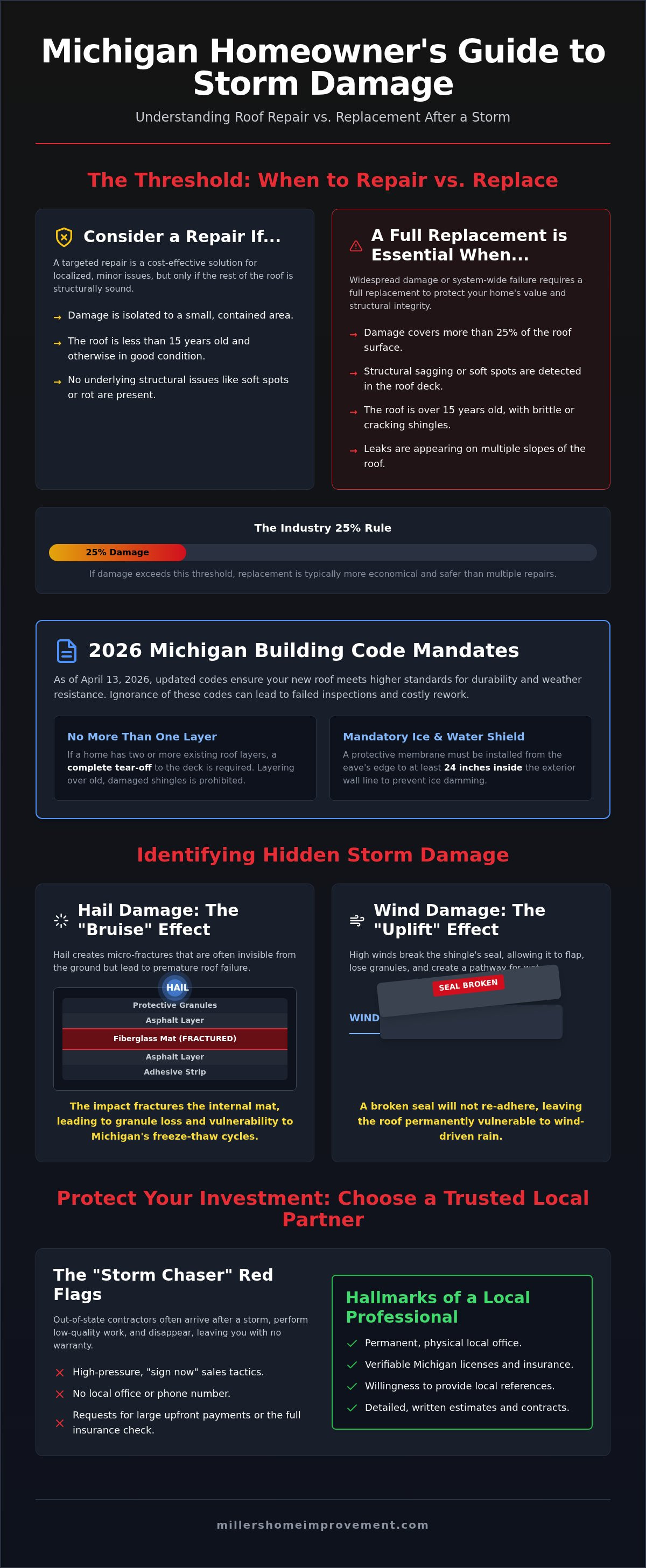
The industry standard generally dictates that if damage covers more than 25% of the total roof surface, a full replacement is the most logical path. However, local regulations in Southeast Michigan add another layer of complexity. As of April 13, 2026, Michigan updated its building codes to require more stringent protection for residential properties. For instance, if your home has two or more existing layers of roofing, the law now mandates a complete strip-down to the deck before a new system is installed. You can't simply layer new shingles over old, damaged ones. This ensures that the underlying structure is inspected for rot and that the required ice and water shields are properly integrated 24 inches inside the exterior wall line.
Signs That Replacement is Non-Negotiable
Some damage is too deep for a simple repair to fix. If you notice structural sagging or soft spots in the roof deck after a heavy storm, the plywood underneath has likely absorbed significant moisture. This leads to internal rot and compromised load-bearing capacity. Additionally, shingle brittleness is a major factor for roofs over 15 years old. If your roof is nearing the end of its natural lifespan, the shingles lose their flexibility. Attempting to lift an old shingle to replace a damaged one beneath it often causes the surrounding materials to crack; this creates a chain reaction of failures. If you have leaks appearing on multiple slopes of the roof, it's a clear signal that the entire system has reached its limit. In these cases, a full storm damage roof replacement is the only way to ensure your property remains protected against the next Michigan winter.
Identifying Hidden Storm Damage on Michigan Roofs
A quick glance from your driveway rarely reveals the true condition of your roofing system after a storm. While missing shingles are obvious, the most destructive issues often remain invisible to the untrained eye. Many homeowners assume their roof is intact because they don't see active leaks, but storm damage is frequently a progressive failure. If you wait until water enters your attic, the cost of a storm damage roof replacement may increase due to secondary issues like mold or saturated insulation. A professional assessment is the only way to catch these "silent" failures before they compromise your home's structural integrity.
Hail Damage: More Than Just Dents
Hail doesn't always leave a visible puncture. Instead, it creates what industry professionals call a "bruise." When a hailstone strikes, it fractures the internal fiberglass mat of the shingle without necessarily breaking the surface. Between June 2025 and June 2026, Michigan recorded at least 69 hail events, many of which caused significant, yet hidden, damage. These impacts lead to shingle degranulation, which is the loss of the protective mineral surface that shields the underlying asphalt from UV degradation and rapid thermal cracking. In Michigan, these micro-fractures are particularly dangerous due to our constant freeze-thaw cycles. Water enters the hail bruise, freezes, and expands, which mechanically forces the shingle fibers apart over time. You should also check soft metals, such as ridge vents and flashing, as these often show clear indentations that justify an insurance claim even when shingles look acceptable.
Wind Damage and the "Lift" Effect
High winds cause damage through a process known as "uplift." You don't need to see shingles lying in your yard to have a wind-damaged roof. Strong gusts can break the factory adhesive seal of a shingle, allowing it to flap during the storm. This is often called the "chatter" effect, where the loose shingle scours away its own protective granules against the shingle above it. Once the seal is broken, the shingle will never re-adhere on its own, leaving a path for wind-driven rain to reach the roof deck. We also look for "creased" shingles. These occur when a shingle is flipped up by the wind and then lays back down. The crease marks a permanent fracture in the fiberglass mat, which significantly weakens the shingle's wind resistance for future storms. If you suspect your roof has been compromised by recent high winds, it is wise to schedule a professional assessment to document these specific points of failure for your records.
The Insurance Restoration Lifecycle: From Claim to New Roof
The aftermath of a severe storm is often chaotic, but the first 48 hours are critical for your claim's success. This window is your best opportunity to capture the state of your property before weather elements further degrade the evidence. While your instinct may be to call your agent immediately, the most effective strategy for a successful storm damage roof replacement involves securing a professional assessment first. This ensures you have a detailed, technical report to present when you eventually open the claim, providing a clear baseline for the adjuster's visit.
Step-by-Step Guide to Filing a Claim
In Michigan, policyholders generally have one year from the date of loss to file a claim, but prompt action is always preferred. We recommend contacting a licensed contractor before your insurance company. This prevents you from filing a claim for damage that might fall below your deductible, which could otherwise lead to an unnecessary premium increase. If you must perform temporary repairs to prevent further water intrusion, keep all receipts and take clear photos before and after the fix. Under Michigan Insurance Code MCL 500.2006, carriers are required to acknowledge your claim within 10 days and complete their investigation within 30 days. This structured timeline protects you from indefinite delays during the restoration process.
The Role of Adjuster Advocacy
An insurance adjuster's report is a technical document that doesn't always align with the reality of local construction costs or material quality. Having Miller’s Home Improvement on-site during the inspection is vital because it ensures the adjuster sees exactly what we see. We speak the same industry language and can point out subtle indicators of damage, such as fractured fiberglass mats, that might be overlooked by a busy adjuster. If you receive a "partial" approval or a denial, don't lose hope. We can provide additional documentation or request a re-inspection to ensure all damage is accounted for. During the tear-off process, it's common to find hidden issues like rotted decking that weren't visible during the initial walk-through. We manage the "supplement" process, which involves submitting evidence of these additional costs to your insurer so the project remains fully funded.
Understanding your policy type is the final piece of the puzzle. An Actual Cash Value (ACV) policy only pays for the depreciated value of your roof based on its age. This often leaves a significant out-of-pocket gap for the homeowner. A Replacement Cost Value (RCV) policy is much more robust, as it covers the full cost of the storm damage roof replacement minus your deductible. Knowing which policy you hold allows us to set realistic expectations for your restoration and ensures your home receives the durable protection it deserves without unexpected financial strain.
Choosing Materials for Storm-Resistant Roof Replacements
A storm damage roof replacement provides a rare chance to correct original construction flaws and upgrade your home's defenses. In 2026, Michigan's updated building codes mandate specific weatherproofing measures that we consider the bare minimum for quality work. We prioritize the installation of corrosion-resistant flashing at every roof-wall intersection and ensure all valley flashing is a minimum of 24 inches wide. These components work alongside a heavy-duty drip edge to prevent water from wicking back into the fascia and roof deck. We also replace traditional felt with high-performance synthetic underlayment. Synthetic barriers are virtually tear-proof and don't absorb moisture, which keeps your decking dry even during the most aggressive Southeast Michigan storms.
Residential Shingle Grades for Detroit Homes
Selecting the right grade of shingle is the most effective way to prevent future damage. Architectural shingles are significantly more durable than standard 3-tab options because their multi-layered construction offers higher wind resistance. For homeowners in hail-prone areas, we recommend Class 4 impact-rated shingles. These materials are engineered to withstand the force of large hailstones without fracturing the underlying fiberglass mat. Your choice of color also plays a role in longevity. Lighter colors reflect more solar radiation, which keeps attic temperatures lower and slows the thermal degradation of the asphalt. This works in tandem with the 1:150 attic ventilation ratio required by current Michigan codes to preserve the life of your new roof and prevent ice dams.
Commercial Flat Roof Resilience
Commercial properties require a different approach to storm resilience. PVC membranes are an excellent choice for high-wind environments because their seams are heat-welded, creating a monolithic surface that resists uplift. If hail is your primary concern, EPDM (rubber) roofing offers superior impact absorption and remains flexible in extreme cold. In Michigan's Climate Zones 5 and 6, we install a minimum of R-49 insulation for low-slope replacements to meet 2026 energy standards. Regardless of the material, proper drainage is non-negotiable. We ensure that every system is designed to prevent ponding water, which can lead to structural strain after heavy rains. For businesses in Southeast Michigan, these technical choices determine whether a roof lasts for decades or fails during the next season.
If you're ready to upgrade your property's defenses with materials built for the Michigan climate, contact us for a professional assessment of your roofing needs.
Why Miller’s Home Improvement is the Trusted Choice for Michigan Restoration
When a severe weather event hits Southeast Michigan, out-of-state "storm chasers" often flood the local market. These companies move from city to city, following weather patterns and prioritizing speed over structural integrity. Miller’s Home Improvement offers a different approach. With over 25 years of owner experience and more than 13 years as an owner-operated local fixture, we provide the stability and accountability that a major home investment requires. We aren't just performing a task; we're protecting a neighbor's property with the same meticulousness we'd use on our own homes. This local presence ensures that if you ever have a question about your storm damage roof replacement years from now, you know exactly where to find us.
The Miller’s Difference: Quality Over Speed
Our commitment to excellence starts with a refusal to take shortcuts. While some contractors might suggest "nailing over" old shingles to save time, we strictly perform complete roof tear-offs. This is the only way to facilitate a thorough structural inspection of the roof deck. As discussed earlier, the 2026 Michigan building codes require specific ice and water shield placements that cannot be verified without stripping the roof to its base. We identify rot, replace compromised plywood, and ensure the foundation of your new roof is sound. Once the installation is complete, our meticulous cleanup process begins. We utilize a high-powered magnetic sweep to collect every stray nail, ensuring your driveway and yard are safe for your family and pets. Every project assessment involves direct owner involvement, providing you with a level of professional oversight that distant corporate entities simply can't match.
Schedule Your Free Storm Damage Assessment
Taking the first step toward restoration shouldn't feel like a high-pressure sales meeting. We utilize a "No-Pressure" educational approach designed to help you understand the true condition of your property. During our comprehensive multi-point inspection, we document everything from hail-bruised shingles to compromised flashing and ventilation issues. We then provide you with a detailed, professional report and estimate that you can present to your insurance provider with confidence. This transparency simplifies the claim process and ensures your insurer has the technical data they need to approve the necessary scope of work. We believe an informed homeowner is a confident homeowner. Protect your property with a roofing system designed to withstand the harshest Michigan winters.
Request your free, no-obligation roof estimate today!
Secure Your Home's Future Against Michigan Weather
Restoring your property after a severe weather event is a significant undertaking that requires a methodical approach. You now understand that a successful storm damage roof replacement relies on identifying hidden structural compromises and navigating the complexities of insurance restoration with professional advocacy. By choosing high-impact materials and adhering to the latest 2026 Michigan building codes, you aren't just fixing a leak; you're investing in a durable shield that will protect your family for decades. Miller’s Home Improvement brings over 25 years of experience and a licensed, fully insured team to every project in Southeast Michigan. We've built an A+ local reputation in Detroit by prioritizing integrity and meticulous workmanship over high-pressure sales tactics. Don't leave your home's safety to chance. Get a Free Storm Damage Inspection & Estimate today to ensure your roof is ready for whatever the next season brings. We're here to provide the clarity and expertise you need to move forward with total peace of mind.
Frequently Asked Questions
How do I know if my roof has storm damage if it isn’t leaking yet?
Hidden damage like hail bruising or broken adhesive seals doesn't always cause an immediate leak. These issues compromise the shingle's integrity, leading to granule loss and fiberglass fractures that worsen during Michigan's freeze-thaw cycles. You can look for indentations in metal vents or "bruises" on shingles. A professional inspection is the only way to confirm if a storm damage roof replacement is necessary before water reaches your attic.
Will my insurance rates go up if I file a roof damage claim?
Filing a single claim for weather-related damage typically doesn't cause your individual rates to increase. These events are classified as "Acts of God," which are outside of your control. However, insurance companies may raise premiums for an entire geographic area if a region experiences widespread severe weather. It's a good idea to review your specific policy details with your agent to understand your local coverage landscape.
How long do I have to file a claim after a storm in Michigan?
Michigan homeowners generally have one year from the date of the storm to file an insurance claim. While this window provides some flexibility, we recommend acting as soon as you suspect damage. Documenting the event and securing a professional assessment immediately after the storm ensures that the evidence is fresh and the investigation can proceed under the timelines set by the Michigan Insurance Code.
Can I just repair the missing shingles instead of replacing the whole roof?
Spot repairs are suitable for minor, localized damage on a relatively new roof. However, if more than 25% of the roof is damaged, or if the shingles are too brittle to lift without cracking, a full replacement is the safer choice. Additionally, Michigan building codes require a complete tear-off if your home already has two layers of roofing. We evaluate the cost-effectiveness of repairs versus a full restoration during our inspection.
What is the difference between wind damage and hail damage on a roof?
Wind damage usually manifests as missing shingles, broken adhesive seals, or permanent creases where shingles have flipped up and laid back down. Hail damage is more subtle and appears as dark, circular indentations where the protective granules have been knocked away. Both types of damage weaken the roof's defenses against moisture, but hail often requires a closer look to identify the fractured fiberglass mat beneath the surface.
Does insurance cover a roof replacement for an old roof?
Insurance typically covers storm damage regardless of the roof's age, but your policy type determines the payout amount. An Actual Cash Value policy pays a depreciated amount based on the roof's remaining lifespan. In contrast, a Replacement Cost Value policy covers the full current cost of a storm damage roof replacement. We can help you review your adjuster's report to ensure the age of the roof isn't being used to unfairly deny a valid claim.
What should I do if the insurance adjuster denies my claim?
If your claim is denied, don't assume the process is over. You have the right to request a re-inspection or file an appeal with your insurance provider. Many denials happen because the initial inspector missed subtle signs of damage or didn't account for local building code requirements. Providing additional photographic evidence or having an experienced contractor present during a second inspection often leads to a more favorable outcome for the homeowner.
How long does a storm damage roof replacement take to complete?
The physical installation of a new residential roof usually takes one to two days. However, the entire lifecycle of a restoration project, from the initial claim filing to the final inspection, can take several weeks. Factors like insurance processing times, material availability, and weather conditions influence the overall schedule. We coordinate every stage of the project to ensure the work is completed efficiently without sacrificing the quality of the installation.


