
Did you know that a hailstone doesn't need to leave a visible hole to effectively end the life of your roof? It's natural to feel a sense of relief when a storm passes and everything looks fine from the driveway. However, many homeowners later discover that "invisible" granule loss and bruising have quietly invited moisture into their structural decking. The fear of an insurance denial or being pressured by out-of-state "storm chasers" only adds to the stress of protecting your home.
You deserve a restoration process defined by transparency and technical precision. This guide will show you how to secure a successful hail damage roof repair in Michigan by navigating the updated 2026 landscape of building codes and insurance requirements. We'll walk through the forensic signs of damage, the nuances of the local claims process, and how to ensure your home meets the strict standards of the 2021 International Building Code, which became effective in Michigan on April 13, 2026. Whether you're dealing with a minor leak or a major loss, you'll gain the confidence to restore your property to pre-storm condition or better.
Key Takeaways
- Learn to distinguish between cosmetic marks and functional failures like shingle "bruising" that can lead to structural leaks over time.
- Understand your rights and the specific timelines for filing a claim under Michigan law to ensure your restoration is fully covered.
- Discover how the Michigan Residential Building Code determines whether you need a localized hail damage roof repair in Michigan or a full system replacement.
- Master the documentation steps needed to provide your insurance adjuster with forensic evidence that supports a successful claim payout.
- Find out why partnering with a local fixture with 25 years of experience protects your home from the common pitfalls of out-of-state storm chasers.
Understanding Hail Damage: The Michigan Homeowner’s Context
Michigan homeowners often view spring storms with a mix of appreciation for the garden and anxiety for the roof. Between April and September, the Lower Peninsula becomes a corridor for volatile weather systems that carry significant hail potential. Understanding what hail is and how it interacts with different roofing materials is the first step in protecting your home's long term integrity. Identifying the need for hail damage roof repair in Michigan starts with a clear distinction between cosmetic blemishes and functional failures.
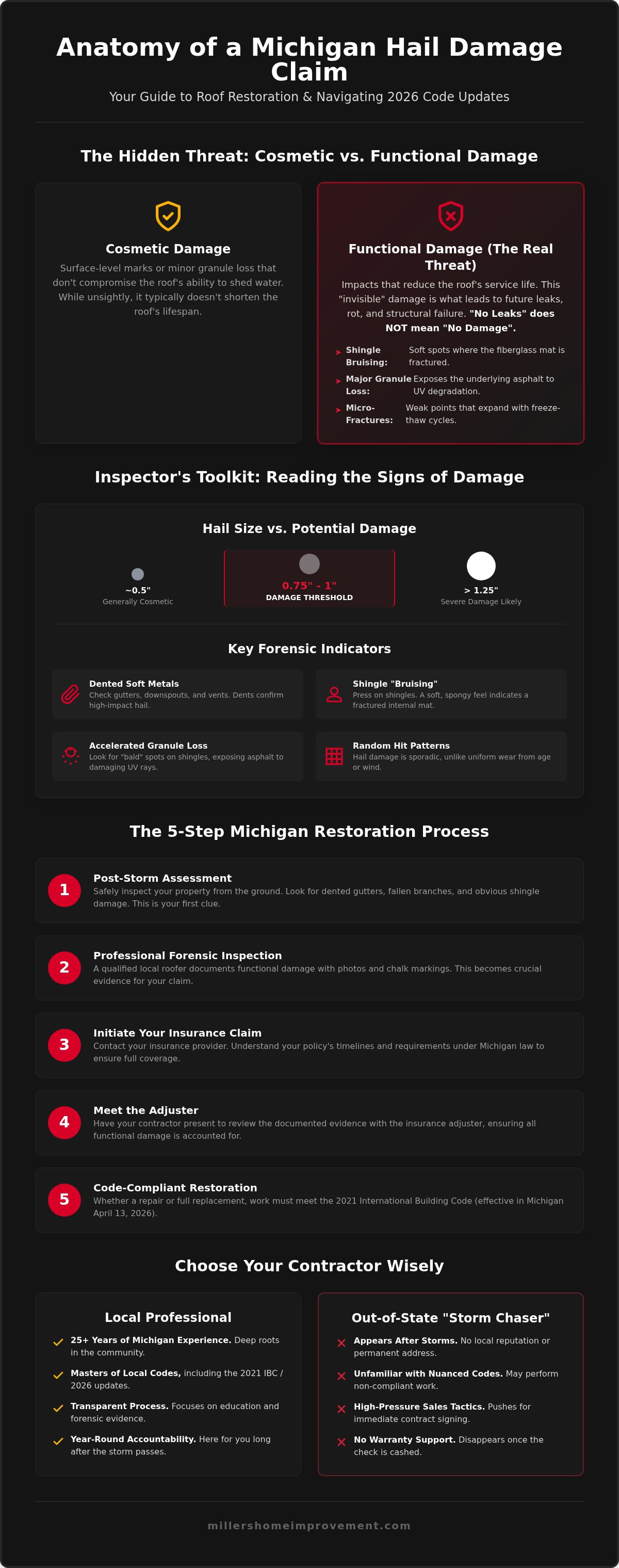
Functional damage is far more than an aesthetic concern. It occurs when a hailstone's kinetic energy is high enough to fracture the shingle’s fiberglass mat or displace the protective mineral granules. When these granules are lost, the underlying bitumen is exposed to the sun’s ultraviolet rays, leading to rapid deterioration and brittleness. A roof that looks fine from the driveway can still be compromised. Assuming that "no leaks" means "no damage" is a dangerous mistake that often leads to saturated insulation and deck rot months after the storm has passed.
The Threshold of Severe Damage
We generally look at a hailstone size of 0.75 inches to 1 inch as the threshold for structural concern. However, size isn't the only factor. Wind-driven hail can strike a roof at an angle, significantly increasing the impact force on windward slopes. This lateral energy often causes "bruising," a type of subsurface fracture that isn't immediately visible. To gauge the severity of a storm, we look at soft metals first. If your gutters, downspouts, or aluminum vent caps show deep indentations, it's a reliable indicator that the asphalt shingles have sustained similar high-velocity impacts.
Why 2026 Weather Patterns Matter
Throughout 2026, Oakland and Wayne counties have experienced a high frequency of discrete hail events rather than a single catastrophic storm. These repetitive, smaller storms have a cumulative effect on shingle integrity, slowly stripping away the roof's primary defenses. Functional damage is defined as any physical impact that reduces the roof's waterproofing lifespan or its ability to shed water. Even if a shingle remains in place, the loss of its protective layer means it can no longer fulfill its 25-year or 30-year design life. Professional hail damage roof repair in Michigan requires a meticulous eye to catch these signs before the next freeze-thaw cycle turns a micro-fracture into a major leak.
Identifying Hail Damage: Beyond the Naked Eye
A standard roof inspection often starts on the ground, but a true forensic assessment requires getting onto the deck. While many homeowners search for missing shingles or obvious punctures, professional hail damage roof repair in Michigan focuses on subtle indicators that the untrained eye misses. We utilize "soft-metal control testing" as an initial diagnostic tool. By examining aluminum gutters, valley flashing, and furnace caps, we can verify the size and density of the hailstones that struck the property. If these soft metals show significant indentations, it provides a clear roadmap for where to look for deeper, structural shingle damage.
Understanding your rights during this assessment is vital. The Michigan homeowners insurance guide provides a helpful framework for what you should expect from your coverage and how to interact with your provider. This baseline knowledge helps prevent misunderstandings when a third-party adjuster arrives to survey the site. It’s important to remember that insurance companies look for "functional damage," which means the impact must affect the roof's ability to shed water or its overall lifespan.
Signs on Asphalt Shingles
Asphalt shingles often hide damage through a phenomenon known as "bruising." This occurs when a hailstone strikes the surface with enough force to crush the internal fiberglass mat without necessarily tearing the top layer. These areas feel soft to the touch, similar to a bruise on an apple. Over time, these weakened spots will fail, leading to localized leaks. We also look for random hit patterns that differ from the uniform wear caused by wind. Granule displacement is another red flag; when these protective stones are knocked loose, the underlying asphalt is left vulnerable to accelerated UV degradation, which turns shingles brittle within a few seasons.
Commercial and Flat Roof Indicators
Commercial roofing systems require a specialized eye. On PVC and EPDM membranes, hail impacts may manifest as small, star-shaped fractures or circular cracks that are nearly invisible when the membrane is dry. These micro-fractures compromise the system's elasticity. In Torch Down systems, we look for punctures that can allow water to seep into the insulation layers. Because many flat roofs already struggle with drainage, even minor hail damage can lead to ponding water accelerating the deterioration of the compromised area. If you suspect your property was in the path of a recent storm, a professional forensic inspection can identify these hidden risks before they become active leaks and cause structural rot.
Catching these issues early is the only way to ensure a successful hail damage roof repair in Michigan. Waiting for a leak to appear often means the damage has already spread to the roof decking and interior ceilings, significantly increasing the complexity of the restoration.
Navigating Michigan Insurance Claims for Storm Damage
Securing a successful hail damage roof repair in Michigan requires more than just a technical assessment; it demands a firm grasp of the state’s insurance landscape. Michigan’s Uniform Trade Practices Act provides specific protections for homeowners, yet many remain unaware of their rights during a dispute. One of the most critical tools at your disposal is the "Appraisal Provision." If you and your insurance company cannot agree on the amount of loss, this provision allows for an independent evaluation, ensuring that the final settlement reflects the actual cost of restoration rather than a depreciated estimate.
Documenting the event immediately is non-negotiable. While the technical "bruising" we discussed earlier might take months to manifest as a leak, the insurance clock starts ticking the moment the storm concludes. We recommend capturing dated photos of hail on the ground and any immediate signs of impact on soft metals. This evidence creates a clear link between a specific weather event and the resulting damage, making it much harder for an insurer to claim the issues are simply the result of pre-existing wear and tear.
The Claim Timeline in Michigan
Michigan law generally requires homeowners to file insurance claims within one year of discovering the damage. However, waiting until the end of that window is a strategy fraught with risk. Most insurance carriers strongly prefer filings within 30 to 60 days of the storm. If you wait until the following spring to report an autumn hail event, you give the adjuster room to argue that subsequent winter weather exacerbated the problem. This can lead to a "prior damage" clause being invoked, which may result in a partial or total claim denial. Acting quickly preserves the forensic evidence and simplifies the path to a full restoration.
Contractor vs. Adjuster: Ensuring a Fair Assessment
We always suggest that your contractor be present during the adjuster’s initial inspection. An adjuster’s primary role is to evaluate the loss from the company’s perspective, while a seasoned contractor looks at the project through the lens of structural integrity and building code compliance. With the adoption of the 2021 International Building Code in Michigan on April 13, 2026, repairs must now meet stricter standards for ice and water shields and flashing. Miller’s Home Improvement provides the detailed, forensic documentation necessary to show that a simple patch isn't enough when the underlying mat is fractured. Having a professional advocate ensures that the conversation stays focused on functional damage rather than being dismissed as a cosmetic exclusion.
Repair vs. Replacement: Making the Right Decision
Determining whether a storm necessitates a targeted fix or a complete overhaul is a decision that balances immediate costs with long-term structural health. While a localized hail damage roof repair in Michigan might seem like the most efficient path, the decision is often dictated by state building regulations and the specific nature of the damage. A few replaced shingles might stop a leak today, but they don't address the underlying mat fractures that we discussed in previous sections. If the integrity of the fiberglass mat is compromised across a wide area, a patch is merely a temporary band-aid that leaves your home vulnerable to the next freeze-thaw cycle.
The 25% Rule and Code Compliance
The Michigan Residential Building Code includes a specific provision often referred to as the "25% Rule." In many local jurisdictions, if the area of the roof being repaired or replaced exceeds 25% of the total roof surface within a 12-month period, the entire roof must be brought into compliance with the current building code. Since Michigan adopted the 2021 International Building Code on April 13, 2026, this means a partial repair could trigger a requirement for a full system upgrade. This includes mandatory ice and water shield protection extending at least 24 inches inside the exterior wall line and updated attic ventilation ratios. Attempting a partial fix on an older roof often leads to mismatched aesthetics and creates weak points where the new materials meet the weathered ones, often resulting in premature failure at the seams.
Upgrading for Future Protection
A storm restoration is a unique opportunity to enhance your home's resilience against future events. We often recommend upgrading to Class 4 impact-resistant shingles during a full replacement. These materials are engineered to withstand the kinetic energy of large hailstones without the "bruising" typical of standard asphalt products. Many Michigan insurance providers offer premium discounts for homes with these verified impact ratings, which helps offset the initial investment over time. Choosing a full system restoration also allows for a thorough inspection of the roof deck. We can identify and replace soft spots or rot that would be impossible to see during a minor repair. If you're unsure which path is right for your property, you can schedule a comprehensive roof inspection to receive a detailed forensic assessment of your roof's current condition.
Investing in a specialized hail damage roof repair in Michigan ensures that your home meets the latest 2026 safety standards. Whether you choose a targeted repair or a complete tear-off, the goal is to restore your property to a condition that is better and more durable than it was before the storm arrived.
Why Miller’s Home Improvement is Michigan’s Restoration Choice
Choosing a contractor after a storm is a decision that impacts the safety and value of your home for decades. Miller’s Home Improvement is a local fixture in Southeast Michigan, bringing over 25 years of owner experience to every restoration project. This extensive background allows us to move beyond the surface-level fixes offered by out-of-state "storm chasers" who often vanish once the shingles are nailed down. We take a "Master Craftsman" approach, which means we prioritize technical integrity, no-nonsense communication, and a commitment to doing the job correctly the first time. Our reputation is built on quiet confidence and the long-term durability of our work.
Our expertise isn't limited to a single type of property. We are equally proficient in residential asphalt shingle installations and complex commercial flat-roof systems. Whether your property utilizes PVC, EPDM, or Torch Down membranes, we understand the specific failure points that hail creates in these materials. This broad professional knowledge ensures that your hail damage roof repair in Michigan is handled with a level of meticulousness that protects your structural investment. We don't just perform a task; we act as a proactive guide to help you maintain your property’s value in a volatile climate.
Our Forensic Inspection Process
The restoration journey begins with a thorough forensic assessment. During your free in-home estimate, we perform a disciplined walk-through of the entire roofing system. We don't just look for leaks. We document the subsurface bruising, granule displacement, and soft-metal indentations that serve as the primary evidence for insurance adjusters. This detailed documentation is designed to lead the reader from a state of concern to a state of informed resolution. By providing your insurance carrier with clear, technical proof of functional damage, we help streamline the approval process. Our commitment to using high-quality materials ensures that every repair meets or exceeds the standards we’ve discussed throughout this guide.
Serving Southeast Michigan and Detroit
We are deeply rooted in the local community, with 13 years of business history serving Detroit and the surrounding areas. This local presence gives us an intimate understanding of the building departments and permit processes across Southeast Michigan. We stay current on every regulatory shift, including the strict requirements of the 2021 International Building Code that recently took effect. Our goal is to provide a seamless, transparent experience that alleviates the typical anxieties associated with storm damage. We take pride in our workmanship and the stability we provide to our neighbors. If you suspect your roof has sustained impact damage, don't wait for a leak to confirm your fears. Schedule Your Free Hail Damage Assessment with Miller’s Home Improvement to ensure your roof is restored with professional confidence.
Restoring Your Peace of Mind After the Storm
Michigan storms are unpredictable, but your restoration process shouldn't be. We've explored how "invisible" bruising can compromise your home's structural integrity and why the 2026 building code updates make professional oversight more critical than ever. Securing a proper hail damage roof repair Michigan requires a blend of forensic expertise and proactive insurance coordination. By identifying damage early and documenting it meticulously, you protect your property from the long-term risks of wood rot and saturated insulation.
Miller’s Home Improvement provides the stability of a licensed and insured Michigan contractor with over 25 years of owner experience. We specialize in expert insurance claim coordination, ensuring that your provider sees the full technical reality of your roof’s condition. You don't have to navigate the complexities of adjusters and building permits alone. Our team is committed to high-integrity workmanship that stands up to the harshest Great Lakes weather.
Get Your Free Forensic Roof Inspection in Southeast Michigan to ensure your home is restored to its full strength. We're here to help you move forward with confidence.
Frequently Asked Questions
How do I know if I have hail damage if my roof isn’t leaking?
You can identify hidden damage by checking for "bruising" on shingles or indentations on aluminum gutters and vents. Hail impacts often fracture the internal fiberglass mat without causing an immediate puncture. These micro-fractures compromise the shingle's integrity; leaks often don't appear until the roof undergoes several freeze-thaw cycles. A professional forensic inspection can uncover these subsurface issues before they lead to structural rot or saturated insulation.
Will my insurance rates go up if I file a hail damage claim in Michigan?
Filing a single claim for storm damage, which is typically classified as an "Act of God," generally doesn't trigger an individual rate increase in Michigan. However, insurance companies may adjust premiums for an entire geographic area based on the total number of claims filed after a major weather event. It is always best to consult the Michigan Department of Insurance and Financial Services for specific consumer protections regarding surcharge practices.
What is the "25% Rule" in the Michigan building code for roof repairs?
The "25% Rule" states that if you replace or repair more than 25% of a roof surface within a 12-month period, the entire roof must be brought up to current building code standards. Since Michigan adopted the 2021 International Building Code in April 2026, a significant repair could require a full system upgrade. This includes mandatory ice and water shields and updated ventilation ratios to meet the latest safety requirements.
Can I just repair the damaged shingles instead of a full replacement?
Partial repairs are viable if the damage is localized to a small area; however, they often lead to mismatched aesthetics and structural weak points where old and new materials meet. If a storm caused widespread bruising across multiple slopes, a targeted repair is often a temporary fix. We evaluate each case to determine if a repair meets the technical requirements for a long-term, code-compliant waterproofing solution.
How long do I have to file a roof insurance claim after a storm in Michigan?
Michigan law generally allows up to one year from the date you discover the damage to file a claim, but most insurers recommend filing within 30 to 60 days. Delaying the process makes it harder to prove the damage resulted from a specific storm rather than normal wear. Prompt filing ensures that forensic evidence, such as impact marks on soft metals, remains clear and indisputable for the insurance adjuster.
What are Class 4 impact-resistant shingles and are they worth it?
Class 4 shingles are engineered to withstand high-velocity hail impacts without fracturing the internal fiberglass mat. They are highly recommended for the hail damage roof repair Michigan homeowners face due to the state's volatile spring weather. While the initial investment is higher, many insurance providers offer premium discounts for these materials. They provide superior durability and significantly extend the functional life of your roofing system in harsh climates.
Does hail damage affect flat commercial roofs differently than shingle roofs?
Hail damage on flat roofs often manifests as micro-fractures in PVC or EPDM membranes rather than visible granule loss. These impacts compromise the membrane's elasticity, leading to cracks that allow moisture to seep into the underlying insulation. Because flat systems often deal with ponding water, even minor hail strikes can lead to rapid saturation. This often necessitates a complete system tear-off to prevent structural deck rot.
Why should I choose a local Michigan contractor over a national storm restoration company?
Local contractors have a long-term commitment to the community and a deep understanding of local building departments and permit requirements. National "storm chasers" often lack specific knowledge of the 2026 Michigan code updates and may not be available for warranty work if issues arise later. Choosing a local fixture ensures your hail damage roof repair Michigan project is handled by a partner who understands our unique regional weather and regulations.


