
What if a roofer’s license record looks current but doesn’t answer every question about your project? Knowing how to check a roofer's license in Michigan starts with the state’s official LARA license search. The result is an important checkpoint, but it doesn’t confirm insurance coverage, local permit requirements, or whether the record matches the contractor doing the work.
Before roofing begins, it’s sensible to confirm who holds the license and how that person or business is connected to your project. Michigan’s license categories depend on the type of residential work, while commercial roofing may involve local requirements.
This guide explains how to search LARA’s records, review the result, and compare it with your contract. It also covers the separate insurance documents and local permit requirements to review before work starts, so you can make a more informed decision about a Detroit-area roofing project.
Key Takeaways
- Learn how to check a roofer's license in Michigan through the state’s official lookup and match the record to the right contractor.
- Understand why the license type can depend on the roofing work and property involved.
- See how to read a license record and what to do if names or details don’t line up.
- Know which insurance, contract, and local permit details to review beyond the license search.
- Keep a clear record of your verification and project documents before roofing work begins.
Before checking a Michigan roofer’s license, know what the search can confirm
A contractor license is state-issued authorization to perform certain work under specified requirements. Checking the official record lets you confirm the listed credential, status, and classification, and compare them with the person or business connected to the project. It’s a useful first step, not a complete assessment of a roofing contractor. More broadly, occupational licensing sets qualifications for work in regulated fields, but the specific scope depends on state rules.
Keep the documents and terms distinct. A license is not proof of insurance, a local business registration, a building permit, or a workmanship warranty. Those serve different purposes and may involve different agencies or parties. The relevant credential can also depend on whether the work is residential or commercial, whether it is a repair or a larger construction scope, and how the property is used.
When Michigan roofing work may require a state license
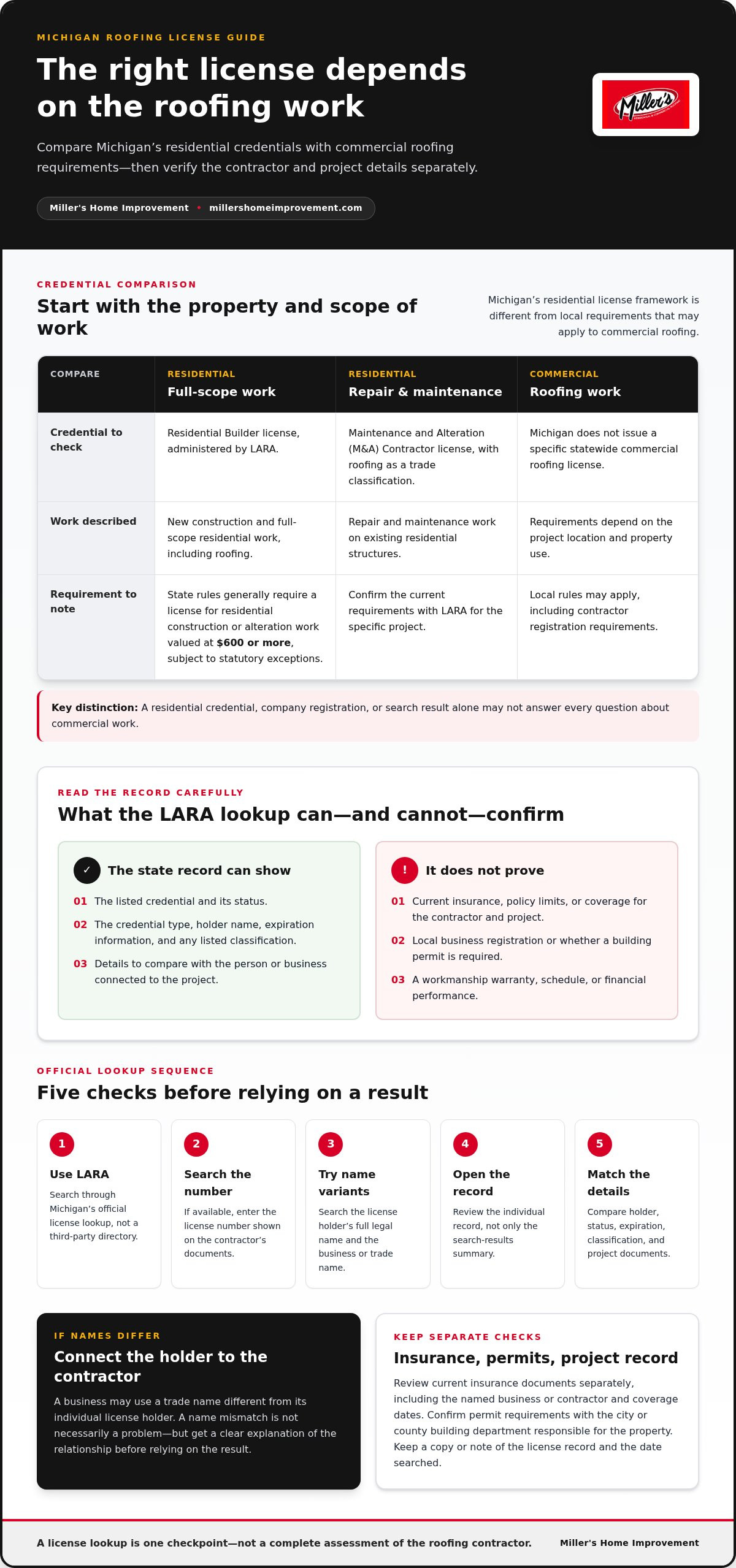
Michigan’s residential licensing framework, administered by the Department of Licensing and Regulatory Affairs (LARA), includes Residential Builder and Maintenance and Alteration (M&A) Contractor licenses. A Residential Builder credential covers new construction and full-scope residential work, including roofing. The M&A Contractor license applies to repair and maintenance work on existing residential structures, with roofing as a trade classification. State rules generally require a license for residential construction or alteration work valued at $600 or more, subject to statutory exceptions. Confirm the current requirements with LARA for the specific project.
Commercial roofing is a separate consideration: Michigan does not issue a specific statewide commercial roofing license. Local rules may apply, including contractor registration requirements, so the project location and property use matter. A residential credential, company registration, or search result alone may not answer every question about commercial work.
What a license search does not prove
A state record can help establish whether a listed credential and status match the work being considered. It does not establish that insurance is current, identify policy limits, or confirm that coverage applies to the contractor and project. Review current insurance documentation separately, paying attention to the named business or contractor and the coverage dates.
Permits and building-code requirements are also separate. Roofing work may require a permit, but rules depend on the local jurisdiction. Confirm requirements with the city or county building department responsible for the property. An active license does not guarantee workmanship, schedule, or financial performance. When learning how to check a roofer's license in Michigan, treat the state lookup as one checkpoint, then review insurance, project documents, and local requirements before work begins.
How to check a roofer’s license in Michigan using the official lookup
Michigan’s Department of Licensing and Regulatory Affairs (LARA) is the state agency responsible for licensing residential builders and maintenance and alteration contractors. Start with Michigan’s official license lookup portal. Use the state source to search for the license record rather than relying on a third-party directory or search-engine listing.
What information to collect before you search
Gather the contractor’s full legal name and any license number shown on the proposal or project documents. A business may operate under a trade name that differs from the name of its individual license holder, so note both if available. The goal is to connect the record to the person or entity responsible for the roofing work, not simply to find a similar company name.
Follow these steps in LARA’s lookup
- Open LARA’s verification page. Follow the state portal’s link to its license search and select the search option that fits the information you have.
- Search by license number first, if available. Enter the number as shown on the contractor’s documents. If you don’t have one, search using the license holder’s full name.
- Try name variations if needed. If the first search doesn’t return a clear match, search the contractor’s legal name and business or trade name. Different names don’t necessarily indicate a problem; you may need to identify who holds the license.
- Open the likely record. Don’t rely only on the search-results summary. Review the individual record and compare it with the proposal and credentials presented for your project.
- Review the details shown. Look for the credential type, holder name, status, expiration information, and any listed classification. Check that the record appears relevant to the work being planned.
How to read the search result
Compare the record details, not just the name. For example, a record for an individual may not show how that person is connected to the business named in your estimate. Note any differences and get a clear explanation of the relationship before relying on the result. If LARA’s search results or record details are unclear, use the contact channel published on the agency’s official site for guidance.
Keep a copy or note of the record and the date you searched. Then compare it with the written scope and other project documents. For a roofing project in Detroit or Southeast Michigan, you can also review residential and commercial roofing work as you organize your next steps.
How to interpret a Michigan roofer license record and resolve discrepancies
A search result is useful only if you can connect it to the contractor and the work in your proposal. Review the license holder, credential type, status, expiration information, and any listed roofing classification together. The details should make sense for the person or business responsible for the project and the scope being contracted.
Pay attention to the exact status wording. LARA’s current record and published explanations are the authority for interpreting labels such as active, expired, suspended, or inactive. Don’t assume an unfamiliar label means a license is current or authorizes the specific work. If the record doesn’t clearly answer your question, consult LARA’s published guidance or contact the agency through its current official channel.
What to do when the name or business does not match
A proposal may use a business or trade name, while the state record identifies an individual license holder or legal entity. Compare the names without assuming they should be identical. If they differ, ask for an explanation of the relationship between the named business and license holder, then search again using the license number or holder’s full legal name. A mismatch is a reason to clarify, not proof of misconduct.
Compare the credential with the project scope
License classification matters because a credential’s scope may not cover every kind of construction work. Michigan’s residential system includes Residential Builder and Maintenance and Alteration Contractor credentials, with roofing identified as a trade classification for M&A work. Requirements can depend on project type, property use, and applicable exceptions. Use LARA’s current rules to assess the specific job rather than relying on a title alone.
For example, if a proposal describes repairs to an existing home, compare that scope with the license type and roofing classification in the official record. If the proposal covers a broader residential project, don’t assume a repair-focused credential answers the question. Confirm the applicable requirement with LARA.
How to handle an expired, inactive, or unclear result
Don’t treat an unclear result as confirmation of current authorization. Search again using the license number or legal name, review LARA’s definitions for the exact status displayed, and contact the agency through its published channel if the record remains ambiguous. Save a dated copy or note of the result and the details you reviewed. This gives you a record to compare with the written proposal and other project documents.
What else to verify beyond a roofer’s Michigan license
A license search answers a specific question about a state credential. It doesn’t replace checks of insurance, contract terms, or local requirements. Review each separately to understand who is responsible for the work, what the project includes, and which requirements apply at the property.
License, insurance, permits, and contract: different checks
| Check | What it helps establish | What to review |
|---|---|---|
| State license | Whether the relevant state credential and listed details match the contractor and work. | Holder name, credential type, status, expiration information, and any applicable classification. |
| Insurance evidence | Whether documentation shows current coverage relevant to the company or contractor doing the work. | Current documents identifying the insured party and coverage dates. A license record does not prove coverage or policy limits. |
| Written contract | What work the parties have agreed to and how responsibilities are set out. | Scope, materials, payment terms, project responsibilities, and any stated changes or exclusions. |
| Local permit check | Which permit and code requirements apply at the project address. | Requirements from the city or county authority that governs the property. Local rules can vary. |
A clear written scope should describe the roofing work in practical terms. Check whether the proposal covers repairs or roof replacement, which materials it specifies, and which tasks are included. That gives you a basis for comparing the agreement with the project and credential information. For more context on evaluating a replacement project, read this guide to Michigan roof replacement.
Questions that make a license check useful
Use these prompts while reviewing the estimate and project paperwork. The goal is to connect the state record to the actual work, not to treat one document as complete approval.
- Which legal business name appears in the proposal, and who is identified as the license holder?
- How does the proposed roofing scope relate to the credential or classification shown in the official record?
- Does the insurance documentation identify the contractor responsible for the work and show current coverage dates?
- Which local authority governs the property, and what permit requirements apply to this project?
Keep the answers and supporting documents with the estimate and signed contract. A project file makes it easier to revisit what was verified and compare the agreed scope with the work planned. You can also explore residential and commercial roofing services as you plan your next step.
Use your license check to move forward with a Michigan roofing project
Put the license lookup in context by comparing it with the proposal and property. Verify the relevant record through Michigan’s official lookup, review current insurance documents, compare the written scope with the credential details, and confirm permit requirements with the local authority responsible for the property.
A simple pre-project verification checklist
- Confirm the license record. Check the holder’s name, credential type, status, expiration information, and any listed classification. Save the date you searched.
- Match the project documents. Compare the license holder and business names with the estimate and contract. Make sure the written scope describes the roofing work and materials clearly.
- Review insurance evidence. Keep current documentation that identifies the contractor responsible for the work and shows relevant coverage dates.
- Check local requirements. Contact the city or county authority for the property to confirm applicable permit and inspection requirements.
- Keep a project file. Store the lookup details, estimate, insurance documents, contract, and permit information together so you can refer back to what was reviewed.
This organized record helps you make decisions based on the whole project, not a single search result. It also gives you a practical reference if the agreed scope changes or you need to revisit a document later.
When you are ready to discuss roofing work
Clear documentation supports a clear conversation about the roof: what needs attention, what work is proposed, and which details belong in the written scope. Miller’s Home Improvement is fully licensed and insured. Reviewing the relevant state record and project-specific insurance documents remains a separate part of your review. A license lookup alone doesn’t establish workmanship or insurance coverage.
If you’re considering roof repairs, replacement, or another roofing project, use the information you’ve gathered to guide the discussion and understand the proposed work. Learning how to check a roofer's license in Michigan is one step toward a well-documented decision. You can review roofing services and explore options for your project.
Move ahead with a clearer roofing plan
Knowing how to check a roofer's license in Michigan gives you a practical starting point, but the record is only one part of your review. Match the license details to the contractor and project, check current insurance documentation, read the written scope carefully, and confirm local permit requirements. Keep the lookup date, estimate, contract, and supporting documents together.
Miller’s Home Improvement is fully licensed and insured, with more than 25 years of owner experience and 13 years in business. These details offer context as you consider a roofing project, but they don’t replace reviewing the relevant license record, insurance documents, and project terms.
When you’re ready to discuss roof repairs, replacement, or other roofing work, request a free in-home roofing estimate and move forward with a clear understanding of your project.
Frequently Asked Questions
How do I check if a roofer is licensed in Michigan?
Use the official license search provided by the Michigan Department of Licensing and Regulatory Affairs (LARA). Search with the license number if you have it, or use the license holder’s legal name. Open the matching record and review its credential type, holder name, status, expiration information, and any listed classification. Compare those details with the proposal. The license record doesn’t verify insurance or permits.
Does a roofer need a license in Michigan?
Residential roofing work may require a state license, depending on the work and circumstances. Michigan generally requires a license for residential construction or alteration work valued at $600 or more, subject to statutory exceptions. A Residential Builder license covers new construction and full-scope residential work; a Maintenance and Alteration Contractor license applies to repair and maintenance on existing homes, with a roofing classification. Michigan has no specific statewide commercial roofing license, but local rules may apply.
What should I do if a Michigan roofer’s license lookup shows no results?
No results don’t by themselves prove that a contractor is unlicensed. Recheck the spelling, search the full legal name instead of only a trade name, and try the license number if you have it. The business name and individual license holder’s name may differ. If you still can’t find a clear record, use LARA’s current published contact channel for help. Don’t treat a missing result as confirmation of current authorization.
Can I hire a roofer if their Michigan license is expired?
Don’t assume an expired record shows current authorization for work that requires a state credential. Review the exact status and expiration information in LARA’s record, then confirm current requirements with the agency before signing or allowing work to begin. A search result can be outdated or unclear, so check the official record again using the license number or legal name. Keep a dated copy of what you reviewed for your project file.
Does a Michigan roofer’s license prove they are insured?
No. A Michigan license record doesn’t establish that a roofer has current insurance, show policy limits, or confirm that coverage applies to your project. Review insurance documentation separately and check that it identifies the contractor or business responsible for the work and shows relevant coverage dates. Keep the documents with your estimate and contract. For a Detroit roofing project, this review helps distinguish state licensing from project-specific insurance evidence.
Is a state license the only approval needed for roofing work in Detroit?
No. A state license, when required, is separate from local contractor registration, permits, and code requirements. Detroit may have its own contractor registration rules, and permit requirements depend on the project and local authority. Check with the Detroit building department responsible for the property to confirm applicable permits and inspections before work begins. Commercial roofing also has no specific statewide license, so local requirements are particularly important.
How can I tell whether a roofer’s license matches my project?
Compare the credential type and any listed classification with the work described in the estimate and contract. For residential projects, a Residential Builder credential covers new construction and full-scope work, while a Maintenance and Alteration Contractor credential includes a roofing classification for repair and maintenance on existing homes. Requirements can depend on project details and exceptions. For commercial work, check local rules. If the record’s scope is unclear, consult LARA before proceeding.


