

A leak on a modified bitumen roof doesn’t always point to a problem directly above the water stain. A lifted seam, damaged flashing, or moisture beneath the membrane can send water across the roof assembly before it reaches an interior finish. For Detroit property owners, winter weather can make that uncertainty more urgent. The right modified bitumen roofing repair in Detroit starts with finding the cause, not simply covering the visible symptom.
It’s reasonable to wonder whether the damage is limited to one spot or points to wider deterioration. The answer depends on the roof assembly and what an assessment finds. This guide covers common failure points, how repair approaches vary, and what a professional assessment should examine. Miller’s Home Improvement handles roof repairs and commercial flat-roof work, including Torch Down systems, across Southeast Michigan. With more than 25 years of owner experience, the company can help Detroit property owners understand the roof’s condition and plan appropriate work.
Key Takeaways
- With modified bitumen roofing repair Detroit, a dependable plan starts by identifying the membrane defect and assessing the roof assembly around it.
- Localized repairs address a diagnosed problem while preserving sound roofing. The right approach depends on the membrane, substrate, and defect location.
- Repeated leaks, widespread wear, and concealed moisture can affect whether a targeted repair or broader work makes sense.
- Document leak symptoms and consider roof access, drainage, penetrations, and interior evidence when preparing for an assessment.
- Miller’s Home Improvement brings commercial flat-roof and Torch Down experience, with 13 years in business, to repair planning in Southeast Michigan.
Modified Bitumen Roofing Repair in Detroit: Recognizing the Problem
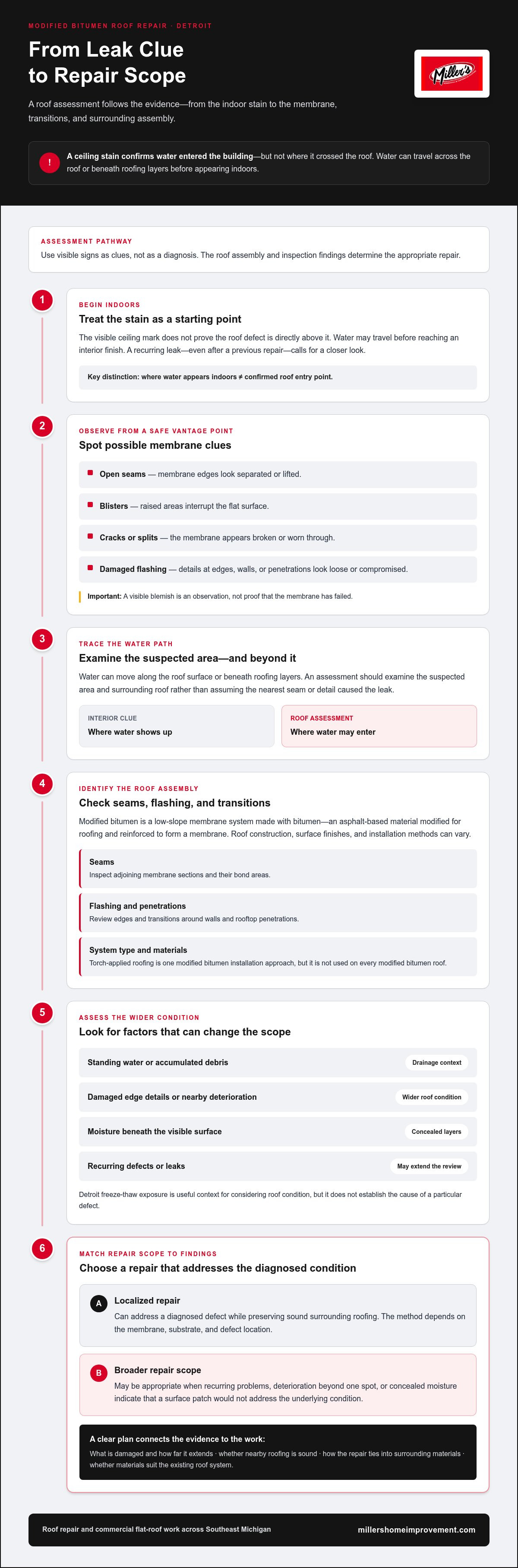
A ceiling stain confirms that water has entered the building, but it doesn’t show where the water crossed the roof. Water can travel along the roof surface or beneath roofing layers before appearing indoors. That’s why modified bitumen roofing repair Detroit property owners can rely on begins with tracing the leak and examining the roof, rather than assuming the defect sits directly above the stain.
Modified bitumen is a low-slope roofing membrane system. It’s a weather-resistant roof covering made with bitumen, an asphalt-based material modified for roofing use and reinforced to form a membrane. The general Modified Bitumen Roofing overview provides background on its use as a flat-roof material. An individual roof’s construction and condition still need an on-site assessment.
How modified bitumen roofing is assembled
A system may include reinforced membrane sheets and bitumen layers, but assemblies vary. Roofers may encounter different surface finishes and installation methods, depending on the system. Torch-applied roofing is one approach associated with modified bitumen, but it isn’t used on every modified bitumen roof. Identifying what’s installed helps ensure the repair plan reflects the actual material and assembly.
Signs a Detroit-area membrane needs attention
From a safe vantage point, property owners may notice clues that call for an assessment. Visible signs include:
- Open seams: Edges between membrane sections appear separated or lifted.
- Blisters: Raised areas interrupt the otherwise flat roof surface.
- Cracks or splits: The membrane surface appears broken or worn through.
- Damaged flashing: Material around roof edges, walls, or penetrations looks loose or compromised.
- Recurring leaks: Water keeps appearing indoors, even after a previous repair.
These are observations, not a diagnosis. A blister doesn’t automatically mean the membrane has failed, and an interior leak doesn’t prove the nearest seam is open. A professional inspection can examine the suspected area and surrounding roof to determine whether the visible clue connects to a membrane, seam, flashing, or another issue.
Standing water, accumulated debris, and damaged edge details also deserve attention because they can complicate an assessment of drainage and vulnerable areas. In Detroit, freeze-thaw exposure is useful context when considering roof condition, but it doesn’t establish the cause of a particular defect. A careful assessment separates visible evidence from conditions that need closer examination, giving the repair plan a sound basis.
How Modified Bitumen Roof Repairs Address Seams, Flashing, and Membrane Damage
A localized repair addresses a diagnosed defect while leaving sound surrounding roofing in place. That doesn’t mean every visible blemish calls for a patch, or that one repair detail suits every roof. A sound plan for modified bitumen roofing repair Detroit properties need accounts for the membrane’s condition, how the roof was assembled, the surface beneath it, and where water may be entering.
These factors shape both the repair method and its limits. Damage at a seam, for example, may require attention to the adjoining bond area. A defect near a wall or rooftop penetration involves a transition between materials. If moisture has reached concealed layers, or deterioration extends beyond the obvious defect, a small surface repair may not address the underlying condition. Inspection findings should guide the scope.
Repairing seams, penetrations, and flashing transitions
Seams join membrane sections, while flashing helps protect edges and transitions around walls and penetrations. Both need close inspection because a weakness at a connection can provide a path for water. A repair plan should identify the affected area, examine nearby bonds and materials, and explain how the work will tie into sound roofing. The appropriate method depends on the specific assembly, so don’t assume one repair detail will suit every roof.
Patching blisters, cracks, and damaged membrane areas
A blister, crack, or puncture may look limited at the surface, but the roofer should assess whether the damage extends beneath it. Preparation matters: the repair area needs to be evaluated and prepared appropriately, and materials must be compatible with the existing roof system. Applying material over a compromised or unsuitable surface can leave the source of the problem unresolved.
Recurring defects call for a wider look. If similar cracks or seam problems keep returning, the issue may involve more than one isolated spot. Reviewing the surrounding membrane and considering whether moisture has affected underlying components helps determine whether the repair scope should expand. Technical details should match the roof assembly and applicable manufacturer guidance.
A clear repair plan should make its reasoning understandable. Look for findings that connect the observed damage to the proposed work, rather than a generic promise to seal the roof. Useful points to review include:
- Defect and boundaries: What is damaged, and how far does the affected area extend?
- Roof condition: Is the adjacent membrane sound, or are there signs of broader deterioration or concealed moisture?
- Repair approach: How will the work address the defect and surrounding area using materials suited to the roof assembly?
- Scope limits: What conditions could call for additional work beyond the localized repair?
Miller’s Home Improvement handles roof repairs and commercial flat-roof work, including Torch Down systems. A careful assessment helps define a repair scope that fits the roof’s actual condition. Learn more about roof repair assessments as you plan the work.
Repair or Replace a Modified Bitumen Roof? Compare Scope Before You Decide
A single roof defect doesn’t automatically mean the whole roof needs replacement. The reverse is also true: sealing one visible leak may not be enough if the membrane has deteriorated across a larger area or moisture has reached underlying components. For modified bitumen roofing repair Detroit property owners should weigh the condition and extent of damage, not rely on one symptom alone.
A useful assessment connects visible evidence with the condition of the surrounding roof. It should distinguish an isolated problem from multiple weak areas, recurring leak locations, or concerns that affect the roof assembly beneath the membrane. This gives owners a clearer basis for comparing a targeted repair with broader roofing work.
When a targeted repair may be a reasonable option
A localized defect in an accessible area may be a candidate for repair when inspection shows the surrounding membrane remains serviceable. For example, damage near an otherwise sound transition may call for a more limited scope than recurring problems in several areas. The findings matter more than appearance alone: a small visible defect doesn’t establish how far the underlying issue extends.
Documenting repair locations and observed conditions gives owners a practical record. If a leak returns or a new concern develops, those notes help compare new evidence with the earlier assessment. A targeted repair can make sense when findings support it, but it shouldn’t replace an evaluation of the wider roof.
When broader roofing work deserves consideration
Repeated leaks, deterioration in multiple locations, and widespread membrane concerns are reasons to evaluate whether a localized approach remains appropriate. Concealed moisture is another consideration: if underlying materials are affected, addressing only the roof surface may leave important conditions unresolved. The assessment should explain what was found, how extensive it appears to be, and why the proposed scope fits those findings.
Depending on the roof’s overall condition, recommendations may extend beyond a small repair to broader restoration or replacement. That decision should account for the membrane and the materials beneath it, rather than relying only on the number of interior stains. For projects with a larger commercial scope, Miller’s guide to commercial roof replacement in Macomb County offers additional planning context.
If replacement is under consideration, the condition of existing roof layers and the need to address underlying components can shape the work involved. A Michigan roof tear-off assessment can help explain when removing existing roofing may be part of a broader project. The goal isn’t to choose the smallest scope by default, or the largest. It’s to match the work to documented roof conditions and make the reasoning clear before the project proceeds.
Planning Modified Bitumen Roof Repair in Detroit
A well-organized repair starts with useful information and a clear scope. For modified bitumen roofing repair Detroit property owners can plan with confidence by documenting where and when leaks appear, arranging a roof assessment, reviewing the findings, agreeing on the work, and coordinating access before repairs begin. This sequence connects reported symptoms to roof conditions without treating an interior stain as a diagnosis.
Detroit-area weather is part of the schedule. Cold temperatures, precipitation, and changing conditions can affect when roof work can proceed. Timing depends on the roof, repair requirements, and conditions at the property. For a commercial building, plan around roof access and affected operations, and let occupants know what areas or activities may be disrupted.
What a thorough roof assessment should examine
An assessment should consider the membrane field, seams, flashing, edges, penetrations, and drainage details as parts of one roof system. Interior moisture clues, such as the location and recurrence of a stain, can help guide the investigation, but they don’t automatically prove where water entered. Clear notes on observed conditions and the proposed repair scope make it easier to understand what the work is intended to address.
Before the assessment, record the room or area affected, when water appears, and whether the leak recurs. Photos taken from a safe location can help show changes over time. Share relevant details about roof access, drains, equipment, and penetrations. Don’t climb onto the roof to investigate. Plan access and inspection with safety in mind.
How to prepare the property and coordinate repair work
Confirm how the roof can be reached and whether the work may affect building entrances, business operations, or occupied areas. If water is actively entering, protect interior contents where practical and keep people away from wet or affected spaces. Discuss how access and work areas will be coordinated, especially in commercial buildings. For system-specific context, Miller’s guide to Torch Down roof repair in Michigan covers a related modified bitumen approach.
Once the assessment is complete, review the documented findings and proposed scope before work begins. Make sure the plan identifies the area being addressed and explains how the repair relates to the observed conditions. Clear communication helps property owners prepare occupants, protect interior spaces, and understand next steps if conditions change during the work.
For a repair plan grounded in the roof’s condition, schedule a modified bitumen roof assessment with Miller’s Home Improvement.
Modified Bitumen Roof Repair in Detroit with Miller's Home Improvement
A reliable repair plan begins with understanding the roof that’s actually on the building. Miller’s Home Improvement is a Michigan roofing contractor serving Detroit and Southeast Michigan, with commercial flat-roof experience, Torch Down systems, and roof repairs. Torch-applied roofing is one approach associated with modified bitumen, but assemblies differ. An assessment connects the roof’s condition and leak evidence to a project scope suited to the property.
The company brings more than 25 years of owner experience and 13 years in business to roofing work. Miller’s is licensed and insured. For property owners considering modified bitumen roofing repair Detroit, those credentials provide useful context alongside a clear explanation of observed conditions and proposed work.
What property owners can expect from Miller's
A professional assessment considers the roof’s condition, reported leak evidence, and the scope needed to address the findings. The goal is to determine whether the issue appears localized or calls for broader work, then explain the reasoning in practical terms. Miller’s tailors the project scope to the property rather than assuming one repair approach fits every flat roof or membrane assembly.
Residential property owners can request a free in-home estimate. For flat-roof concerns, sharing when and where water appears, any previous repairs, and changes noticed over time provides useful context. The assessment findings can then inform proposed next steps, giving owners a clearer basis for planning the work.
Choose a practical next step for your flat roof
Before an assessment, note the interior locations affected, when leaks occur, and whether earlier repairs addressed the same area. Keep photos or records available. These details don’t replace a roof inspection, but they help establish a useful timeline and give the assessment a more informed starting point.
Commercial property owners can also identify roof access arrangements and building operations that may need coordination. Consider which entrances or work areas could be affected and how occupants should be informed. Sharing those needs early helps align the repair plan with the practical demands of the property.
To discuss a Detroit-area flat-roof assessment, request a roofing estimate from Miller's Home Improvement. A careful review of the roof and its conditions helps establish an appropriately scoped repair plan.
Move Forward With a Clear Roof Plan
Roof concerns are easier to manage when the next decision is based on current conditions rather than guesswork. Keep a simple record of new water entry, changes in the affected area, and steps taken to protect the interior. If the leak changes or appears in another location, add that detail. This history gives the assessment useful context and helps keep the focus on protecting the property.
With modified bitumen roofing repair Detroit, the goal isn’t to decide on repair or replacement before the roof is evaluated. It’s to understand what the building needs now and use that information to set a practical scope. A measured approach gives you a stronger basis for planning work, coordinating building access, and making informed decisions about what comes next.
Take the next step toward a roof plan tailored to your property. Request a roofing estimate from Miller's Home Improvement and move forward with greater clarity.
Frequently Asked Questions
What is modified bitumen roofing?
Modified bitumen roofing is a low-slope roof covering made from asphalt-based bitumen modified with polymers and reinforced to form a membrane. It is installed in layers, though the exact assembly, surface finish, and application method vary by roof. For a property owner, the practical point is that seams and flashing details are part of the system. Knowing the existing assembly helps guide compatible maintenance or repair decisions.
Is modified bitumen the same as Torch Down roofing?
No. Modified bitumen describes a roofing membrane system, while Torch Down refers to one way of applying certain membranes using heat. Some modified bitumen roofs are torch-applied, but the terms aren’t interchangeable because modified bitumen systems can use different application methods. Before planning work, identify the roof assembly and installation approach. A repair method suitable for one system may not be appropriate for another.
Can modified bitumen roofing be repaired instead of replaced?
Yes, modified bitumen roofing can sometimes be repaired rather than replaced, depending on the roof’s overall condition. In modified bitumen roofing repair Detroit assessments, a contained puncture with sound surrounding material presents a different situation from recurring leaks across several areas. A roofer should consider the membrane and underlying roof components before recommending a scope. If moisture or deterioration extends beyond the visible damage, a surface repair may not address the full concern.
How long does a modified bitumen roof repair last?
There isn’t one reliable lifespan for every modified bitumen roof repair. Performance depends on factors such as the repair’s scope, the condition of the surrounding roof, and whether the work addresses the source of water entry. A patch over a symptom may not perform like a repair based on a diagnosed defect. Keep a record of the repair’s location and date with your roof documents for future reference.
Can modified bitumen roofing be repaired during cold weather in Detroit?
Sometimes, but suitable timing depends on the roof system, repair materials, weather, and site conditions. Cold, snow, ice, or a wet surface may affect safe access or whether a particular repair can be completed according to applicable manufacturer guidance. Don’t assume a repair is suitable just because the damaged spot is accessible. An assessment can help determine whether work can proceed under current conditions or should be scheduled for a more suitable window.
What causes modified bitumen roof seams to open?
An open seam can have several possible causes, including changes in the bond between membrane sections, movement in the roof assembly, or wear over time. Exposure to Detroit’s changing temperatures may be relevant context, but it doesn’t establish the cause of a particular opening. The seam and nearby membrane should be examined together. If similar openings appear in several places, that pattern can help determine whether the issue is isolated.
Does ponding water always mean a modified bitumen roof must be replaced?
No. Ponding water alone doesn’t prove a roof needs replacement. An assessment should consider where water remains, how drainage is functioning, and whether the membrane or nearby details show damage. Standing water near a drain, for example, may call attention to drainage conditions, but it doesn’t by itself confirm membrane failure. Document the location and discuss it during an inspection so the roof’s condition, rather than the symptom alone, informs next steps.


