
The monthly payment isn't the only thing that determines whether a roof loan fits your budget. Roof replacement financing options can run from a few months to 10 years or more, depending on the financing type, while terms for a new roof replacement are generally between 3 and 12 years. A longer term may reduce each payment, but it can also mean paying interest for longer.
Look beyond the monthly payment: the loan structure, interest rate, and repayment period all affect what you’ll pay overall. Understanding how these terms work together makes it easier to choose a financing option that fits your budget.
This guide explains the main ways to finance a roof, how long repayment can take and what to consider when setting a budget. You’ll also learn how project details and the condition of your roof shape the next steps, so you can make a clear, informed decision.
Key Takeaways
- Compare home equity loans and HELOCs by how you access funds, what secures the debt, and how repayment is structured.
- Look beyond the monthly payment: a fixed rate can make payments predictable, while the term affects the total interest paid.
- Unsecured personal loans avoid using your home as collateral, but approval and rates depend on your credit profile and loan terms.
- Build a realistic roof budget around the work required, then choose a financing approach that fits your financial priorities.
Do roofers offer payment plans?
Some roofing contractors offer financing, while homeowners can also arrange funds through a lender. Common options include home equity loans, HELOCs, and personal loans, each with different collateral requirements and repayment terms.
Collateral and Home Equity Requirements
A home equity loan or HELOC uses your property as collateral, so the lender considers its value and your mortgage balance. An appraisal may help establish the home’s current value and available equity. A personal loan generally doesn’t require home equity or use your home as collateral, which may suit homeowners with limited equity. Lenders still assess credit and income to determine repayment capacity.
Borrowing Limits and Qualification
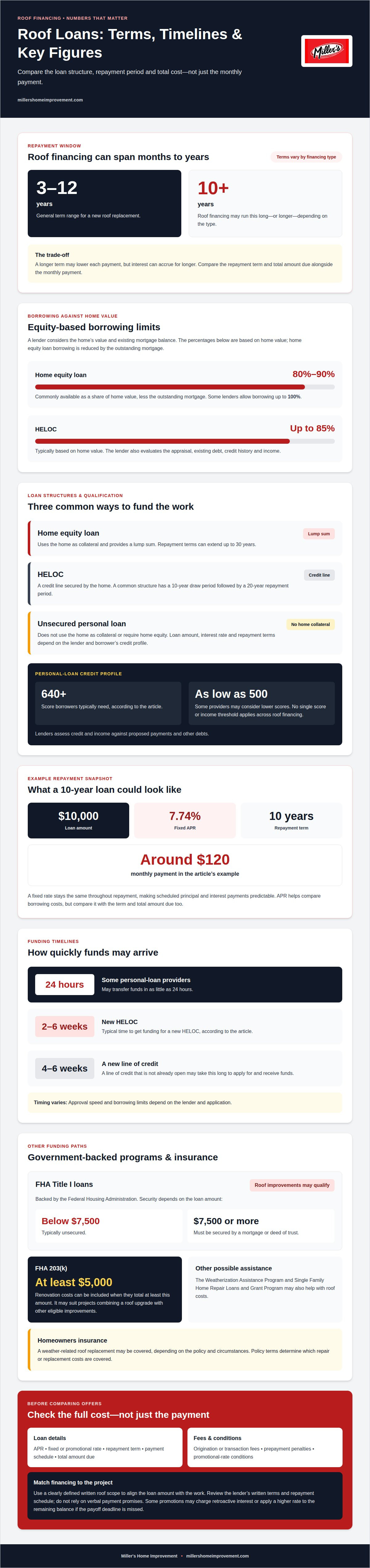
Home equity loans commonly allow borrowing up to 80% to 90% of a home’s value, less the outstanding mortgage; some lenders allow up to 100%. HELOC lenders typically allow borrowing up to 85% of home value. A lender evaluates the appraisal, existing debt, credit history, and income. There’s no single credit score or income threshold across roof financing; personal loan borrowers typically need a score of at least 640, though some providers may consider scores as low as 500. Income is assessed against the proposed payments and other debts.
Comparing Equity Options With Personal Loans
A home equity loan provides a lump sum, often with repayment terms up to 30 years. A HELOC is a credit line: a common structure has a 10-year draw period followed by a 20-year repayment period. Funding a new HELOC typically takes two to six weeks. A personal loan provides funds without home collateral, but its interest rate and loan amount depend on the borrower’s credit profile and lender criteria.
For a planned project with a defined cost, compare a lump-sum loan with a HELOC’s payment structure. If you have limited equity, a personal loan avoids pledging your home, but compare its rate and term with secured borrowing. These differences can help you narrow your roof replacement financing options before committing.
How long can you finance a roof for?
Roof financing can last from a few months to 10 years or longer, depending on the financing type. Terms for a new roof replacement generally range from 3 to 12 years.
Interest Rates and Repayment Terms
A fixed interest rate stays the same throughout repayment, making scheduled principal and interest payments predictable. APR helps compare borrowing costs, but doesn’t capture every effect of interest compounding. Compare APR alongside the repayment term and total amount due, rather than focusing only on the monthly payment.
For example, a $10,000 roof loan at a fixed 7.74% APR over 10 years has a monthly payment of around $120. Longer terms can reduce each payment while extending how long interest accrues. Some homeowners choose 120 months or longer to fit payments into their budgets.
Financing Amounts and Funding Timelines
The loan amount and term depend on the financing type, project amount, and borrower’s credit profile. Personal loans may offer terms from a few months to 10 years or more. A new line of credit that isn’t already open may take 4-6 weeks to apply for and receive funds; some personal loan providers can transfer funds in as little as 24 hours.
Before applying, match the requested amount to the project scope, then compare each offer’s APR, fixed or promotional rate, term, and payment schedule. Approval timing and borrowing limits vary by lender and application.
To compare offers and guard against financing scams, review the lender’s written terms, APR, repayment schedule, and total amount due. Don’t rely on a verbal promise about payments.
Check for origination or transaction fees, prepayment penalties, and conditions tied to promotional rates. Some promotions may apply a higher rate to the remaining balance and charge retroactive interest if you miss the payoff deadline.
A clearly defined roofing scope helps you align the loan amount with the work. Explore residential roofing services as you plan the project.
Unsecured personal loans for roof replacement
An unsecured personal loan can fund roofing work without using the home as collateral. The loan amount, interest rate, and repayment terms depend on lender criteria and the borrower’s credit profile. Homeowners often choose Miller's Home Improvement for reliable roofing services after securing their funding.
Compare the full repayment cost as well as the monthly payment. A lower payment may reflect a longer term, while a higher APR increases borrowing costs. A personal loan may suit homeowners with limited equity or those who prefer not to secure debt against their property.
Government-backed funding may also fit a roof repair or replacement. FHA Title I loans are backed by the Federal Housing Administration and may fund home improvements such as roofing. Amounts below $7,500 are typically unsecured; loans of $7,500 or more must be secured by a mortgage or deed of trust. The Weatherization Assistance Program and Single Family Home Repair Loans and Grant Program may also help with roof costs.
For broader renovation work, an FHA 203(k) loan can include renovation costs when they total at least $5,000. This route may suit homeowners combining a roof upgrade with other eligible home improvements, rather than financing roofing alone. Compare the scope each loan can cover before choosing.
Homeowners insurance may cover a new roof needed after a weather-related event, depending on the policy and circumstances. Policy terms determine which repair or replacement costs are covered.
Before applying, match the roof project’s written scope to the requested loan amount, then compare APR, repayment term, collateral requirements, and eligible uses. A personal loan may avoid using your home as collateral, while FHA Title I and renovation loans have their own security or project conditions.
Roof replacement and repair budgeting
Build your budget around the work required, not a target monthly payment. Ask for an estimate that breaks down the roof scope, materials, labor, and any additional repairs. Roof size, pitch, material choice, and underlying damage can affect the work, so a clear scope helps you match funding to the project.
Compare the written estimate with the amount you plan to borrow, then review the term, interest rate, and monthly payments together. A longer repayment period may lower the monthly payment but increase total interest. Your credit profile can also affect available terms, so assess the full repayment commitment rather than choosing by payment alone.
Include financing charges in the budget. Contractor financing with no interest may increase the total bill by up to 10% to cover a dealer fee. Promotional terms can also carry conditions, including higher rates or retroactive interest if the balance remains when the offer ends. Check how the total due changes after the promotional period before accepting funding.
For a robust estimate, consult at least three roofing professionals before taking out a roof replacement loan. Use each written scope to identify differences in included work, then base the requested loan amount on the project you intend to complete. A repair may be the right budget decision when the roof issue is limited; more extensive damage may call for replacement planning.
The National Association of the Remodeling Industry’s 2019 Remodeling Impact Report reported that homeowners may recover 107% of a new roof’s cost after installation when selling. Treat resale value as one budgeting consideration, not a substitute for comparing financing terms and immediate affordability.
For roof repairs related to storm damage, request an assessment of the roof damage to clarify the work scope before settling on a funding amount.
Miller's Home Improvement
Miller's Home Improvement helps Detroit-area homeowners define the roofing work their property needs before they decide how much to borrow. A clear project scope can show what the funding needs to cover and help avoid financing unnecessary work. Residential Roofing and flat-roof systems, including PVC and EPDM, suit different roof types and project requirements.
Turn to Miller's Home Improvement to assess whether your roof needs repair or replacement before settling on a loan amount. The work scope gives you a practical basis for comparing funding offers, repayment terms, and monthly payments with your lender.
Contact Miller's Home Improvement for a free in-home estimate and discuss the roofing work your property needs.
Set Your Next Step With Confidence
Before choosing a loan, make the roofing decision concrete: clarify the work your property needs, then align the funding with that scope. The best roof replacement financing options are the ones whose repayment fits your budget without distracting from the quality and durability of the work. A well-defined project gives you a steadier basis for moving forward.
Miller's Home Improvement handles the roofing work behind that decision, from Residential Roofing and Commercial Roofing to PVC Flat Roofing. A clear understanding of the project helps you weigh financing against the roof’s practical needs, rather than treating the loan as a separate decision.
When you're ready to discuss the roofing work your property needs, contact Miller's Home Improvement. Take the next step with a clear scope and a financing plan that works for you.
Frequently Asked Questions
Can I pay monthly for a new roof?
Yes, financing such as a personal loan, home equity loan, or HELOC can be repaid in monthly installments. The payment depends on the amount borrowed, interest rate, and repayment term. A fixed-rate loan has scheduled payments across its term, while a HELOC may have different payment phases. When working with Miller's Home Improvement, first define the work your roof needs, then compare the payment with your household budget.
How much does it cost to replace a roof?
The cost depends on the roof’s size, pitch, materials, and scope of work, including whether the existing roofing needs removal or underlying damage needs repair. One figure won’t reflect every Detroit home or roof system. Get a written estimate from Miller's Home Improvement that separates the work and materials, then use that scope to plan funding. Borrow only for the work the project requires.
What financing options are available for roof replacement?
Homeowners may consider personal loans, home equity loans, HELOCs, credit cards, cash-out refinancing, and government-backed home improvement financing. These options differ in collateral, application requirements, access to funds, and repayment structure. A credit card may suit a smaller repair if its introductory terms fit your payoff plan, while a renovation loan may be relevant when roofing is part of broader home improvements. Compare total repayment, not just initial payments.
What are typical roof replacement loan interest rates, terms, and monthly payments?
Rates, terms, and payments vary with the loan type, amount, and borrower’s credit profile. Personal loan APRs for roof financing range from 5.99% to 35.99%; terms can extend from a few months to 10 years or longer. A $10,000 loan at a fixed 7.74% APR over 10 years has a monthly payment of around $120. Treat that as an example, not a personalized offer.
Can you finance a roof replacement with a contractor loan or payment plan?
Some roofing contractors, including Miller's Home Improvement, offer financing through lending partners, including promotional plans. A promotion may offer low or no interest for a period, but check the terms: any remaining balance could face a higher rate or retroactive interest. Review the written agreement for the deadline, payment schedule, fees, and consequences of carrying a balance. Don’t assume a payment plan stays interest-free throughout repayment.
Are FHA Title I or other government programs available to finance roof repairs or replacement?
Yes. FHA Title I loans are backed by the Federal Housing Administration and may fund roofing improvements. Amounts below $7,500 are typically unsecured, while loans of $7,500 or more must be secured by a mortgage or deed of trust. The Weatherization Assistance Program and Single Family Home Repair Loans and Grant Program may also help with roof costs. Eligibility and eligible work differ by program, so review those conditions before planning funds.


