
The lowest roofing quote isn’t always the strongest deal. A roofing price match guarantee is conditional: the quotes need to cover comparable roof scope, materials, installation details, and warranties, while the written offer terms determine eligibility. A lower total may reflect work or protection left out of the estimate.
Comparing roofing quotes can be difficult when the totals differ and the details don’t line up. This guide explains how scope, materials, warranties, and other terms affect a roofing price match guarantee, and what to review before deciding whether two bids are genuinely comparable.
Key Takeaways
- Compare the work included in each quote, not just the total, so key roof details aren’t overlooked.
- Look at materials, installation methods, and warranty terms to understand what may explain a price difference.
- Learn which quote details can affect eligibility for a price match and how to assess whether bids are comparable.
- Understand why a price-match offer is conditional and what terms shape the next step.
Matching roof scope, materials, and warranties
A roofing price match guarantee may apply when another written quote covers the same work under comparable terms. It does not necessarily mean matching any lower total. Scope, materials, installation details, and warranties all affect whether the offers are equivalent.
Materials, labor, permits, and disposal are included only when the offer says so. A quote that includes tear-off and debris removal, for example, is not directly comparable with one that excludes those tasks. Check that both documents describe the same roof area and work, including flashing, ridge caps, ice shield, ventilation, synthetic felt installed with cap nails, and sealant. Missing details can affect both the total and the finished roof.
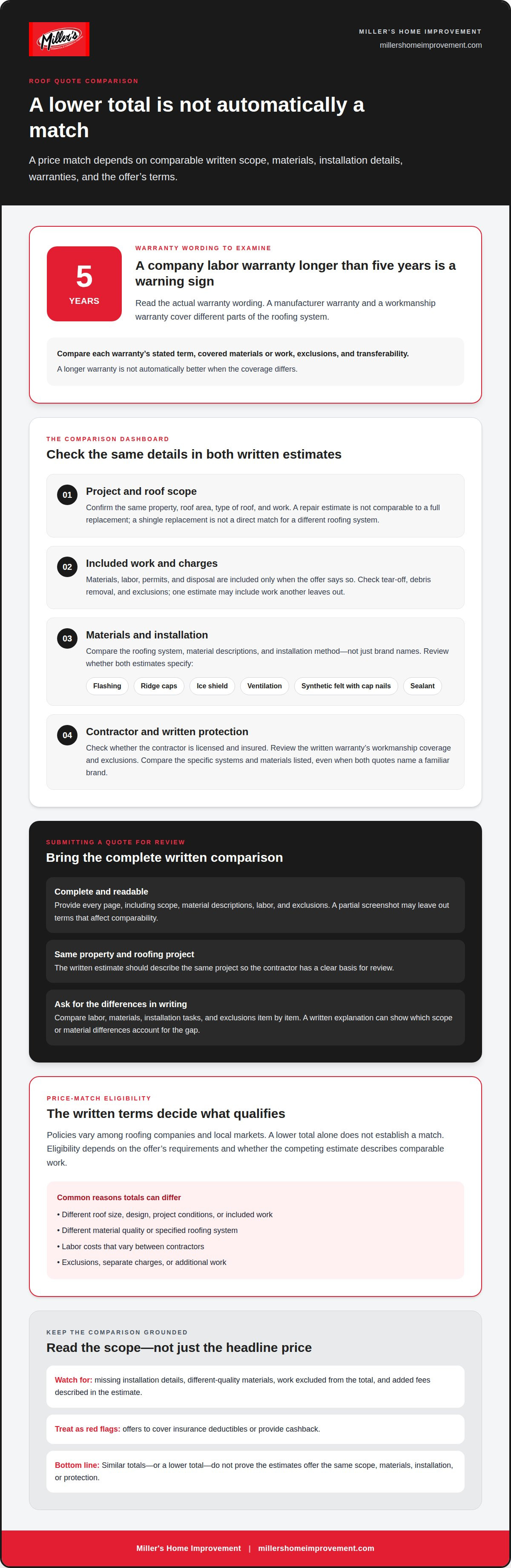
Compare warranty terms closely. A manufacturer warranty and a workmanship warranty cover different parts of the roofing system, so review each document’s coverage and exclusions. Note the stated term, covered materials or work, and any transferability terms. A longer warranty is not automatically better if the coverage differs. One warning sign in quote comparisons is a company labor warranty longer than five years. Read the actual wording rather than relying on the headline.
For a practical review, put the quotes side by side and mark what each includes. Compare the roofing system, installation method, flashing, leak barriers, and ventilation. Check whether the contractor is licensed and insured, and whether the written warranty clearly describes workmanship. Flashing helps keep water from seeping inside, leak barriers matter at eaves, valleys, and roof penetrations, and ventilation helps manage moisture buildup.
Even if a contractor says, “I’ll beat any quote,” ask what qualifies as a match. Price depends on roof size, design, materials, and included work; your quote sets out the amount for your project. Clear terms help you compare offers without overlooking work or assuming that different coverage is equivalent.
Lone Wolf Roofing advises comparing materials, installation details, warranties, licenses, insurance, and the work included in the contract, not just the total. Integrity Roofing highlights flashing, ridge caps, ice shield, ventilation, synthetic felt installed with cap nails, sealant, and warranties as details that can be compromised to reduce costs.
Reviewing and explaining quote differences
Written estimates for the same roof can differ because labor costs and material quality vary. Before considering a price match, compare what each quote includes.
Submitting a Competitor Quote
To request a comparison, provide a complete, readable copy of the competing written quote. Attach or send a digital copy by text if that option is available. Include every page, especially the scope, material descriptions, labor, and exclusions. A partial screenshot may leave out terms that affect whether the estimates cover the same work.
Use a quote for the same property and roofing project. An estimate for a repair is not comparable to one for a full replacement. The written document gives the contractor a clear basis for reviewing the request.
Explaining Quote Differences
Review the estimates item by item, separating labor from materials and comparing the roofing system, installation tasks, and exclusions. One quote may include tear-off while another covers installation without removal. That difference can explain a lower total without meaning the contractors are offering the same scope.
Material descriptions matter, too. Quality materials and craftsmanship can affect both the specified system and how the work is performed. Estimates may also differ because contractors pay different labor prices. A written explanation should identify which scope or material differences account for the gap. To discuss how roofing estimates are reviewed, share the competing quote and project details.
Extra Fees and Lowest-Quote Risks
Can a roofing company match a lower quote and still charge extra fees? Yes, if the matched scope excludes certain work or the written terms list separate charges. Review exclusions and added work in the estimate to understand exactly what the total covers.
To request a match, provide the complete written quote and ask for a written explanation of how its scope compares. The lowest quote may omit installation details or specify different-quality materials. Offers to cover insurance deductibles or provide cashback are also red flags in roofing comparisons. Focus on the written scope, materials, and terms, not just the headline total.
Eligibility for a roofing price match
Eligibility depends on the written offer’s terms and whether the competing estimate covers comparable work. A lower total alone does not establish a match. The review needs to compare the property, roofing system, materials, labor, and stated exclusions.
Price-match policies vary among roofing companies and local markets. Labor costs, available materials, and project conditions can differ by location, and each company sets its own terms. For Detroit homeowners, the key question is whether both written estimates describe the same project and scope, not whether a policy uses the same wording elsewhere.
Start by reviewing the offer’s requirements. A complete competing quote shows the work, materials, and terms being compared. Check whether the roofing price match guarantee applies to the same type of roof and installation. For example, a shingle replacement estimate is not a direct match for a different roofing system or a quote that includes additional work.
Compare brand names carefully, too. If an estimate names a GAF system, the name alone does not prove another quote is equivalent. Compare the specific systems and materials listed in both documents, along with the installation scope and warranty terms. This keeps the decision tied to written specifications rather than assumptions based on brand recognition.
Before deciding, compare the estimates and identify differences that could affect the price. Check whether both include the same roof area, removal work, installation tasks, and materials. Missing or different terms can change the result, even when the quotes are for the same address.
For a clear review, submit the complete written estimate alongside the offer terms. This gives the roofing company a consistent basis for assessing eligibility and explaining its decision. It also keeps the comparison focused on the actual scope, not a headline total or incomplete description.
Conditional roofing price-match offer
A price match is conditional, not a promise to match every lower total. The offer’s terms define which written quotes qualify, what work must match, and how the comparison is handled. Treat it as a question of equivalent roofing work, not simply reducing an estimate’s total.
Roofing companies across the United States set their own price-match terms. There isn’t one nationwide list of companies or shared eligibility rule. The written offer explains whether a competing quote qualifies and what details must align before a match can be considered.
Read the conditions before treating two quotes as equivalent. Compare the roofing system, materials, underlayment, installation tasks, and exclusions. A quote that omits underlayment or roof removal describes different work from one that includes those items. A lower total may reflect a narrower scope, not the same work at a lower price.
A clear offer explains what happens when estimates differ. It may require a complete written quote, a comparable project, and matching materials or work. The contractor can explain which differences matter and whether they affect eligibility. That helps homeowners understand the terms before committing, rather than relying on a verbal promise to “beat” another quote.
Price should not come at the expense of the roofing system. Cutting corners on materials or installation can undermine a roof replacement. Review whether the written scope specifies underlayment, workmanship, and included protections, and consider whether the contractor is insured. A clear comparison helps you weigh quality and scope alongside price instead of assuming the lowest total is the best value.
If you believe your quotes describe equivalent work, share both documents and request a written explanation of the offer’s terms. Discuss your roofing quote and the scope you’re comparing.
Miller's Home Improvement
Miller's Home Improvement works with homeowners planning roofing projects and comparing estimates in Detroit. Services include residential and commercial roofing, PVC and EPDM flat roofing, roof repairs, and complete tear-offs. A free in-home estimate can clarify the work and materials proposed for your property, so you can understand what each quote covers before deciding.
If you’re comparing proposals, share your roofing project details and the work you’re considering. That gives you a practical starting point for discussing the scope and next steps, without assuming that a lower total means two offers are equivalent.
Contact Miller's Home Improvement to discuss your roofing project.
Make Your Next Roofing Decision With Clarity
A roofing price match guarantee can inform your decision, but it should not make it for you. Choose a proposal that clearly explains the work and supports the outcome you want for your property. Resolve unclear terms before committing. A sound decision starts with understanding what you’re agreeing to, not pressure to accept the lowest total.
Your next step is simple: share your project details and the estimate you’re considering with Miller's Home Improvement. Request a free in-home estimate to discuss your roofing needs and project scope, and move forward with a clearer plan.
Discuss your roofing project with Miller's Home Improvement, and take the next step with confidence.
Frequently Asked Questions
What conditions must a competing roofing estimate meet for a price match?
A price-match request generally needs a complete written estimate for the same property and roofing project. The offer’s terms determine eligibility, so check requirements such as matching work categories, materials, and included services. For a Detroit home, a quote for the house roof is not automatically comparable to one that also covers a garage roof. A clear estimate helps identify the difference.
How do roofing contractors verify and compare competing quotes?
Contractors compare the written details with the project being priced, then identify differences or points that need clarification. If one estimate includes a detached garage and another does not, for example, the scopes differ. The review can also separate a stated task from an assumption: “replace roof” may not explain every part of the proposed work. Written explanations keep decisions grounded in the documents.
Are there exclusions such as different shingles, warranties, or project scope?
Yes, an offer may exclude quotes that differ in shingles, warranty terms, or project scope. A proposal specifying one shingle type may not be equivalent to one specifying another. A repair estimate and a replacement estimate also describe different work. Read the offer’s exclusions alongside the estimate, and note any changes made after an inspection before treating the documents as comparable.


