
Most Michigan homeowners wait for a missing shingle to fall in the yard before they worry about a storm, but the most dangerous roof damage is often the kind you can't see from the driveway. It's natural to feel uncertain about what your insurance covers or whether those recurring high winds are slowly compromising your home's integrity. You want peace of mind, not a surprise attic leak in the middle of a winter thaw. By learning the specific signs of wind damage on roof Michigan properties typically experience, you can identify subtle seal failures before they escalate into major structural issues.
This guide provides a clear checklist of symptoms to look for, from minor wear to significant storm impact. You'll learn how to differentiate between standard aging and true wind uplift, giving you the confidence to navigate the claims process and protect your property's value. We'll walk through exactly what to document so you can maintain a safe, dry home for your family and ensure your roof is ready for whatever the Great Lakes send next. Being proactive today prevents the hidden mold and structural decay that often follows a neglected storm event.
Key Takeaways
- Understand how atmospheric uplift and Great Lakes weather patterns create pressure that can compromise your roof’s structural integrity.
- Learn to identify the specific signs of wind damage on roof Michigan homes often face, including creased shingles and failed perimeter seals.
- Discover the "parachute effect" and other warning signs unique to commercial flat roofing systems like PVC, EPDM, or torch down.
- Follow a safe, ground-level inspection strategy to document storm impact without putting yourself at risk on a ladder.
- Simplify your insurance claim process by understanding how professional documentation and a free in-home estimate ensure a fair assessment from your adjuster.
Understanding How Michigan Wind Storms Impact Your Roof
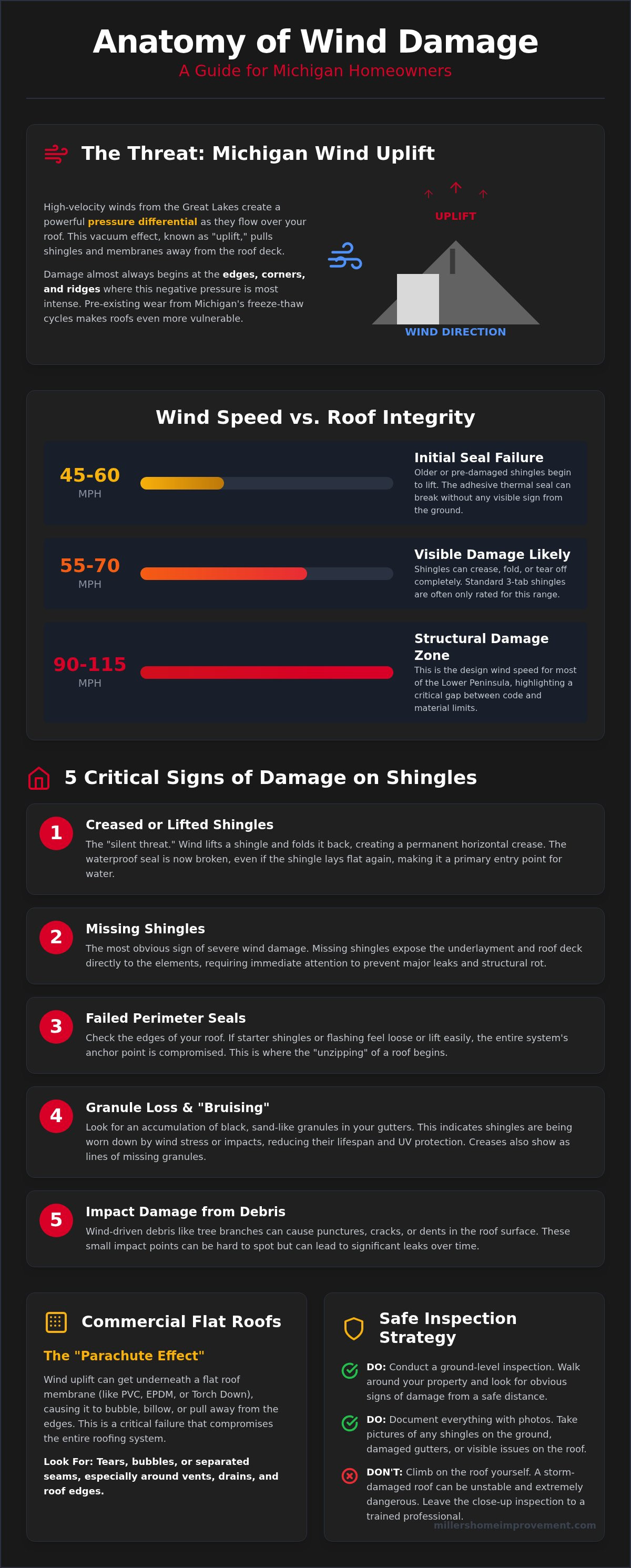
Michigan roofs face a unique set of atmospheric challenges that go beyond simple gusts. Because of our proximity to the Great Lakes, wind patterns often involve sustained, high-velocity air that gains momentum over open water before hitting residential neighborhoods in Southeast Michigan. This creates a specific type of stress known as the "uplift" effect. When wind hits the side of your home, it's forced upward and over the roofline, creating a pressure differential. This vacuum effect literally pulls at your shingles or commercial membranes, trying to lift them away from the roof deck. While you might expect damage to happen in the center of the roof, it almost always starts at the edges and corners where the pressure is most intense.
The age of your roofing system plays a critical role in how well it survives these events. Over time, the thermal seal on asphalt shingles in the Detroit area becomes brittle due to our intense seasonal shifts. Once that adhesive bond fails, even moderate winds can catch the edge of a shingle and peel it back. Beyond the wind itself, we also see significant secondary damage from wind-driven debris. Falling tree branches or flying debris from nearby construction can create impact points that puncture the roof surface, leaving your home vulnerable to the next rainstorm.
The Science of Wind Uplift in Southeast Michigan
Wind uplift isn't just about the wind blowing against the shingles; it's about the negative pressure created as air moves quickly across the roof surface. This suction is most dangerous at the perimeter. If the flashing or starter shingles aren't perfectly secured, the wind finds a foothold and begins to unzip the roof. In Michigan, our frequent freeze-thaw cycles often expand and contract these materials, subtly loosening fasteners or cracking sealants before a storm even arrives. This pre-existing wear makes it much easier for wind to compromise the system's integrity.
Wind Speed vs. Roof Integrity
Many homeowners believe their roof is safe unless they experience a tornado, but the reality is more nuanced. Data shows that signs of wind damage on roof Michigan properties can begin with wind speeds as low as 45 to 60 mph, particularly on older or poorly maintained systems. Once winds reach the 55 to 70 mph range, significant structural damage becomes much more likely.
- Straight-line winds: These common Southeast Michigan gusts can push over large areas, causing widespread seal failure across an entire slope.
- Microbursts: These localized, intense downdrafts can hit a single home with enough force to mimic a small tornado, often focusing damage on one specific section of the roof.
- Hidden Damage: It's common for a storm to break the adhesive seal on shingles without blowing them off. While the roof looks fine from the ground, it's no longer water-tight.
Most of the Lower Peninsula falls into design wind speed zones of 90 to 115 mph, but standard 3-tab shingles are often only rated for 60 to 70 mph. This gap between local building standards and material limitations is why professional inspections after a storm are so vital for your peace of mind.
5 Critical Signs of Wind Damage on Residential Shingles
Missing shingles are the most obvious indicators of a compromised roof deck, but they represent only the most extreme cases. Most high wind events in the Detroit area leave behind subtle symptoms that require a closer look to detect. Professional inspectors look for specific signs of wind damage on roof Michigan structures to determine if the integrity of the system has been fundamentally broken or if a simple repair will suffice.
Identifying Creased and Lifted Shingles
A creased shingle is a silent threat to your home's safety. This occurs when a gust is strong enough to lift the shingle but not powerful enough to rip it away. The shingle flaps upward and folds back on itself, creating a permanent horizontal line of "bruising" or broken granules across the top. Shingle tabbing is the primary defense against Michigan gusts, and once that adhesive seal is broken, the shingle loses its ability to shed water. Even if a shingle looks flat from the ground, the wind may have already "unzipped" the thermal bond, leaving it vulnerable to the next rainstorm.
You can sometimes identify these failures by checking the perimeter of your roof. If the edges feel loose or the shingles lift easily with very little pressure, the system is no longer secure. This type of damage is often overlooked by insurance adjusters who only look for missing materials, yet it's a leading cause of slow attic leaks and eventual mold growth.
Checking Gutters and Downspouts for Clues
Your gutters often hold the evidence of a storm's severity. High winds create intense friction across the roof surface, scrubbing off the protective mineral granules that shield the asphalt from UV rays. If you find excessive amounts of these sand-like particles in your downspouts after a storm, your shingles have likely suffered accelerated aging. You should also look for pieces of shingle "teeth" or small black sealant strips on the lawn; these are clear indicators that the wind has physically torn the material.
Extreme wind force can also pull gutters away from the fascia board or cause them to sag. If your gutters appear misaligned or are hanging at an odd angle, it's a sign that wind has entered the soffit area, creating internal pressure. If you notice these issues, scheduling a professional roof repair assessment is the most reliable way to verify the condition of your home. A seasoned craftsman can distinguish between standard wear and legitimate storm damage, ensuring your property remains protected throughout the changing seasons.
Signs of Wind Damage on Commercial Flat Roofing Systems
Commercial flat roofing systems in Southeast Michigan face a different set of physics during a windstorm than residential homes. Because these buildings often have larger, unobstructed surface areas, they are particularly susceptible to extreme pressure differentials. Identifying the signs of wind damage on roof Michigan commercial buildings involves more than just looking for leaks; it requires a disciplined inspection of the membrane's attachment and the security of the perimeter hardware. While residential damage is often visible as missing material, commercial failure is frequently hidden beneath the surface of the membrane.
Billowing and Parachuting in PVC and EPDM
When a breach occurs in the roof's edge or a seam, air can force its way beneath the membrane. This creates the "parachute effect," where the material billows upward away from the substrate. This air infiltration is a critical failure that compromises the entire system. If left unaddressed, sustained Michigan winds can eventually pull the entire membrane off the roof deck. You might notice subtle ripples or tent-like ridges across the surface. These ridges suggest that mechanical fasteners have begun to pull out of the deck under the stress of the uplift, a clear sign that the system's structural integrity is failing.
Perimeter and Flashing Failure
The edges are the most vulnerable points for any flat roof. You should carefully check the metal coping and termination bars for any gaps, warping, or loose fasteners. If these components are compromised, wind-driven rain can be forced deep into the roofing assembly, saturating the insulation. For EPDM flat roofing or PVC flat roofing, the corners are where wind pressure is highest, making them the most likely spots for initial failure. In torch down flat roofing, check the seams specifically; while these systems are exceptionally durable, extreme wind can cause micro-tears at the lap joints that lead to slow, persistent leaks.
High winds often dislodge rooftop equipment, such as HVAC access panels, vent covers, or loose gravel from ballasted systems. If these items are blown across the roof, they can create puncture points in the membrane. These small holes are difficult to spot from a distance but allow water to enter the building's interior. Finding loose hardware or branches on your commercial roof is a clear indicator that a professional inspection is necessary to verify the integrity of the watertight seal and prevent costly interior damage.
How to Safely Inspect Your Roof After a Michigan Storm
Safety is the primary concern for any homeowner following a severe weather event. You should never attempt to walk on your roof to check for damage. Shingles that have been lifted or creased are notoriously slippery; additionally, the structural integrity of the roof decking could be compromised in ways that aren't visible from the surface. Instead of risking a fall, you can conduct a thorough assessment from the safety of the ground using simple tools you likely already own. By following a disciplined process, you can identify the most common signs of wind damage on roof Michigan properties without ever leaving the lawn.
While traditional advice often suggests using binoculars, your smartphone's zoom lens is actually a more effective tool for modern homeowners. Digital zoom allows you to snap high-resolution photos of specific sections, such as the ridges, valleys, and chimney flashing, which you can later enlarge to spot small fractures or lifted edges. This documentation is invaluable when you eventually speak with your insurance adjuster, as it provides a clear, time-stamped record of the roof's condition immediately following the wind event.
The 360-Degree Ground Inspection
Start by walking the entire perimeter of your property. Look specifically for shingle fragments or "teeth" that may have been torn off and scattered in your landscaping or near downspouts. You should also pay close attention to the drip edge, which is the metal flashing installed along the edges of the roof deck. If this metal appears bent, lifted, or displaced, it's a primary indicator that high-velocity gusts have managed to get beneath the roofing system. Check your chimney flashing and roof vents as well; these components are often the first to shift when subjected to the intense directional wind stress common in Southeast Michigan.
Interior and Attic Warning Signs
The most critical part of a post-storm inspection happens inside your home, specifically in the attic. This is where you can find evidence of damage that remains invisible from the ground. During a bright day, turn off the attic lights and look for "daylight" peeking through the roof boards. Even a pinhole of light suggests a puncture or a failed seal that will eventually allow water to enter. You should also inspect the insulation for any signs of moisture or matting. If you notice a musty or damp smell in the days following a storm, it likely indicates wind-driven rain has been forced into your attic vents or under lifted shingles. Identifying these leaks early is the only way to prevent the spread of mold and structural decay.
If your ground-level walk or attic assessment reveals any of these symptoms, the next step is to get a professional opinion. You can schedule a free in-home estimate with Miller's Home Improvement to have a seasoned expert verify your findings. Our team understands the nuances of Detroit area weather and can provide the detailed documentation required to simplify your insurance claim and restore your peace of mind.
Navigating the Michigan Insurance Claim Process for Wind Damage
Filing an insurance claim in Southeast Michigan requires more than just a phone call to your agent. Most policies in the Detroit area mandate reporting within 6 to 12 months of the event, but acting quickly strengthens your case. High-resolution, date-stamped photos of the signs of wind damage on roof Michigan homeowners typically find, such as displaced flashing or shingle fragments on the lawn, serve as undeniable proof of the storm. This evidence links the damage directly to a specific weather date, preventing the insurer from arguing that the wear is simply a result of long-term neglect or aging.
The adjuster meeting is the most critical phase of the recovery process. While adjusters are trained to assess damage, their primary goal is often to limit the scope of the claim. Having a seasoned roofer present ensures that functional damage, the kind that compromises the watertight seal of the system, is not dismissed as merely cosmetic. For example, if the wind has broken the thermal bond on a significant percentage of shingles, the entire slope may require replacement to meet current Michigan Building Codes, which mandate stripping the roof to the deck if two layers of shingles already exist.
Why a Professional Inspection Should Precede Your Claim
Opening a claim prematurely can lead to a "nuisance claim" on your record if the total repair cost is lower than your deductible. In Michigan, many modern policies have moved to a percentage-based wind deductible, often set at 1% of the home's insured value. If your home is insured for $350,000, you are responsible for the first $3,500 of the repair. Miller's Home Improvement provides the technical data needed to verify that the restoration costs exceed this threshold, saving you from filing a claim that could raise your premiums without providing a payout. We distinguish between minor wear and legitimate storm impact to protect your insurance standing.
The Miller's Home Improvement Restoration Advantage
With over 25 years of experience in Southeast Michigan, our team specializes in insurance-funded storm restoration for both residential and commercial properties. We don't just patch holes; we return your roofing system to its pre-storm condition while ensuring all work complies with the latest April 2026 Michigan Building Code updates, including mandatory ice and water shields. Our team acts as your proactive guide, educating you on every step of the restoration to ensure your property remains a stable and secure investment. Contact Miller's Home Improvement today for a free, no-obligation wind damage assessment to ensure your roof is ready for the next Great Lakes storm.
Protecting Your Michigan Home Against the Next Storm
Michigan weather demands a roof that is more than just a covering; it requires a system designed for durability and long-term resilience. You now know that identifying the signs of wind damage on roof Michigan properties involves looking deeper than the surface to find failed seals, hidden creases, and compromised membranes. Whether you are managing a residential shingle roof or a complex commercial flat roofing system, addressing these vulnerabilities promptly is the only way to avoid the recurring stress of hidden leaks and structural decay. Proactive maintenance today ensures your home remains a stable sanctuary regardless of the forecast.
Miller's Home Improvement brings over 25 years of expert roofing experience to the Detroit area. As a fully licensed and insured Michigan contractor, we specialize in identifying storm impact and providing the expert insurance claim assistance you need to navigate the restoration process with confidence. We prioritize transparency and meticulous workmanship, offering free in-home estimates to provide the clarity you deserve. Get Your Free Wind Damage Estimate from Miller's Home Improvement today and ensure your property is prepared for whatever the Great Lakes send next.
Frequently Asked Questions
Does Michigan home insurance cover wind damage to a roof?
Most standard Michigan homeowners' insurance policies cover wind damage as a covered peril. You'll typically be responsible for a deductible, which in Michigan is often a percentage-based amount, such as 1% of the home's insured value. It's important to review your specific policy for any exclusions regarding older roofing materials. Professional documentation of the damage is required to secure a fair settlement from your insurance carrier.
What wind speed causes damage to asphalt shingles in Michigan?
Roof damage typically begins at wind speeds between 45 and 60 mph, particularly for older shingles with weakened adhesive seals. Once gusts reach 55 to 70 mph, the risk of significant structural damage increases. While modern architectural shingles are often rated for 110 to 130 mph, the atmospheric uplift common in Southeast Michigan can still cause seal failure during moderate thunderstorms. Regular inspections help identify these vulnerabilities before a major storm hits.
How long do I have to file a roof wind damage claim in Michigan?
While Michigan state law doesn't set a universal deadline, most insurance policies require homeowners to file a claim within 6 to 12 months of the storm event. Some policies have much shorter initial reporting windows, occasionally as brief as 30 to 60 days. Delaying your claim can lead to a denial, especially if secondary damage like mold or wood rot develops. We recommend documenting the damage and contacting your insurer immediately after the event.
Can I have wind damage if no shingles are missing?
You can absolutely have significant damage even if all shingles appear to be in place. High winds often break the thermal seal of a shingle without blowing it off the roof. These are common signs of wind damage on roof Michigan homeowners overlook. Once the seal is broken, the shingle can flap and crease, or simply allow water to seep underneath. This "invisible" damage is a primary cause of attic leaks and structural decay.
Is it better to repair or replace a wind-damaged roof?
The decision depends on the extent of the damage and the age of your roofing system. If the damage is localized to one area, a targeted repair may be sufficient. However, if the storm has compromised the adhesive seals across multiple slopes, a full replacement is often necessary. Michigan building codes also require a full tear-off if your roof already has two layers of shingles. A professional assessment will determine the most cost-effective and durable solution.
What is shingle uplift and why is it dangerous?
Shingle uplift occurs when wind hitting the side of your home creates a vacuum effect on the roof surface. This negative pressure pulls the shingles upward, straining the fasteners and breaking the adhesive bond. It's dangerous because it "unzips" the roof's primary defense against water. Once uplift occurs, the shingles lose their ability to shed rain, leaving the underlying roof deck vulnerable to saturation and wood rot during the next storm.
How can I tell if my commercial flat roof has wind damage?
Commercial systems like PVC or EPDM show damage through membrane billowing or "parachuting," where air gets trapped beneath the surface. You should also check the perimeter flashing and metal coping for gaps or displacement. These are clear signs of wind damage on roof Michigan commercial properties. Punctures from wind-blown debris or loose rooftop equipment are also common. Identifying these issues early prevents saturated insulation and costly interior damage to your business.
What should I do if a tree branch hits my roof during a storm?
If a tree branch strikes your roof, the first step is to ensure everyone's safety and avoid walking on the impacted area. Look for visible punctures, cracked shingles, or "bruising" where the impact has knocked off protective granules. Even if the roof doesn't look punctured, the force can break the underlying wood decking. You should schedule a professional inspection to verify the structural integrity of the area and check for hidden leaks in the attic.


