
Your flat roof doesn't just need to be waterproof; it needs to be flexible enough to survive a Michigan winter that can swing forty degrees in a single day. When seams begin to fail or water starts ponding after a heavy downpour, finding the right approach for torch down roof repair in Michigan becomes a race against the next ice storm. It's exhausting to deal with recurring leaks or the anxiety of fire hazards during a patch job. You want a solution that actually holds up, not a temporary fix that fails the moment the temperature drops.
We understand that property owners often feel caught between technical confusion and the need for a reliable, leak-free surface. This guide will help you master the technical requirements and repair strategies necessary to protect your investment for the long term. We'll break down the vital differences between rubber-like SBS and plastic-based APP systems. You'll also learn how to navigate 2026 code updates like mandatory ice shields and R-49 insulation requirements, ensuring your next repair is both durable and compliant with Michigan's latest safety standards.
Key Takeaways
- Learn why rubber-like SBS membranes are better suited for Michigan’s extreme temperature swings compared to traditional APP systems.
- Identify the early warning signs of membrane failure, such as open seams and blistering, to schedule a torch down roof repair in Michigan before leaks reach your interior.
- Discover how professional moisture probes and infrared thermal imaging can pinpoint hidden water pockets that standard visual inspections often miss.
- Apply the "25% rule" to determine whether a localized repair or a full roof replacement provides the best long-term value for your property.
- Understand the critical safety protocols and precision techniques used by master craftsmen to eliminate fire hazards during the torch application process.
Understanding Torch Down (Modified Bitumen) Roofing in Michigan
Torch down roofing, technically known as modified bitumen, represents a significant advancement in flat roof technology. It builds upon the traditional foundation of Asphalt roll roofing by adding polymers that enhance the material's durability and flexibility. In Michigan, these asphalt-based systems remain a top choice for property owners because they provide a thick, resilient barrier against heavy snow loads and the relentless cycle of freezing and thawing. The material is essentially a hybrid, combining the time-tested waterproofing of asphalt with the modern performance of high-tech plastics or rubbers.
The name comes from the specific installation method where a propane torch is used to heat the underside of the membrane. This process melts the bitumen, allowing it to fuse directly to the substrate or the layer beneath it. This thermal fusion creates a monolithic, waterproof bond that is far more reliable than the glues or adhesives used in older roofing styles. While some installers offer single-layer applications, most professional torch down roof repair Michigan specialists recommend a multi-layer approach. A two-ply or three-ply system provides redundant protection, which is vital when dealing with the standing water often found on flat commercial or residential surfaces across Southeast Michigan.
APP vs. SBS: Choosing the Right Membrane for the Mitten
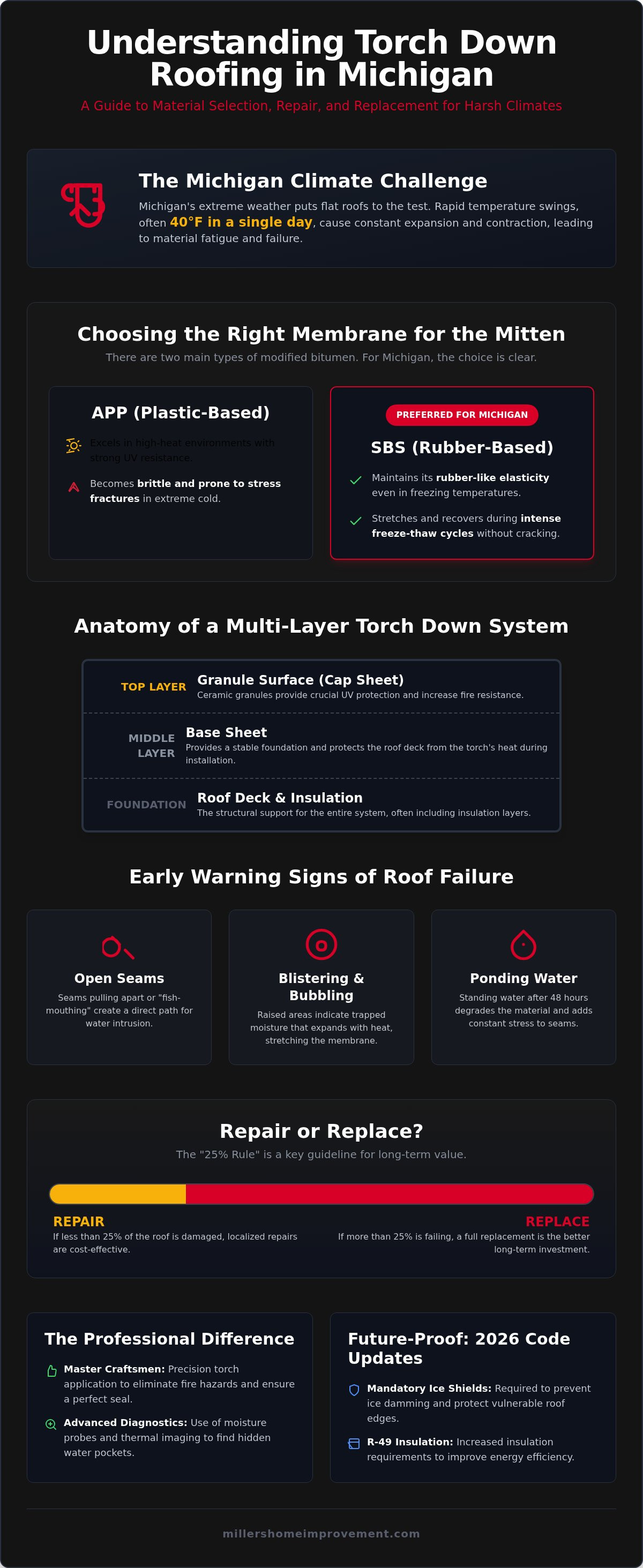
There are two primary types of modified bitumen membranes: APP and SBS. APP (Atactic Polypropylene) is a plastic-modified asphalt that excels in high-heat environments and offers excellent UV resistance. However, it can become brittle when temperatures drop significantly. SBS (Styrene-Butadiene-Styrene) is a rubber-modified asphalt that maintains its elasticity even in extreme cold. SBS is the preferred choice for local properties because its rubberized composition allows the membrane to stretch and recover during Michigan's intense freeze-thaw cycles without developing stress fractures.
The Anatomy of a Torch Down Roof System
A high-quality torch down system relies on the synergy between its layers. The base sheet acts as the initial foundation, providing a stable surface for the subsequent layers and protecting the roof deck from heat during installation. Above this sits the cap sheet, which often features a surface of ceramic granules. These granules aren't just for looks; they provide essential UV protection and increase the roof's fire resistance. When these layers are properly fused, they create a seamless shield that prevents ponding water from penetrating the seams. Understanding this structure is the first step toward an effective torch down roof repair Michigan property owners can trust to withstand the next winter storm.
Common Signs Your Michigan Torch Down Roof Needs Professional Repair
Identifying a failing membrane before it becomes a structural crisis is a hallmark of proactive property management. In our region, the most frequent catalyst for torch down roof repair Michigan calls is a failing seam. Because torch down is applied in rolls, the integrity of the roof depends entirely on the thermal bond between those sheets. If the heat wasn't applied correctly during the initial install, or if the material has aged past its prime, these seams can "fish-mouth" or pull apart, creating a direct path for water to reach the substrate.
You might also notice blistering or bubbling across the surface. These raised areas usually indicate that moisture was trapped within the layers during installation or has seeped in through a pinhole leak. As the sun heats the roof, that moisture turns to vapor and expands, stretching the membrane. Similarly, ponding water is a major concern. Flat roofs are designed to shed water within 48 hours. If you see standing pools long after the rain stops, the weight and constant pressure are degrading the bitumen and testing every fused joint. Since torch down involves open flames and high temperatures during the fixing process, the guidelines for Protecting Roofing Workers emphasize the risks of high-temperature application. This is why localized repairs must be handled by technicians who respect the material's thermal requirements.
Michigan-Specific Failure Modes: Ice and Snow
Michigan winters introduce unique stressors like thermal shock. When a roof goes from a freezing night to a sunny, 40-degree afternoon, the membrane expands and contracts rapidly. This movement puts immense pressure on older, less flexible systems. Ice dams can also form around drains and scuppers, causing water to back up under the membrane edges. Heavy snow loads further compress the system, potentially forcing water through microscopic cracks that wouldn't leak under normal conditions.
Interior Warning Signs for Business Owners
For commercial property owners, the signs are often found inside before they are spotted on the roof. Discolored ceiling tiles or damp warehouse walls are obvious indicators, but musty odors can also signal that your insulation is harboring mold. Saturated insulation loses its R-value, which often leads to a noticeable spike in monthly heating or cooling costs. If you suspect your system is compromised, a professional assessment from Miller's Home Improvement can help identify the source of the failure before the damage spreads to the roof deck.
The Step-by-Step Torch Down Repair Process: From Inspection to Sealing
A successful repair begins long before the torch is lit. Because water can travel far from its entry point on a flat roof, we start with a thorough diagnostic phase. We utilize moisture probes and infrared thermal imaging to identify hidden saturated spots within the insulation. These tools allow us to see what the naked eye cannot, ensuring that we don't simply "patch over" a problem that will continue to rot the deck from the inside out. Once the damaged area is mapped, we strip away the compromised membrane and thoroughly clean the surrounding surface. We then apply a high-quality asphalt primer to the existing system, which creates the necessary chemical bond for the new material to adhere properly.
Precision torching is the core of any torch down roof repair Michigan project. We cut a patch of modified bitumen to size, ensuring it overlaps the existing membrane by at least four inches on all sides. Using a controlled flame, we heat the underside of the patch until the bitumen reaches its melting point. This requires a steady hand and years of experience to ensure the material is hot enough to fuse without scorching the reinforcement mat. Understanding the ins and outs of modified bitumen roofing is essential here, as different thicknesses and reinforcement types require specific heat levels to achieve a permanent, waterproof seal.
Professional Seam Repair Techniques
The most critical indicator of a successful repair is the "bleed-out" rule. When a seam is properly fused, a small bead of melted bitumen (roughly 1/4 to 3/8 of an inch) should squeeze out from the edge of the patch. This bead confirms that the two layers have become one. For intricate detail work around plumbing vents, chimneys, or roof drains, we use specialized hand-torches that allow for greater heat control in tight spaces. While we prioritize thermal fusion for its superior strength, we may occasionally use cold-process adhesives in specific areas where an open flame poses an unnecessary risk to sensitive building components.
Addressing Flat Roof Drainage and Ponding
Repairing the membrane is only half the battle if the roof doesn't drain correctly. We often install tapered insulation "crickets" during the repair process to redirect water away from low spots and toward the primary drains. We also inspect and clear scuppers and internal drains to ensure they can handle the volume of a Michigan summer thunderstorm. Establishing a proper pitch is the single most effective way to prevent 90% of torch down failures caused by standing water. By combining membrane integrity with better drainage, we provide a solution that stands up to the elements year after year.
Repair vs. Replacement: Evaluating Costs and Long-Term Value
Deciding whether to invest in a localized fix or commit to a full replacement is a financial crossroads every property owner eventually faces. We follow a standard industry guideline known as the 25% rule. If the estimated cost of a torch down roof repair Michigan exceeds 25% of the total replacement value, the long-term math usually favors a new installation. This is particularly true if your membrane is approaching the end of its expected lifespan. A two-layer torch down roof typically lasts about 15 years, while a robust three-layer system can provide 20 to 25 years of service. If your roof is already 18 years old, spending significantly on a patch is often a case of diminishing returns.
The condition of the underlying components also dictates the path forward. If diagnostic tools reveal saturated insulation, a simple patch won't suffice. Saturated insulation loses its thermal resistance and can lead to structural rot or mold growth. Under Michigan building codes updated in April 2026, any roof with two or more existing layers must be stripped down to the deck before a replacement can occur. While a full tear-off is a larger initial investment, it allows for the installation of a new, reflective cap sheet. These modern surfaces deflect UV rays more effectively than older systems, helping to stabilize interior temperatures and lower cooling costs during humid Michigan summers.
Insurance Claims for Storm-Damaged Flat Roofs
Severe weather often plays a role in premature membrane failure. Hail bruises on modified bitumen are frequently invisible to the untrained eye, appearing as subtle circular depressions that eventually crack and leak. High winds can also create uplift pressure that compromises the perimeter flashing and pulls at the fused seams. We specialize in documenting these specific failure modes to assist with insurance restoration. If you suspect recent storm activity has compromised your roof's integrity, schedule a professional flat-roof assessment to identify hidden damage before the next rain event.
Long-Term Maintenance to Prevent Early Replacement
Proactive care is the most effective way to extend the life of your investment. We recommend semi-annual inspections, specifically in the spring and fall, to catch minor seam separations before they become major leaks. In Michigan, keeping drains and scuppers clear of autumn leaves and debris is vital; standing water that freezes in a clogged drain can expand and tear the membrane. For aging roofs that are still structurally sound, applying a reflective elastomeric coating can add several years of life by providing an extra layer of UV protection and sealing microscopic fissures in the bitumen surface.
Professional Torch Down Solutions with Miller’s Home Improvement
Success in flat roofing requires more than just the right materials. It demands a level of precision that only comes from decades of hands-on experience. At Miller’s Home Improvement, we bring over 25 years of specialized expertise to every torch down roof repair Michigan project. We don't believe in quick fixes that fail after the first freeze. Instead, our master craftsmen prioritize the technical integrity of every fused seam and perimeter flashing. We understand that a flat roof is a significant investment, and our goal is to provide a repair that restores your peace of mind while protecting your property from the elements.
Safety remains our highest priority during the torch application process. Because the installation involves open flames and high temperatures, we follow rigorous protocols to protect your building and our team. We back our workmanship with comprehensive warranties on both materials and labor, ensuring that our clients are never left vulnerable to recurring issues. Every project begins with a transparent, free estimate. We don't just quote a price; we identify the root cause of your leaks, whether it’s a drainage failure or a compromised membrane, so you can make an informed decision for your property.
Serving Detroit and Southeast Michigan Communities
We are a local fixture in the Southeast Michigan community, serving Detroit, Macomb County, and the surrounding areas. Being a local expert means we understand exactly how our regional climate impacts modified bitumen systems. Our team is fully licensed and insured, and we approach every job with the respect your property deserves. Direct owner involvement is a cornerstone of our business model. Eric Miller personally oversees project assessments to ensure that our high standards for quality and durability are met on every roof we touch.
Get Started with Your Flat Roof Assessment
Scheduling a diagnostic visit is a straightforward process designed to provide you with clear answers. During our on-site assessment, we perform a detailed inspection of your roof's current state, looking for the specific failure modes discussed earlier, such as "fish-mouthing" seams or ponding water. We take the time to explain our findings and provide a roadmap for restoration that fits your long-term goals. If you're ready to secure your building against the next Michigan storm, Request Your Free Torch Down Roof Estimate Today and experience the difference that seasoned craftsmanship makes.
Secure Your Investment Against the Next Michigan Winter
Maintaining a durable flat roof requires a combination of the right materials and expert thermal application. By choosing rubberized SBS membranes and addressing seam failures early, you can avoid the structural damage caused by trapped moisture and heavy snow loads. Whether you're navigating an insurance claim or simply extending the life of an aging system, a precise approach to torch down roof repair Michigan is the only way to ensure long-term stability. A well-executed repair doesn't just stop a leak; it preserves the integrity of your entire property.
At Miller’s Home Improvement, we bring more than 25 years of specialized experience to every project. As licensed and insured flat roof experts, we prioritize the safety and precision of your roof system above all else. We're here to help you move from the stress of recurring leaks to the peace of mind that comes with a professionally sealed surface. Take the first step toward a leak-free future by reaching out to our team for a thorough, honest assessment. We're ready to provide the expert guidance you need to protect your home or business.
Get Your Free Flat Roof Repair Estimate from Miller’s
Your property deserves a roof that is as resilient as the Michigan landscape. We look forward to helping you protect it for years to come.
Frequently Asked Questions
How long does a torch down roof typically last in Michigan?
A torch down roof typically lasts between 15 and 25 years in Michigan. The specific lifespan depends on the number of layers and the quality of the maintenance program. Two layer systems often reach 15 years, while three layer systems are designed to withstand our climate for up to 25 years. Consistent maintenance is the most effective way to reach these milestones.
Is torch down roofing safe to install on a residential home?
Torch down roofing is safe for residential homes when installed by experienced professionals who follow strict safety protocols. The process involves an open flame that reaches high temperatures to fuse the membrane. While it's a standard industry practice, it requires technicians who understand fire safety and proper thermal application to protect the residential structure and prevent any hazards during the installation.
Can I install a new torch down roof over an old one?
You can install a new membrane over an existing one, but Michigan building codes limit the total number of roof layers. As of April 13, 2026, state regulations require that homes with two or more existing layers must be stripped to the deck before a new system is installed. This ensures the structural integrity of the roof and allows for a clean, permanent bond.
What is the difference between torch down and EPDM rubber roofing?
The main difference lies in the material composition and seam technology. Torch down uses asphalt based modified bitumen rolls that are heat fused together to create a monolithic bond. EPDM is a synthetic rubber membrane that is typically glued or taped at the seams. Many Michigan owners prefer the thickness and fused seams of torch down for better resistance against ice damming and heavy snow.
How much does it cost to repair a leak in a torch down roof?
The investment required for a torch down roof repair in Michigan is determined by the scope of the damage and the health of the roof deck. Technicians must account for the time needed to clean the area, the amount of new membrane required, and whether specialized equipment is needed to find hidden leaks. Factors like rotted plywood or saturated insulation will also influence the final project scope.
Does insurance cover flat roof repairs after a Michigan storm?
Insurance typically covers flat roof repairs if the damage is the direct result of a sudden peril like a hailstorm or high winds. Standard policies usually distinguish between weather related damage and long term wear or poor maintenance. We recommend having a professional document the specific signs of storm impact, such as membrane bruising or perimeter uplift, to support your claim and ensure transparency.
Why is my flat roof ponding water even though it was recently repaired?
Ponding water often indicates a drainage or structural pitch issue rather than a failure of the repair itself. If the roof deck has sagged or if the drains are positioned higher than the surrounding surface, water will continue to pool. A successful repair stops the leak, but a long term solution may require installing tapered insulation crickets to redirect water toward the primary drains.
Can torch down roofing be applied in the winter in Michigan?
Applying a torch down roof repair in Michigan during the winter is possible, provided the surface is clear of ice and moisture. SBS membranes are particularly useful for winter repairs because they don't become brittle in the cold. It's vital to work with a team that understands how to manage thermal application when ambient temperatures are low to ensure a reliable, waterproof bond.


