
In Michigan, a hail storm doesn't just leave visible dents; it starts a ticking clock that counts down to the first major winter freeze. Most homeowners look up after a storm, see no missing shingles, and assume they've dodged a bullet. It's natural to feel relieved when the damage isn't obvious, but those subtle bruises often lead to structural failure once the ice sets in. You're likely wondering about the real hail damage roof repair cost Michigan homeowners should expect in 2026 and whether your insurance policy will actually cover the bill.
We understand the frustration of dealing with high-pressure contractors and the anxiety of potential hidden leaks. This guide will help you identify the quiet signs of shingle fatigue that adjusters often miss and explain how current 2026 insurance trends, such as percentage-based deductibles, affect your out-of-pocket expenses. You'll learn how to document damage properly, compare repair versus replacement options, and navigate the claims process with the steady confidence of a seasoned professional. Our goal is to provide the clarity you need to protect your home's integrity before the next season arrives.
Key Takeaways
- Learn to identify subtle shingle bruising and gutter dents that indicate your roof's protective layer has been compromised.
- Understand the variables like roof pitch and material grade that determine the hail damage roof repair cost Michigan homeowners encounter in 2026.
- Navigate the insurance claim timeline with confidence by knowing the specific deadlines and documentation requirements for Michigan residents.
- Discover why a professional tear-off is essential for inspecting the underlying decking and preventing expensive leaks during the winter freeze.
How to Identify Hail Damage on Your Michigan Roof After a Storm
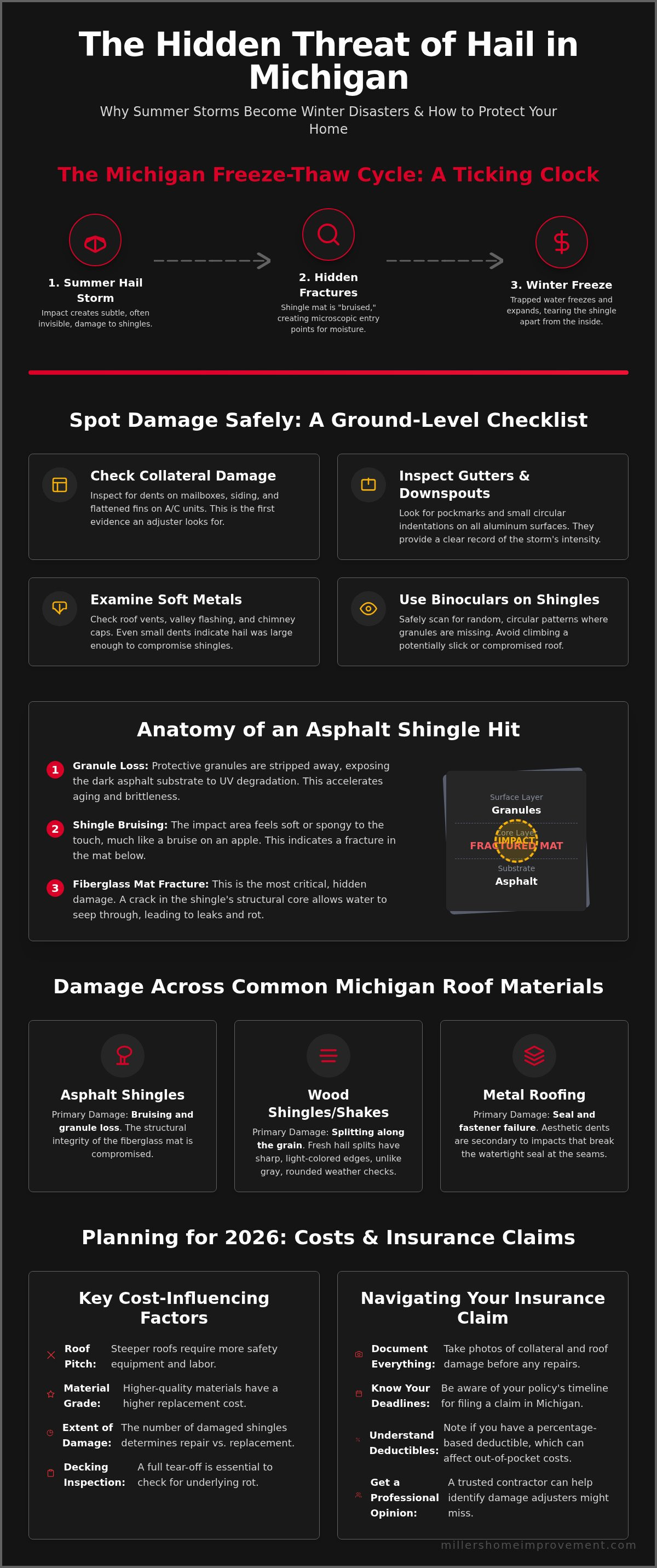
The moments following a severe storm are often filled with high adrenaline and immediate concern for your property. While your first instinct might be to grab a ladder, a seasoned master craftsman knows that the most effective inspection begins with your feet firmly planted on the ground. Safety is our primary concern; roof surfaces can be slick and structurally compromised after a heavy weather event. Instead of climbing, use a pair of high-quality binoculars to scan your roofline. This allows you to spot displaced materials or distorted shingle patterns without putting yourself at unnecessary risk.
Understanding what hail is and how these frozen projectiles impact different surfaces helps you prioritize which areas of your property to check first. Start by walking the perimeter of your home and looking for collateral damage. If your mailbox is dented, your siding has chips, or your outdoor AC unit's cooling fins are flattened, there's a high probability your roof sustained similar or greater force. These signs are often the first pieces of evidence an insurance adjuster looks for when validating a claim.
Visual Cues on Gutters and Soft Metals
Metal surfaces often tell a clearer story than shingles because they lack the "self-healing" properties of asphalt. Inspect your aluminum gutters and downspouts for pockmarks or small, circular indentations. These marks are permanent records of the storm's intensity. Next, look at the "soft metals" on your roof, including the vents, valley flashing, and chimney caps. Even small circular dents in these components indicate that the storm produced hail large enough to compromise your shingles. These metal components are vital for ventilation and waterproofing; any distortion can lead to slow leaks that remain hidden until the first Michigan winter freeze.
The Anatomy of a Hail Hit on Asphalt Shingles
On an asphalt roof, damage is often more subtle than a simple hole or crack. You should look for circular patterns where the protective granules have been stripped away, exposing the dark substrate beneath. This granule loss isn't just an aesthetic issue; those granules protect the asphalt from UV degradation. When they're gone, the sun's rays will quickly brittle the exposed area. It's also vital to distinguish these hits from natural wear. Unlike standard aging, hail hits are typically random and often feel soft to the touch, similar to a bruise on an apple. Shingle bruising is a structural fracture of the fiberglass mat. This hidden fracture allows water to seep through the shingle over time, which is why understanding the potential hail damage roof repair cost Michigan homeowners face starts with a thorough, honest assessment of the shingle's internal integrity.
Comparing Hail Damage Across Common Michigan Roofing Materials
Every roofing material tells a different story after a storm. While asphalt shingles are the most frequent sight in Southeast Michigan, the way hail interacts with wood, metal, or commercial membranes requires a specialized eye to diagnose accurately. Understanding these material-specific reactions is the first step in determining the eventual hail damage roof repair cost Michigan homeowners will face. A surface-level glance rarely reveals the full extent of the impact, especially when dealing with high-performance materials designed to hide stress.
Asphalt shingles remain the most common victim of shingle bruising. As established, these hits strip away protective granules and fracture the internal fiberglass mat, leaving the shingle vulnerable to UV rays. Wood shingles and shakes react differently; they tend to split along the grain. You can distinguish a hail hit from natural weathering by looking at the crack itself. A fresh hail split will have sharp, light-colored edges, while an old weather check will appear gray and rounded from years of exposure. Metal roofing presents a unique challenge. While many homeowners worry about aesthetic dents, a seasoned expert looks for structural seal failures at the seams or fasteners. If an impact is strong enough to shift a panel or loosen a screw, the roof's water-tight integrity is gone, regardless of how the surface looks.
The Michigan Winter Factor: Why Small Hits Matter
In Michigan, a June hail storm is rarely just a summer problem. Our state's unique freeze-thaw cycles turn minor shingle fractures into major structural issues. When hail bruises a shingle, it creates a microscopic entry point for moisture. During the winter, this water enters the mat, freezes, and expands. This expansion physically tears the shingle apart from the inside out, a process that repeats dozens of times throughout a single season. Michigan's high humidity further complicates things by keeping exposed fiberglass mats damp, which accelerates rot and mold growth. What seems like a minor issue during a summer inspection often evolves into a significant leak by the time January arrives.
Commercial Flat Roof Vulnerabilities
Commercial properties in Detroit often utilize PVC, EPDM, or Torch Down systems. While these materials are incredibly durable, large-diameter hail can cause circular "star-shaped" punctures that are difficult to see without a close-up inspection. These punctures are particularly dangerous in areas prone to ponding water. If your facility has flat sections where water collects, even a tiny puncture can lead to massive interior damage and insulation rot. We often recommend a professional assessment for flat roof ponding repair Detroit businesses need after a storm to ensure no membranes were breached. If you're concerned about your roof's condition, reaching out to Miller's Home Improvement for a thorough inspection can provide the peace of mind you need before the snow flies.
Calculating Hail Damage Roof Repair Costs in Michigan (2026)
Estimating the financial impact of a storm requires more than a cursory glance at your shingles. In the professional roofing world, we calculate everything by the "square," which is a 100-square-foot area. This standard unit allows for consistent quoting across different home sizes and ensures that material orders are precise. When evaluating the hail damage roof repair cost Michigan homeowners might see, several regional factors come into play that weren't present in previous years. Understanding these variables helps you move from a state of uncertainty to a clear plan for restoration.
The 2026 Michigan market presents a unique landscape for homeowners. While asphalt shingle prices have reportedly stabilized this year after a period of volatility, local labor rates in the Midwest continue to reflect a shortage of skilled tradespeople. This makes the timing of your project critical. We've seen that waiting until the post-storm "rush" can lead to longer lead times and higher demand-based pricing. A proactive approach allows you to secure a slot before the seasonal backlog begins, ensuring your home is protected before the harsh weather returns.
We often encounter the question of whether a simple patch job is sufficient. A repair is often cost-effective if the damage is localized to one slope or a few specific areas. However, many adjusters and contractors use an informal "8 in 10" rule; if they find eight or more hail impacts in a ten-by-ten foot square, a full replacement is usually recommended. Patching a roof that has reached this threshold is often a temporary fix that fails during the first heavy snow load. A full tear-off allows us to inspect the underlying decking for structural integrity, which is a standard we never compromise on.
Typical Cost Factors for Residential Repairs
Replacing a few individual shingles is a straightforward task, but replacing a full slope ensures color matching and uniform protection. In historic Detroit neighborhoods, the steep pitch of many homes requires specialized safety equipment and more labor hours, which naturally increases the project's scope. Beyond the surface, you must consider hidden factors like damaged plywood decking. If hail was large enough to fracture the shingle mat, it might've also compromised the wood beneath. We also account for debris disposal and municipal permit fees, which can vary significantly between Michigan townships.
Commercial Roofing Cost Considerations
Commercial systems like PVC or EPDM are evaluated based on membrane integrity and the potential for insulation saturation. Large-scale restoration involves precision heat-welding for patches or full membrane overlays to restore a water-tight seal. These systems require a different technical approach than residential shingling. With 25+ years of experience, we've refined our estimating process to account for the complexities of Michigan's commercial landscape. This meticulousness ensures that your quote reflects the actual requirements of the job, preventing unexpected costs during the restoration process.
Navigating the Insurance Claim Process for Michigan Hail Damage
Dealing with insurance adjusters often feels like learning a second language while under pressure. In Michigan, the legal timeline for filing a claim is relatively strict. You generally have one year from the date you discover the damage to initiate a claim. Waiting until the final month is a significant gamble. Insurance carriers prefer to see reports filed within 30 to 60 days of the storm event. This promptness makes it easier to link the damage to a specific weather occurrence, which is why a professional date-of-loss report is your most valuable asset. This document provides the objective evidence needed to prove the storm actually happened and caused the specific bruising we discussed in earlier sections.
One of the most critical moments in the process is the adjuster's site visit. We strongly recommend having your contractor present during this meeting. An adjuster's job is to look for damage, but they often miss subtle signs of shingle fatigue or structural stress. When we walk the roof with an adjuster, we speak the same technical language. We can point out compromised flashing or fractured mats that might otherwise be overlooked. According to the Michigan Insurance Code (MCL 500.2006), insurers are required to acknowledge a claim within 10 days and complete their investigation within 30 days. This collaborative approach ensures the initial estimate reflects the true hail damage roof repair cost Michigan residents should expect, rather than a low-ball figure that leaves you with out-of-pocket expenses.
Step-by-Step Insurance Filing Guide
Following a structured plan reduces stress and ensures no details are missed. Start with a professional inspection before you even pick up the phone to call your agent. This ensures you have a valid claim and avoids an unnecessary "zero-pay" claim on your record. Once damage is confirmed, file the claim using the specific storm date and the photo evidence provided by your inspector. Finally, coordinate the adjuster's visit with your Miller's Home Improvement expert to ensure a fair and thorough assessment. For more detailed advice, you can read our guide on how to file roof insurance claim successfully.
Common Insurance Myths Debunked
Many homeowners hesitate to file because of common misconceptions. One frequent myth is that your individual rates will skyrocket if you file a "No-Fault" weather claim. In Michigan, insurance companies typically raise rates based on the risk level of an entire zip code after a storm, not just for the individual who filed. Another myth is the "neighbor logic" where homeowners assume they are covered just because a neighbor got a new roof. Every policy is different, and every roof reacts to wind and hail uniquely. If you want a straightforward assessment of your property's condition, Miller's Home Improvement offers the expert guidance you need to move forward with confidence.
Restoring Your Michigan Home with Miller’s Home Improvement
Understanding the potential hail damage roof repair cost Michigan homeowners face is only half the battle; the other half is finding a partner who values your home's longevity as much as you do. With over 25 years of owner experience in Southeast Michigan, we've seen how a single storm can compromise a property's future. We don't just view storm restoration as a series of repairs. We see it as a commitment to stabilizing your most significant investment. Our approach is built on transparency, meticulous craftsmanship, and a deep understanding of the local climate's demands on residential and commercial structures.
Our "Tear-Off" philosophy is a cornerstone of our quality standard. While some contractors might suggest an overlay to save time, we believe that the only way to ensure structural integrity is to see what's happening beneath the shingles. By performing a complete tear-off, we can inspect the plywood decking for soft spots, rot, or fractures caused by heavy hail impacts. This thoroughness prevents hidden issues from becoming catastrophic failures during a heavy snow load. Whether we are working on a residential shingle roof or specialized commercial systems like PVC, EPDM, and Torch Down flat roofing, our goal is to provide a solution that lasts for decades, not just until the next season.
Why Detroit Homeowners Trust Miller's
As a Detroit-based company, we are deeply rooted in the communities we serve. We are fully licensed and insured in Michigan, providing a level of professional assurance that "storm chasers" simply cannot match. You won't deal with a rotating cast of sales representatives; instead, you'll benefit from direct owner involvement. Eric Miller personally oversees project assessments to ensure that every detail, from flashing to ventilation, meets our rigorous standards. We are dedicated to returning every roof we touch to a state that is better than its pre-storm condition.
Schedule Your Free Michigan Hail Damage Inspection
The worst time to discover a roof leak is during a January thaw when ice dams have already formed. Taking a proactive approach today can save you thousands in interior repair costs later. Our free in-home estimates for Southeast Michigan are designed to be educational rather than high-pressure. We provide a clear, honest assessment of your roof's health, allowing you to make an informed decision about your home's protection. Don't let invisible bruising turn into a structural crisis this winter. Contact Miller's Home Improvement for your free storm damage assessment and gain the peace of mind that comes from a job done correctly the first time.
Protect Your Home Before the First Michigan Freeze
Michigan weather is relentless; a roof that survives a summer storm might not survive a winter freeze. We've explored how subtle shingle bruising and granule loss create microscopic entry points for moisture. Addressing these vulnerabilities now prevents the structural failure that follows our state's aggressive freeze-thaw cycles. Understanding the total hail damage roof repair cost Michigan homeowners face in 2026 requires looking beyond surface-level aesthetics to the integrity of the fiberglass mat and decking beneath.
You don't have to navigate the complexities of insurance adjusters or technical assessments alone. With 25+ years of local owner experience, Miller's Home Improvement provides the expert insurance claim assistance and meticulous craftsmanship your property deserves. We are a licensed and insured Michigan contractor committed to transparency and long-term durability. Schedule Your Free Hail Damage Inspection with Miller's Home Improvement to ensure your home remains a safe, dry sanctuary for your family. Taking a proactive step today is the best way to maintain your home's value and your own peace of mind.
Frequently Asked Questions
Does Michigan homeowners insurance always cover hail damage?
Yes, most standard policies in Michigan cover hail, though the specific payout depends on whether you have Replacement Cost Value (RCV) or Actual Cash Value (ACV). Many insurers are now shifting toward percentage-based deductibles, which are often 1% to 2% of your home's total insured value. It's vital to review your policy's wind and hail endorsement to understand your out-of-pocket exposure before a storm hits.
How much does the average hail damage roof repair cost in Michigan in 2026?
While national averages for 2026 range from $1,500 to $8,000, your specific hail damage roof repair cost Michigan will depend on your roof's pitch and material. Minor repairs for leaks might start at a few hundred dollars, while a full replacement for a 2,000 square foot home can vary significantly based on your municipality's permit fees. Local labor rates and the height of your home also influence the final estimate.
Can I wait until next year to repair hail damage in Michigan?
Waiting is a significant risk due to Michigan's unique climate. While you typically have one year from the date of discovery to file a claim, waiting allows water to enter shingle bruises and expand during winter freeze-thaw cycles. This expansion turns small fractures into major structural leaks. Filing within 30 to 60 days of the storm is the best way to ensure your insurance carrier links the damage to the correct weather event.
What size hail is needed to actually damage a shingle roof?
Hail measuring 1 inch in diameter, roughly the size of a quarter, is the standard threshold for causing functional damage to asphalt shingles. In the corridor between Detroit and Grand Rapids, these significant hail events occur an average of 3 to 5 times annually. Even smaller hail can cause damage if accompanied by high winds, as the velocity increases the impact force against your roof's protective granule layer.
Should I repair or replace my roof after a hail storm?
The decision depends on the density of the impacts. We often use the 8 in 10 guideline; if there are eight or more hits in a 100-square-foot area, a full replacement is usually the most sustainable choice. Repairing a few shingles is fine for localized damage, but widespread bruising compromises the entire system's integrity. A full tear-off allows us to verify that the underlying wood decking hasn't sustained hidden fractures.
How long does a roof insurance claim take to process in Michigan?
Michigan law provides a specific timeline for these interactions. Under MCL 500.2006, your insurance company must acknowledge your claim within 10 days of filing. They are then required to complete their investigation within 30 days. Having a professional contractor present during the adjuster's inspection often speeds up this process by ensuring all damage is documented accurately the first time, preventing the need for secondary inspections.
Will my insurance company cancel my policy if I file a hail claim?
It's highly unlikely that an insurer will cancel your policy for a single hail claim, as these are considered Acts of God beyond your control. However, filing a claim can affect your premiums for 3 to 5 years. In Michigan, rate increases typically happen across an entire zip code after a major storm rather than targeting one specific homeowner. You should only file if the damage significantly exceeds your deductible amount.
How do I find a reputable hail damage roofer in Detroit?
Look for a contractor with deep local roots and a permanent physical presence in Southeast Michigan. Reputable roofers will be licensed, insured, and willing to provide a detailed, written estimate after a thorough inspection. Avoid storm chasers who knock on doors immediately after a storm with high-pressure tactics. A trustworthy professional will focus on education and long-term stability, offering to meet with your insurance adjuster to ensure a fair assessment.


