
In Michigan, the most significant threat to your commercial facility isn't always a major storm; it's the silent, daily stress of thermal expansion and contraction. Property managers across the state understand that our unique climate, characterized by heavy rains and brutal freeze-thaw cycles, places an immense burden on flat roofing systems. Effective commercial flat roof maintenance Michigan strategies are no longer optional if you want to avoid the high costs of emergency winter repairs or premature membrane failure. You've likely felt the frustration of discovering ponding water after a spring downpour or worrying about how your roof will handle the next sub-zero stretch.
This guide provides a professional roadmap to protect your commercial investment and significantly extend your roof's lifespan. We'll outline a clear maintenance schedule designed for 2026 standards, focusing on how to lower your long-term capital expenditures through proactive care. You will learn how to document your roof's condition for insurance purposes and identify minor issues before they require a full tear-off. By the end of this article, you will have the tools to move from reactive repairs to a state of informed, steady property management.
Key Takeaways
- Understand how Michigan's 100-degree temperature swings and freeze-thaw cycles impact membrane elasticity and cause premature failure.
- Implement a proactive schedule for commercial flat roof maintenance Michigan to identify minor issues before they escalate into costly emergency repairs.
- Learn the specific maintenance requirements for PVC, EPDM, and Torch Down systems to ensure seam integrity and long-term durability.
- Follow a structured seasonal checklist to manage drainage clearing and UV damage assessments during the critical spring and summer months.
- Discover how professional documentation protects your manufacturer warranty and significantly reduces long-term capital expenditures.
Why Michigan’s Climate Demands Specialized Commercial Flat Roof Maintenance
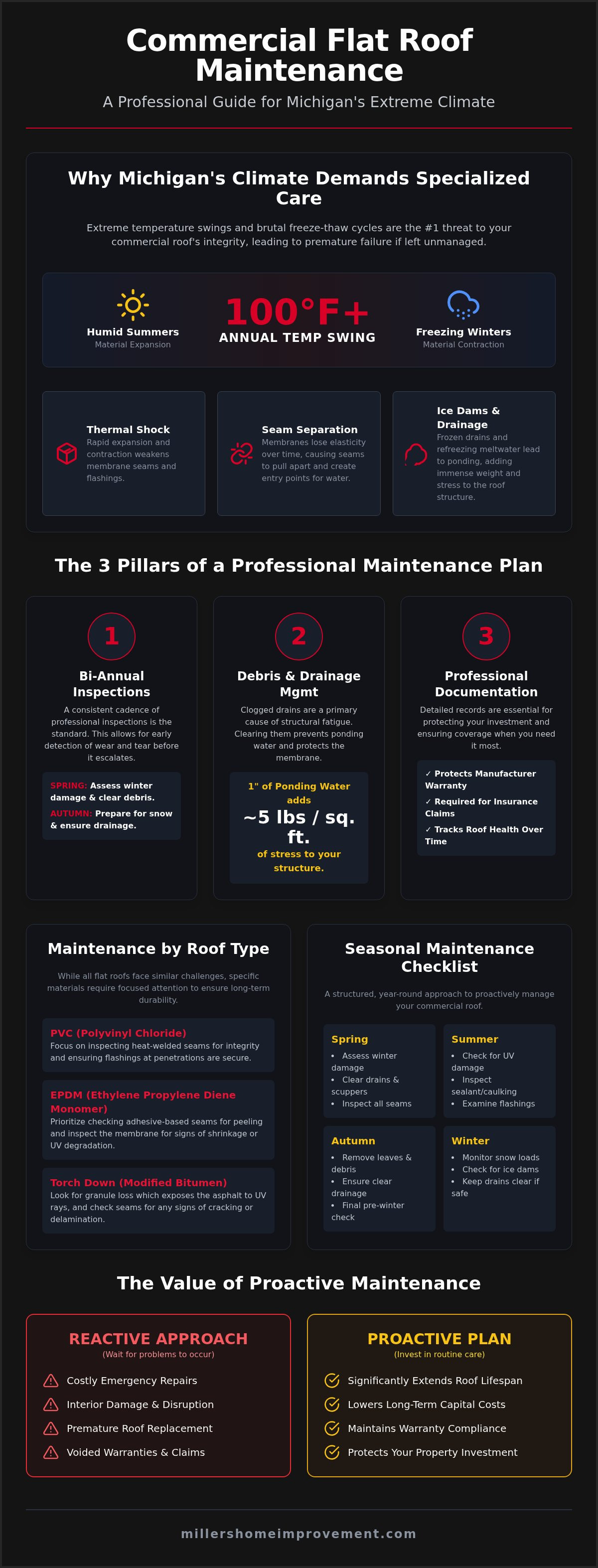
In Southeast Michigan, commercial buildings endure some of the most extreme weather conditions in the country. We regularly see temperature swings exceeding 100 degrees between the depths of a February freeze and the peak of a humid July. This volatility isn't just a matter of local trivia; it's a physical assault on your building's exterior. Effective commercial flat roof maintenance Michigan requires a deep understanding of how these shifts impact material integrity. Without a proactive strategy, these cycles lead to thermal shock. This occurs when rapid temperature changes cause materials to expand and contract so quickly that seams and flashings pull apart.
Viewing maintenance as a preventative ROI strategy is essential for any facility manager. Instead of waiting for a leak to disrupt operations, a structured program identifies common flat roof vulnerabilities before they become structural liabilities. In our 25 years of experience across the Detroit area, we've seen that the most expensive roofs aren't the ones with the highest initial cost. They're the ones neglected until a total tear-off is the only remaining option. Proactive care preserves the membrane's ability to handle the elements, protecting your capital investment for years beyond the standard warranty period.
The Role of Thermal Expansion in Flat Roof Failure
Every material on your roof has a different coefficient of expansion. Your metal gravel stops, PVC membranes, and masonry parapet walls all grow and shrink at different rates. This creates "hot spots" near transitions and penetrations where stress is most concentrated. If a membrane loses its elasticity due to age or UV exposure, it can no longer accommodate this movement. Professional maintenance focuses on these high-stress areas. We ensure that seam seals remain flexible and flashings are securely anchored. This prevents the seam separation that often goes unnoticed until water reaches the building's interior.
Michigan Winter Challenges: Ice and Drainage
The freeze-thaw cycle is the primary cause of roof failure in Michigan. When snow melts during a sunny afternoon and refreezes at night, it creates ice dams that trap water on the roof surface. This is particularly dangerous for buildings with internal drains. If these drains freeze internally, melting snow has nowhere to go. The resulting ponding water adds immense weight to the structure. It eventually finds even the smallest microscopic pinhole in the membrane. Regular commercial flat roof maintenance Michigan ensures that drainage paths remain clear. We also monitor snow load patterns to prevent the structural fatigue that leads to catastrophic leaks during the spring thaw.
The 3 Pillars of a Professional Maintenance Plan
A reliable maintenance strategy isn't built on guesswork; it's a disciplined process of documentation and action. In our region, a bi-annual schedule is the professional standard. We recommend performing these inspections once in the spring to assess winter wear and once in the autumn to prepare for the coming snow. This consistent cadence allows you to meet cold climate roofing challenges with confidence. Proper documentation during these visits is more than just good record-keeping. By July 2026, insurance carriers and manufacturers have become increasingly strict about requiring proof of routine care before honoring claims or warranty repairs. A documented history of commercial flat roof maintenance Michigan is your building's best defense against denied coverage.
Comprehensive Debris and Drainage Management
Clogged drainage systems are the leading cause of structural roof fatigue and eventual collapse. When water cannot exit the building, it pools in low spots, creating immense pressure. A single inch of ponding water adds roughly five pounds of weight per square foot. For buildings in wooded areas of Southeast Michigan, leaf litter and pine needles can choke scuppers and gutters within a single season. Our approach involves more than just clearing visible trash. We focus on removing biological growth like moss and algae, which trap moisture against the membrane and accelerate material degradation. Keeping these pathways clear ensures that heavy spring rains exit the roof as quickly as they arrive.
Seam and Flashing Integrity Checks
Industry data indicates that 90% of flat roof leaks originate at the flashings rather than the field membrane. These transitions occur around HVAC units, vents, skylights, and parapet walls. These areas bear the brunt of the thermal movement we discussed previously. If a sealant cracks or a flashing pulls away, water has a direct path to your building's interior. At Miller's, we perform a manual seam probing technique to identify voids or delamination that are invisible to the untrained eye. This allows us to catch a failing lap before it becomes a leak. If you haven't had your penetrations checked since the last freeze, a professional commercial roofing assessment can identify these vulnerabilities before the next storm hits. Minor repairs to these critical points today can save thousands in future capital expenditures.
Maintenance Requirements for PVC, EPDM, and Torch Down Roofing
A one size fits all approach does not work for commercial flat roof maintenance Michigan. Each membrane has a unique chemical composition and physical structure that dictates how it ages and where it fails. While the goal remains the same, to keep the building dry and the insulation protected, the methods we use to achieve that goal vary significantly between single-ply and multi-ply systems. Understanding these distinctions is the difference between a simple repair and a premature roof replacement.
Choosing the right cleaning agents is a critical, yet often overlooked, part of this process. Using petroleum-based cleaners on an EPDM roof, for instance, will cause the rubber to swell and degrade almost instantly. We always recommend using manufacturer-approved, pH-neutral cleaners that won't strip away protective UV coatings or compromise heat-welded seams. This level of meticulous care preserves the membrane's integrity for its full intended service life.
PVC and EPDM: The Modern Standard
PVC roofing is prized for its high reflectivity and its ability to withstand chemical exposure, making it a favorite for restaurants and manufacturing facilities. Maintenance for PVC focuses heavily on weld integrity. Over time, environmental pollutants can settle on the surface, reducing the "cool roof" energy benefits. Keeping these white surfaces clean is essential for managing building cooling costs during hot Michigan summers. We also look for signs of UV degradation, which often appears as "shattering" or small cracks in older, lower-quality PVC formulations.
EPDM, a synthetic rubber membrane, faces different challenges. It's known for its durability, but it's prone to shrinkage as it ages. This shrinkage often leads to a phenomenon called "bridging," where the membrane pulls away from the corners where the roof meets the parapet wall. If left unaddressed, this tension will eventually tear the membrane or pull the flashings loose. During our inspections, we pay close attention to seam tape aging. The adhesives used in EPDM seams have a finite lifespan and typically require professional reinforcement or "stripping in" as they reach the ten-year mark.
Torch Down Maintenance for Detroit Industrial Buildings
Torch down, or modified bitumen, remains a staple for many older industrial buildings in the Detroit area. These systems are incredibly tough, but they rely on multiple layers that must remain bonded. The most common sign of aging in these roofs is granule loss. These ceramic granules protect the underlying asphalt from the sun. When they wear away, the asphalt begins to "alligator," creating a pattern of deep cracks that look like reptile skin. This is a clear indicator that the membrane is becoming brittle and needs a protective coating or repair.
We also keep a close eye on "blisters," which are pockets of air or moisture trapped between the layers of the roof. In the Michigan freeze-thaw cycle, these blisters can expand and contract, eventually popping and creating an easy entry point for water. Managing the transition points between old torch down sections and new repairs requires a seasoned hand. Our 25 years of experience ensures that these different generations of materials are bonded correctly, maintaining a watertight seal across the entire surface.
A Seasonal Michigan Maintenance Checklist for Facility Managers
Managing a facility in the Great Lakes State means your building is constantly transitioning between environmental extremes. Adopting a seasonal rhythm for commercial flat roof maintenance Michigan ensures that you aren't caught off guard by the first heavy snowfall or a sudden spring thaw. A disciplined approach identifies minor wear before it results in a costly insurance claim. While professional inspections are the backbone of roof longevity, facility managers can maintain stability by following a structured quarterly checklist.
- Spring: Conduct a post-winter assessment. Focus on identifying cracks in the membrane caused by ice expansion and ensure that all internal drains are free of winter grit and silt.
- Summer: Monitor for UV damage. High heat can cause older EPDM membranes to "bridge" or pull away from walls. Check HVAC condensation lines to ensure they aren't dumping water directly onto the roof surface, which leads to localized membrane degradation.
- Fall: Clear all leaf litter and organic debris. This is the most critical time to inspect perimeter metal and scuppers before they are buried under snow.
- Winter: Establish safe snow removal protocols. If snow depth exceeds your building's structural design limits, use only plastic shovels and leave a thin layer of snow to avoid puncturing the membrane.
The 10-Minute Visual Roof Walk
You don't always need a ladder to spot trouble. A simple visual walk from a safe access point or even the ground can reveal significant issues. Look for "tide marks," which are dark rings of dirt and debris that remain after ponding water evaporates. These marks indicate low spots that require attention even if the roof is currently dry. Inside the building, pay close attention to ceiling tiles. Water stains, even small ones, are often the first sign that a flat roof seam has failed. Catching these early is the primary goal of comprehensive roof maintenance programs.
Preparing for Michigan Storm Seasons
High winds and heavy rains are common in Detroit and Macomb County. Before storm season hits, ensure that all HVAC access panels are securely fastened. A loose panel can act like a sail, catching the wind and causing significant mechanical and roof damage. Inspect the perimeter metal flashing for any sections that have pulled away from the masonry. If the wind gets under these edges, it can peel back large sections of the membrane in a matter of seconds. To ensure your facility is truly ready for the elements, you should Schedule a professional inspection with Miller's Home Improvement. Our 25 years of local experience allows us to spot the subtle signs of wind uplift and drainage failure that others might miss.
Extending Your Roof’s Life with Professional Maintenance Programs
Investing in a professional maintenance program is the most effective way to protect your building's structural integrity while stabilizing your annual budget. While we've discussed the physical stresses of our local climate, the business side of roofing is equally critical. Professional documentation serves as an essential insurance policy for your manufacturer’s warranty. Most major roofing manufacturers require proof of annual or bi-annual inspections to keep their coverage active. Without these records, a valid claim for material failure could be denied, leaving your business to foot the bill for a premature replacement.
A clear cost-benefit analysis favors prevention every time. The expense of a consistent commercial flat roof maintenance Michigan program is a fraction of the capital required for an emergency tear-off. Reactive roofing often forces property managers into expensive, unplanned projects that disrupt tenants and daily operations. By contrast, a proactive approach allows you to extend the life of your current membrane by years, deferring major expenditures until they can be properly budgeted and planned for in your long-term facility strategy.
The Miller’s Advantage: Local Expertise
Eric Miller brings over 25 years of experience to every assessment. This deep professional knowledge translates to better diagnostics for your specific facility. Unlike corporate entities that follow a generic, one size fits all checklist, we take a "Seasoned Master Craftsman" approach. We understand how Detroit and Macomb weather patterns specifically impact different roof assemblies. Our commitment to Southeast Michigan means we prioritize transparency and long-term reliability over high-pressure sales. You receive a detailed, honest report of exactly what was found and what was fixed, ensuring you have total peace of mind regarding your property's safety.
Transitioning from Repair to Prevention
Our goal is to help you move away from the stress of reactive roofing. We work with you to build a custom maintenance schedule that fits the specific needs of your facility and its age. This transition allows you to plan for future capital roofing expenditures with precision. Instead of being surprised by a failure during a winter storm, you'll have a documented roadmap of your roof's condition. This methodical approach values stability and straightforward communication above all else. To start protecting your investment with a partner who understands the local landscape, Contact Miller's today for a free commercial roof assessment.
Securing Your Facility’s Future with Proactive Care
A disciplined approach to commercial flat roof maintenance Michigan turns a vulnerable asset into a predictable component of your facility management plan. By adhering to a seasonal rhythm of inspections and addressing material-specific needs for PVC, EPDM, or Torch Down systems, you effectively eliminate the threat of emergency repairs during a winter storm. Consistent documentation doesn't just satisfy insurance requirements; it provides a clear roadmap for your capital expenditures over the next decade.
Eric Miller brings over 25 years of owner experience to every inspection, ensuring that your roof is assessed with the meticulous eye of a seasoned master craftsman. As a family-owned and operated local business, we prioritize the long-term stability of your building over quick fixes. You can protect your investment and gain true peace of mind by partnering with experts who understand the unique demands of our local climate. Secure Your Commercial Asset with a Miller's Maintenance Assessment today. Taking this proactive step ensures your facility remains dry, safe, and efficient for years to come.
Frequently Asked Questions
How often should a commercial flat roof be inspected in Michigan?
You should have your commercial flat roof inspected at least twice a year in Michigan. The most effective schedule involves a spring visit to assess winter damage and a fall visit to prepare for snow. These bi-annual checks allow you to catch seam separations and drainage issues before they escalate into leaks. Consistent commercial flat roof maintenance Michigan schedules are often required by manufacturers to keep warranties in good standing.
What is the most common cause of commercial flat roof leaks in Detroit?
The most common cause of leaks in Detroit is the combination of failed flashings and Michigan's intense freeze-thaw cycles. As ice expands and contracts, it puts immense pressure on transitions around HVAC units and parapet walls. When these areas pull away, water finds a direct path into the building. Clogged internal drains also contribute significantly, as trapped water eventually forces its way through the membrane under heavy pressure.
Can I perform flat roof maintenance myself?
While facility managers can perform basic visual walks, actual maintenance should be handled by professionals. Climbing onto a commercial roof carries significant safety risks and potential liability issues. An untrained eye often misses the early signs of seam delamination or microscopic membrane punctures. Professional contractors have the specialized tools and materials required to perform repairs that meet manufacturer specifications and local building codes.
Will regular maintenance help with my roofing insurance claims?
Regular maintenance is vital for successful insurance claims. Carriers often look for a documented history of care when assessing storm damage or leaks. If you can provide inspection reports showing the roof was in good condition prior to a major event, you're in a much stronger position. By 2026, many insurance protocols require proof of routine commercial flat roof maintenance Michigan to differentiate between sudden storm damage and long-term neglect.
How long can maintenance extend the life of a PVC or EPDM roof?
Proper maintenance can extend the life of a PVC or EPDM roof by five to ten years beyond its initial warranty period. Most single-ply membranes are designed to last 20 to 25 years, but environmental stressors in the Great Lakes region can shorten that lifespan if ignored. Proactive seam reinforcement and UV protection help maintain the membrane's elasticity, allowing it to withstand the thermal expansion that typically causes older roofs to fail.
What are the signs that my flat roof is beyond maintenance and needs replacement?
You likely need a replacement if more than 25% of your roof's insulation is wet or if you're experiencing recurring leaks in multiple areas. Other signs include extensive "alligatoring" on torch down roofs or significant shrinkage and bridging in EPDM systems that can no longer be repaired. If the cost of annual repairs begins to approach the amortized cost of a new system, it's time to transition to a full replacement.
Does ponding water always mean I need a new roof?
Ponding water does not always necessitate a new roof, but it does require immediate attention. Standing water is often caused by clogged drains, scuppers, or compressed insulation rather than a failed membrane. A professional can often resolve these issues by clearing blockages or installing tapered insulation to redirect water flow. If the water remains for more than 48 hours, it can accelerate membrane degradation and lead to structural fatigue.
How does Michigan's humidity affect flat roofing membranes?
High humidity in Michigan can lead to condensation issues within the roofing assembly if the vapor barrier is compromised. This internal moisture can rot the roof deck and saturate insulation from the inside out. Humid conditions also encourage the growth of algae and moss on the membrane surface. These organisms trap moisture and debris, which can eventually break down the protective coatings of PVC and EPDM systems over time.


