
In Indian Village, a roof’s design and condition can matter as much as its size. The cost of roof replacement in Indian Village Detroit depends on the home, roof pitch, selected material, tear-off requirements, and any damage found beneath the existing roof. Miller's Home Improvement provides a free in-home estimate based on the details of your project.
That variability matters in a neighborhood known for distinctive homes, where a generic estimate may not reflect the work a particular roof needs. This guide explains what can shape a replacement estimate, how to assess the proposed scope, and what to consider when choosing a licensed and insured roofer.
The guide also explains how to think through material choices and the replacement process, so you can approach the decision with a clearer picture of your home’s needs and the questions that matter before work begins.
Key Takeaways
- Roof pricing depends on the home’s roof size, pitch, chosen material, tear-off needs, and any damage found beneath the existing roof.
- Review an estimate for a clear scope of work, including what the tear-off covers and how unexpected repairs are handled.
- Before work begins, understand the roofer’s insurance coverage and the terms and limits of any workmanship warranty.
- Indian Village’s distinctive homes call for attention to each roof’s design and condition rather than assumptions based on a standard house.
- Look beyond review scores: consider whether homeowners describe clear communication, careful work, and reliable follow-through.
Are your Detroit roofers licensed and insured?
Before signing a roofing contract in Michigan, distinguish licensing, insurance, and workmanship coverage. Ask for applicable license details and current insurance documents in writing. Compare the business name on those records with the name on the estimate and contract. Matching names clarify which business is responsible for the work.
Insurance documents should identify the coverage that applies during the project. Request a certificate of insurance and confirm that the named business matches your agreement. Discuss liability coverage and worker protection, including how accidental property damage or an injury is handled. Keep the written details with your roofing documents rather than relying on a verbal assurance.
A workmanship warranty covers installation, while a material warranty covers the roofing product. Read each document separately instead of assuming one covers both. Check the covered work, exclusions, duration, and claim process. Ask how flashing, roof penetrations, and repairs are treated, and get the answers in writing before installation.
Michigan winters make careful installation and clear responsibility especially important. Snow, ice, and freeze-thaw conditions can expose weaknesses around eaves, valleys, and flashing. Before work starts, clarify who oversees installation and who handles warranty questions afterward. Keep the responsible contact and process in the contract, along with the final contract, warranty documents, and insurance records.
Storm damage requires a separate paper trail. Spring and summer wind and hail drive roughly 40% of Michigan homeowner insurance claims. After a storm, photograph visible damage from the ground, note the date, and save related communications. Avoid climbing onto a damaged roof. If you file a claim, keep the adjuster’s findings and the contractor’s inspection notes for comparison.
Use a short review process before choosing a contractor:
- Match the contractor’s business name across the estimate, contract, and insurance certificate.
- Get applicable Michigan licensing details and insurance documentation in writing.
- Read workmanship and material warranty terms separately, including exclusions and claim steps.
- Keep storm photographs, inspection notes, and insurer communications in one project file.
These steps give Detroit homeowners a record of responsibility, applicable coverage, and how workmanship concerns are handled. Clear documentation matters as much as a confident conversation.
How much does a new roof cost in Detroit?
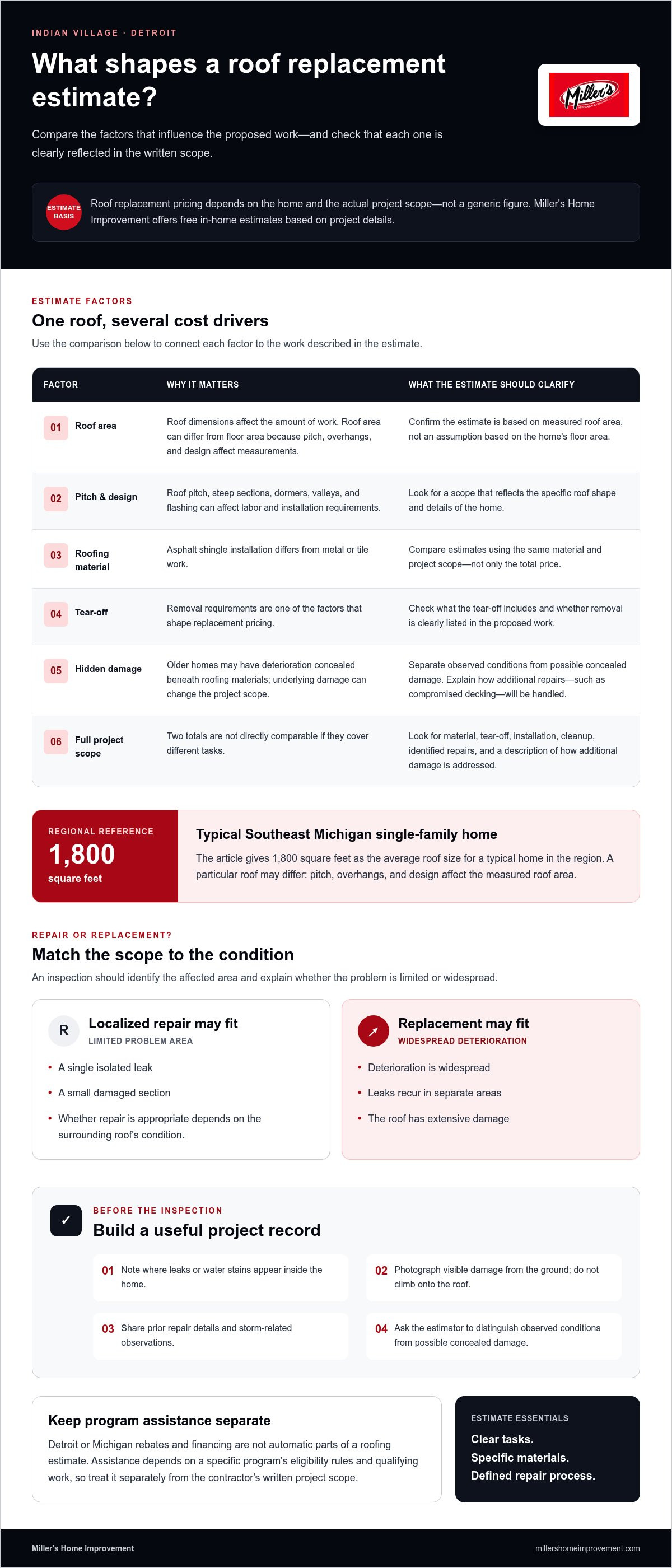
A Detroit roof replacement estimate depends on roof area, pitch, material, tear-off requirements, and underlying damage. The actual project scope determines the price, so request a written estimate based on your roof rather than a generic figure. Miller's Home Improvement offers free in-home estimates to document visible conditions and describe proposed work. Ask for major tasks, including removal, installation, and identified repairs, to be clearly listed.
Indian Village homes can have distinctive designs and details that affect an estimate. Roof shape, steep sections, dormers, valleys, flashing, and material selection all influence labor and installation requirements. Older homes may also have deterioration concealed beneath roofing materials. An inspection should distinguish visible conditions from possible hidden issues and explain how observed conditions shape the proposed scope.
Look for a written estimate that connects inspection findings to the proposed work. It should describe the roofing material, tear-off scope, installation, cleanup, and how additional damage will be addressed. For example, if the roof decking is found to be compromised, the estimate should distinguish that repair from the original roofing work. Clear descriptions let you compare project scopes accurately instead of assuming two estimates cover the same tasks.
Replacement may be more appropriate than a localized repair when deterioration is widespread, leaks recur in separate areas, or the roof has extensive damage. A single isolated leak or small damaged section may be repairable, depending on the surrounding roof’s condition. An inspection should identify the affected area and explain whether the problem is limited or extends across the roof.
For a more useful estimate, prepare a short project record before the inspection:
- Note where leaks or water stains appear inside the home.
- Photograph visible damage from the ground, without climbing onto the roof.
- Share any prior repair details and storm-related observations.
- Ask the estimator to separate observed conditions from possible concealed damage.
Detroit or Michigan rebates and financing aren't automatic parts of a roofing estimate. Any assistance depends on a specific program’s eligibility rules and qualifying work, so homeowners should treat it separately from the contractor’s written project scope. For storm-related problems, an inspection can also help distinguish repair needs from full replacement; roof repair options may suit localized damage.
Roof replacement costs in Detroit
Detroit replacement estimates reflect roof dimensions, slope, material, tear-off scope, and the condition beneath existing shingles. A written estimate should separate these elements so you can see what the proposed installation includes.
Roof Replacement Cost Estimates
The average roof size for a typical Southeast Michigan single-family home is 1,800 square feet. Actual roof area can differ from the home’s floor area because roof pitch, overhangs, and design affect measurements. Asphalt shingle installation also differs from metal or tile work, so compare estimates by material and scope, not just by total.
The project price depends on roof size, pitch, material, tear-off, and concealed repairs, and is provided after a quote request. Ask the estimate to identify the selected shingles, underlayment, flashing, and any work outside the main roof surface. A properly installed architectural-shingle roof in Wayne County can last 20 to 30 years.
Roof Removal and Disposal
Roof removal means taking off existing roofing materials; disposal means hauling away the debris. Confirm whether the written scope includes removal, disposal, and cleanup, and whether it assumes one existing roofing layer.
If decking damage is found after tear-off, repairs may change the project scope. Ask how concealed damage will be documented and approved before additional work proceeds. This distinguishes the original removal plan from repairs identified once the roof surface is exposed.
Roof Insulation Costs
Insulation needs depend on the existing roof assembly and the material selected for replacement. Treat insulation and roofing as separate components to discuss, not interchangeable estimate items.
Ask whether proposed insulation goes above the roof deck or within the attic. Its placement affects the work and how the assembly is described in the estimate. Keeping insulation separate makes the roofing and insulation scopes easier to understand.
Permit charges also affect project budgeting. Detroit charges a $150 roof replacement permit fee for the first $2,000 of work, plus $20 for each additional $1,000 of work. Ask how the permit is represented in the project paperwork, and keep it distinct from labor, materials, and disposal.
To compare estimates, check that each describes the same roof area, material, removal scope, insulation work, and permit handling. A lower total may reflect a different scope, not an equivalent installation. Review each line item and resolve gaps before approving the work.
Indian Village as a Metro Detroit service area
Indian Village sits on Detroit’s east side, with the Detroit River bordering the neighborhood to the south. Its distinctive housing makes local roof assessments more useful than assumptions based on a standard house.
The historic district includes 352 homes, and Indian Village has no tract homes. Each property has its own design, so roof area, slope, rooflines, and details can vary from house to house. A contractor preparing an assessment should consider the specific home rather than rely on a typical roof profile.
Indian Village’s three mansion-lined streets extend one mile north to Mack Avenue. That compact geography places the neighborhood within Detroit’s broader roofing market, but each project still differs. A home with multiple roof sections, dormers, valleys, or intricate edges needs careful attention to each junction and transition.
Some homes in Indian Village and Boston-Edison include Victorian houses dating from the 1880s. Detroit’s housing stock also includes century-old construction. For an older home, an inspection should document the roof’s visible materials and condition, plus any signs of water intrusion inside. Those observations help distinguish the work needed on one property from another.
Detroit weather adds another practical consideration. Metro Detroit receives around 33 inches of annual snowfall, while Detroit receives approximately 34 inches of rain annually. Snow and rain make drainage paths, valleys, flashing, and eaves important points to assess. Homeowners can note interior water stains and visible exterior damage before an inspection, then share where and when they noticed them.
Seasonal conditions also shape planning. Detroit’s January average low temperature is approximately 19°F, and its July average temperature is approximately 74°F. These figures describe a wide seasonal range, not a project schedule. A roof assessment should focus on the existing assembly and the work required for the particular home, rather than treating weather averages as a substitute for inspection.
If you’re considering roof replacement in Indian Village Detroit, use your property’s details to guide the conversation. A practical inspection can identify:
- Changes in roof height, slope, and section layout.
- Visible wear near valleys, eaves, flashing, and roof penetrations.
- Interior water stains that may correspond to exterior areas.
- Material transitions between different roof sections.
These details give you a clearer basis for discussing scope and installation. Planning roof replacement in Indian Village Detroit starts with the home’s design and observed condition, not location alone.
Which roofing contractors serve Indian Village and have strong reviews?
For an Indian Village project, start with a shortlist of contractors that clearly describe Detroit service coverage and residential roofing. A business name or broad service-area statement alone won’t show whether its work suits your home. Read reviews for project details, such as roof replacement, cleanup, communication, and how questions were handled.
Review details matter more than a star score without context. Look for comments describing a specific roofing project and its outcome. For example, an account of how a crew protected landscaping, explained a scope change, and cleaned up offers more practical information than a brief rating. Consistent, project-specific comments help show what customers experienced.
Check whether reviews describe work comparable to your property. Indian Village has distinctive homes, and a review about a straightforward roof may not reflect a roof with dormers, valleys, or several material transitions. Give more weight to comments describing the roof features, inspection, and communication about the proposed work.
Read critical reviews as carefully as positive ones. Note the concern, the contractor’s response, and whether the account describes a resolved issue or an unanswered question. A detailed response can show how a business communicates publicly, but it does not replace written project documents. Reviews describe individual experiences; an estimate defines the work proposed for your home.
Use these steps to assess a roofing contractor’s reviews:
- Find reviews that specifically mention roof replacement or substantial roofing work.
- Compare comments about communication, worksite care, cleanup, and follow-through.
- Look for examples involving roof details similar to your home’s design.
- Read both positive and critical accounts, including any public responses.
- Compare review descriptions with the written estimate and proposed project scope.
For an Indian Village home, pair review reading with a project-specific assessment. Check that the estimate identifies the work, materials, removal scope, and process for handling concealed damage. Compare those details with experiences described in relevant reviews. This grounds your decision in both customer accounts and the work planned for your property.
If you’re planning a Detroit roof project, request a roofing estimate to discuss the home’s needs and proposed scope.
Miller's Home Improvement: Residential Roofing
Miller's Home Improvement provides residential roofing for homeowners weighing repairs against a full roof replacement. A free in-home estimate lets you discuss the roof’s condition, proposed work, and project scope directly. The company also handles insurance claims when storm damage is part of the situation.
For Indian Village homes, a project discussion can take the roof’s layout and visible condition into account. Miller's Home Improvement also provides commercial roofing and PVC or EPDM flat roofing for buildings that need those systems. A clear estimate helps you understand the proposed work before deciding how to proceed.
Contact Miller's Home Improvement to discuss your roofing project, or visit millershomeimprovement.com.
Make a Clear Plan for Your Roof
Planning roof replacement in Indian Village, Detroit, gives you a chance to make a considered decision about your home’s protection and upkeep. Before moving ahead, identify the project details that matter most, such as material appearance, work sequence, and how the finished roof should suit the home. Keep those priorities together to make discussions and decisions more focused.
Miller's Home Improvement provides residential and commercial roofing, along with PVC flat roofing. For homeowners, the next step is to discuss the property and the work you’re considering. A direct conversation and free in-home estimate can help turn your research into a project plan tailored to your home.
Contact Miller's Home Improvement to discuss your roofing project. With a clear plan and the right information in hand, you can move forward with confidence.
Frequently Asked Questions
Does Roof Replacement Increase Home Value?
Roof replacement can contribute to home value, and the average return on investment for roof replacement is 50%. That figure is an average, not a promise about an individual Indian Village property. A buyer may weigh the roof’s condition alongside the home’s overall maintenance, design, and comparable sales. Keep project records and material details, so you can explain the work completed when discussing the home’s condition.
How long does an asphalt roof last in Michigan?
A properly installed architectural-shingle roof in Wayne County can last 20 to 30 years. Actual service life depends on installation quality, roof ventilation, maintenance, and exposure to Michigan weather. For example, repeated leaks or damaged shingles deserve attention before they affect roof decking. Keep records of repairs and note changes after storms; that history helps track the roof’s condition over time.
What is the average cost to replace a roof in Indian Village, Detroit?
The price depends on the home and project scope and is determined after a quote request. Roof size, pitch, material, tear-off requirements, and concealed damage shape the estimate. On an Indian Village home, roof geometry and details can also affect labor and material needs. A project-specific written estimate is more useful than applying a broad average to a distinctive property.
What permits are required for roof replacement in Detroit?
Detroit residential roofing permits are issued by the Buildings, Safety Engineering, and Environmental Department. Include permit handling in project planning and keep permit documentation with your contract and final project records. Permit paperwork is separate from the roofing estimate, so clarify how it fits the project and who is responsible for submitting it.
Does Indian Village historic district approval apply to roof replacement?
Historic-district review is a separate consideration from a Detroit roofing permit. Whether it applies depends on the proposed exterior work and the district’s review criteria. Record the existing roof’s materials, color, and profile, then document proposed changes. A like-for-like replacement and a proposal that changes visible roof features raise different review questions, so include those details in project planning.
How much does roof replacement cost per square foot in Detroit?
The price per square foot depends on material, pitch, measured area, tear-off requirements, and project scope, and is determined after a quote request. A per-square-foot figure may leave out important items, such as insulation or repairs to concealed damage. Compare written estimates using the same scope and material assumptions rather than relying on the unit price alone.
How long does a residential roof replacement take in Detroit?
Project duration depends on roof size, layout, material, tear-off work, weather, and any damage found beneath the existing roof. A simple roof shape has different installation demands from one with several sections, dormers, or complex transitions. The work sequence also includes protecting the property, removing old materials, installing the new roof, and cleaning the site. A project schedule should account for those tasks.
What warranties and insurance should homeowners check before hiring a roofing contractor?
Review the workmanship warranty separately from the roofing material warranty. Check what each covers, its term, exclusions, claim process, and whether maintenance affects coverage. For insurance, confirm that the contractor’s business name on the certificate matches the contract, and note the policy dates and coverage types. Keep these records with the signed agreement, material documentation, and completion records for future reference.


