
A roofing contractor for insurance work can document visible damage, prepare a repair or replacement estimate, and explain the roof’s condition to the insurance adjuster. The insurer makes the final coverage decision based on the policy and its assessment. If the claim is approved, the roofer can complete the covered work and provide supporting documentation if the estimate needs review.
It’s understandable to want clear answers before agreeing to major roof work, especially when the claims process and payment terms are unfamiliar. This article explains how roofers coordinate with insurers, what replacement cost value (RCV) and actual cash value (ACV) mean, and how deductibles affect a claim.
You’ll also learn what to expect as an estimate moves toward approval, why ordinary wear and tear may be treated differently from sudden storm damage, and how to recognize warning signs associated with storm-chasing contractors and scams. The goal is a sound roof and a clearer understanding of each decision along the way.
Key Takeaways
- Understand how roof documentation and an adjuster meeting can support a claim, while the insurer retains the coverage decision.
- Learn how RCV and ACV account for replacement costs and depreciation, and why the terms affect claim payments.
- See why insurers assess roofing risks and how clear documentation can help explain the work included in an estimate.
- Spot warning signs such as pressure to sign quickly or promises of guaranteed coverage, and protect your decisions with a clear written scope.
Contacting the insurer and scheduling an adjuster
After wind, hail, or a fallen tree limb damages a roof, document what you can see from the ground. Photograph the roof from different angles, including damaged shingles, gutters, and debris. For hail, photograph a hailstone beside a tape measure if available. A roofing contractor for insurance work can organize these observations and prepare an estimate for review. Sudden damage from a covered event may qualify, while ordinary wear and deferred maintenance are generally excluded.
Contact your insurer to report the damage and ask how your policy handles roof claims. Confirm whether wind or hail coverage is limited or excluded, then review your deductible and coverage limits. Your deductible is the amount you pay before insurance contributes to an approved claim. Because policies vary, review the terms that apply to your roof before arranging an inspection.
- Save photographs and notes about the storm and visible damage. Avoid climbing onto a damaged roof; record what you can safely see from the ground.
- Urgent roof damage may need prompt attention to help limit further damage. Otherwise, contact the insurer first, since some policies require that order.
- Arrange an inspection and adjuster meeting. Your roofing contractor for insurance work can point out documented damage and answer questions about the proposed repairs.
The adjuster evaluates the claim, but the insurer makes the final coverage decision. Compare the insurer’s estimate with the contractor’s assessment, including the listed materials and necessary work. If the original scope leaves out a needed repair, the contractor can submit a supplement with supporting documentation. Keep estimates, photographs, and claim correspondence together.
For Detroit roof repairs, claim approval does not itself establish compliance with local permits, building codes, or contractor-licensing requirements. Applicable requirements depend on the repair and local rules, so treat insurance approval and construction compliance as separate matters.
Roof claims can take weeks or months to move from inspection to final payment. The average time to file a roofing claim is around one year, but the deadline varies by insurer. Report damage promptly, keep a record of conversations, and note the next requested step in the claim process.
Replacement cost value and actual cash value
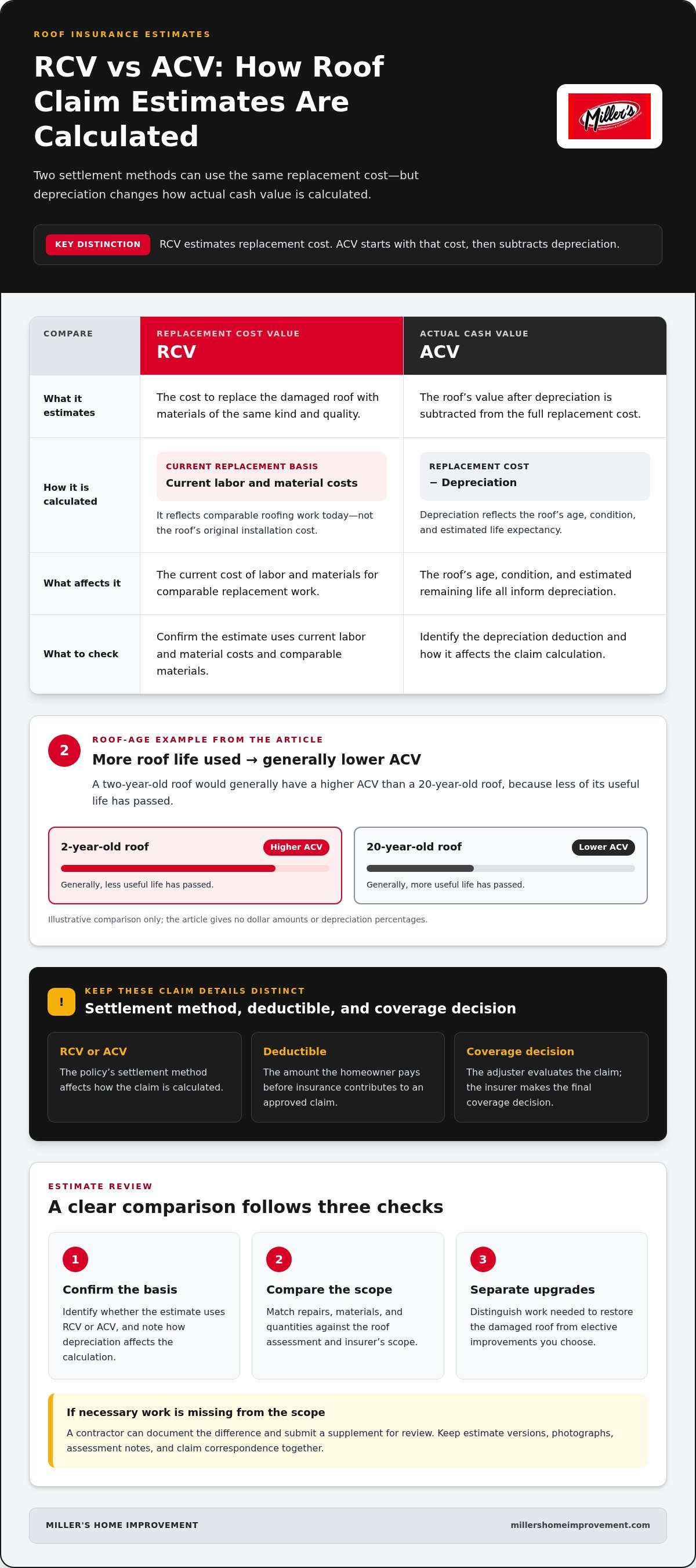
Replacement cost value (RCV) estimates what it would cost to replace a damaged roof with materials of the same kind and quality. The estimate uses current labor and material costs, not the roof’s original installation cost. For example, it reflects the current cost of comparable roofing work rather than simply reimbursing the original purchase amount.
Actual cash value (ACV) begins with the full replacement cost, then subtracts depreciation. That deduction reflects the roof’s age, condition, and estimated life expectancy. A two-year-old roof would generally have a higher ACV than a 20-year-old roof because less of its useful life has passed. The policy’s settlement method affects how the claim is calculated.
These terms shape how an insurer’s estimate relates to the roof being repaired. Homeowners’ insurance generally aims to restore damaged property, not automatically pay for improvements beyond its previous condition. If you choose a higher-grade material or an elective upgrade, separate that choice from the work needed to restore the damaged roof.
A roof repair estimate and an insurer’s scope may differ in the work, material quantities, or labor and material pricing they list. A roofing contractor for insurance work can compare them line by line and explain specific differences. If the scope omits necessary work, the contractor can document the gap and submit a supplement for review.
- Review the basis: Identify whether the estimate uses RCV or ACV, and note how depreciation affects the claim calculation.
- Compare the scope: Match listed repairs and materials against the roof assessment, including affected areas that may be easy to overlook.
- Separate repair from upgrade: Distinguish work that restores the roof from elective improvements you choose.
Clear records connect the roof’s condition to each requested repair. A roofing contractor for insurance work can organize photographs, assessment notes, and estimate details so the proposed scope is easy to follow. Keep each estimate version with claim correspondence to track revisions and outstanding items throughout the review.
Why insurers are cautious about roofing businesses
Roof claims involve both property damage and decisions about the work needed to restore the roof. Clear estimates, documented damage, and defined warranty terms help keep those decisions distinct.
Yes, homeowners should compare multiple roofing estimates with the insurer’s scope. Review repairs, materials, and quantities side by side. The lowest total alone doesn’t show whether an estimate includes all the necessary work.
Deductibles and Waivers
A deductible is the homeowner’s share of an approved claim, paid before insurance contributes. Treat a contractor’s offer to waive it cautiously, because whether a waiver is lawful depends on applicable state law and the specific arrangement.
For example, compare the claim paperwork with the contractor’s written proposal and identify who is responsible for the deductible. Don’t treat an advertised “no out-of-pocket cost” promise as proof that the deductible disappears. The policy’s deductible remains part of the claim calculation.
Storm Damage Inspection and Documentation
A storm-damage inspection records visible roof conditions and connects them to specific repair needs. Contractors may photograph damaged shingles, flashing, gutters, or impact marks, then organize those observations alongside an estimate.
Useful documentation makes the proposed scope easier to assess. For example, a photograph of a damaged roof area paired with a note about the affected materials gives the adjuster clearer context than a general statement that the roof needs work. Keep copies with your claim records.
Warranties for Insurance-Funded Repairs
A warranty describes which repair or material issues are covered and under what written terms. Insurance funding doesn’t automatically determine a contractor’s workmanship warranty or a manufacturer’s material warranty.
Review the written documents for covered work, exclusions, claim procedures, and any conditions tied to maintenance. For example, a repair warranty may cover installation workmanship, while a material warranty addresses the roofing product. Keep both documents with the final scope and completion records.
Roofing companies can also carry insurance policies limited to certain property types, such as residential or commercial work. That distinction matters because the relevant coverage depends on the project category. Clear project descriptions and records help separate the homeowner’s property claim from a roofing business’s own insurance arrangements.
Avoiding storm-chasing contractors and scams
After a Detroit storm, take time to review a roofer’s documentation, work scope, and contract before committing. Claim approval doesn’t establish a contractor’s qualifications or settle the terms of your agreement.
Recognizing Storm-Chasing Contractors and Scams
Storm-chasing contractors solicit roofing work after severe weather, sometimes using urgency to secure a quick signature. Be cautious if someone pressures you to sign immediately, promises guaranteed insurance coverage, or offers to erase your deductible. The insurer decides coverage, not the contractor. Read any contingency agreement carefully, because its terms and enforceability vary by state.
Contractor Credentials and Licenses
For a Detroit roofing project, ask which credentials and licenses apply and request supporting documents. Requirements can depend on the work and local rules, so distinguish required credentials from voluntary qualifications. Don’t treat an insurer’s approval of roof damage as proof that construction requirements are satisfied. A clear written proposal should identify the contractor responsible for the work.
Finding Insurance-Claim Experience
To find a roofer experienced with insurance claims, ask how they document storm damage and explain differences between estimates. Look for a process that separates observed damage from proposed repairs and records each item clearly. Ask how the roofer handles a scope that leaves out necessary work. A useful answer describes documentation and supplements, not a promise of claim approval.
Verifying Insurance, Bonding, and References
Request current insurance and bonding documents, then compare the business name and covered work with the proposed project. Roofing policies can limit covered work to residential or commercial properties, so the project type matters. Ask for references from similar storm-related jobs and permission to contact them. Before signing, read the scope, payment terms, and change process. Ask who handles documentation and what written warranty applies.
For help with storm-related roof work, discuss your roofing repair needs before committing to a contractor’s proposed scope.
Miller's Home Improvement: Residential Roofing
Miller's Home Improvement provides residential roofing for homeowners assessing storm damage, repairs, or a replacement after an insurance claim. The team handles insurance claims and can connect documented roof damage with the work needed to restore your home. The insurer still makes coverage decisions, so keep the approved scope and contractor’s written work description clear and distinct.
For homes with flat roofs, Miller's Home Improvement also offers PVC and EPDM flat roofing. Commercial roofing is available for business properties. The right roofing system depends on the building and project, while the claim scope sets out the work the insurer has approved.
For residential roof damage or a repair project, contact Miller's Home Improvement to discuss your roofing needs.
Move forward with a clear roof plan
Your next step is to turn claim paperwork into a practical plan for your property. Keep the approved work scope, contractor proposal, and questions about unresolved repairs together. This gives each discussion a shared reference point and helps you understand the planned work before signing an agreement. A roofing contractor for insurance work can connect roof repairs with documented damage, while coverage decisions remain with the insurer.
Miller's Home Improvement handles residential and commercial roofing, including PVC flat roofing. If your project involves storm damage or roof repairs, a clear conversation about the property and its needs can help establish the next step. Make a sound decision based on the roof, the written scope, and the work required.
Contact Miller's Home Improvement to discuss your roofing project and move ahead with clarity.
Frequently Asked Questions
How Do Roofing Companies Work with Insurance Companies?
Roofing companies support the repair process by assessing roof conditions, documenting damage, and preparing estimates. In Detroit, a roofer can also explain the proposed scope during an adjuster inspection and identify differences between observed damage and listed repairs. The insurer, not the roofer, decides coverage. Treat the contractor’s estimate as project documentation, not a promise of claim approval or payment.
What roof damage may be covered by homeowners’ insurance?
Homeowners’ insurance may cover sudden roof damage from a covered event, such as wind, hail, a tornado, or a fallen tree limb. Coverage depends on the policy’s terms, limits, and exclusions. For example, a storm-damaged section may be treated differently from shingles that have deteriorated with age. Review the policy language for wind and hail provisions, the deductible, and any limits that apply to roof damage.
Can homeowners choose their own roofing contractor?
Yes. Homeowners generally retain the right to choose their roofing contractor, even if an insurer suggests a preferred contractor. A recommendation doesn’t require you to use that company. In Detroit, compare proposed scopes and written agreements to understand who will perform the work and what it includes. Keep the insurer’s estimate separate from the contractor’s contract, since each document serves a different purpose.
Does insurance cover roofing upgrades?
Insurance generally aims to restore damaged property rather than automatically fund improvements beyond its prior condition. If you want a different material or added feature during a covered roof project, distinguish that upgrade from repairs needed to address the loss. Ask for the proposed work to separate restoration items from elective changes. This makes it easier to see which items relate to the claim and which are your choices.
How do I make a successful roof leak insurance claim?
Report the leak promptly and document its visible effects, including interior water marks and the suspected roof area. If active leaking needs urgent attention, arrange a roof repair to prevent further damage, then keep records of the condition and work performed. For a non-urgent issue, review your policy’s reporting instructions first. A clear timeline connecting the leak, observed damage, and repair documentation helps explain the claim.
How do I negotiate a hail damage claim?
Compare the adjuster’s estimate with a roofer’s inspection, focusing on specific roof areas, materials, and repair tasks, not just the total. For hail, photographs of affected areas and a hailstone beside a tape measure can provide context. If an estimate omits necessary work, ask for the difference to be documented and submitted with supporting information. Keep each estimate and claim response together for reference.


