
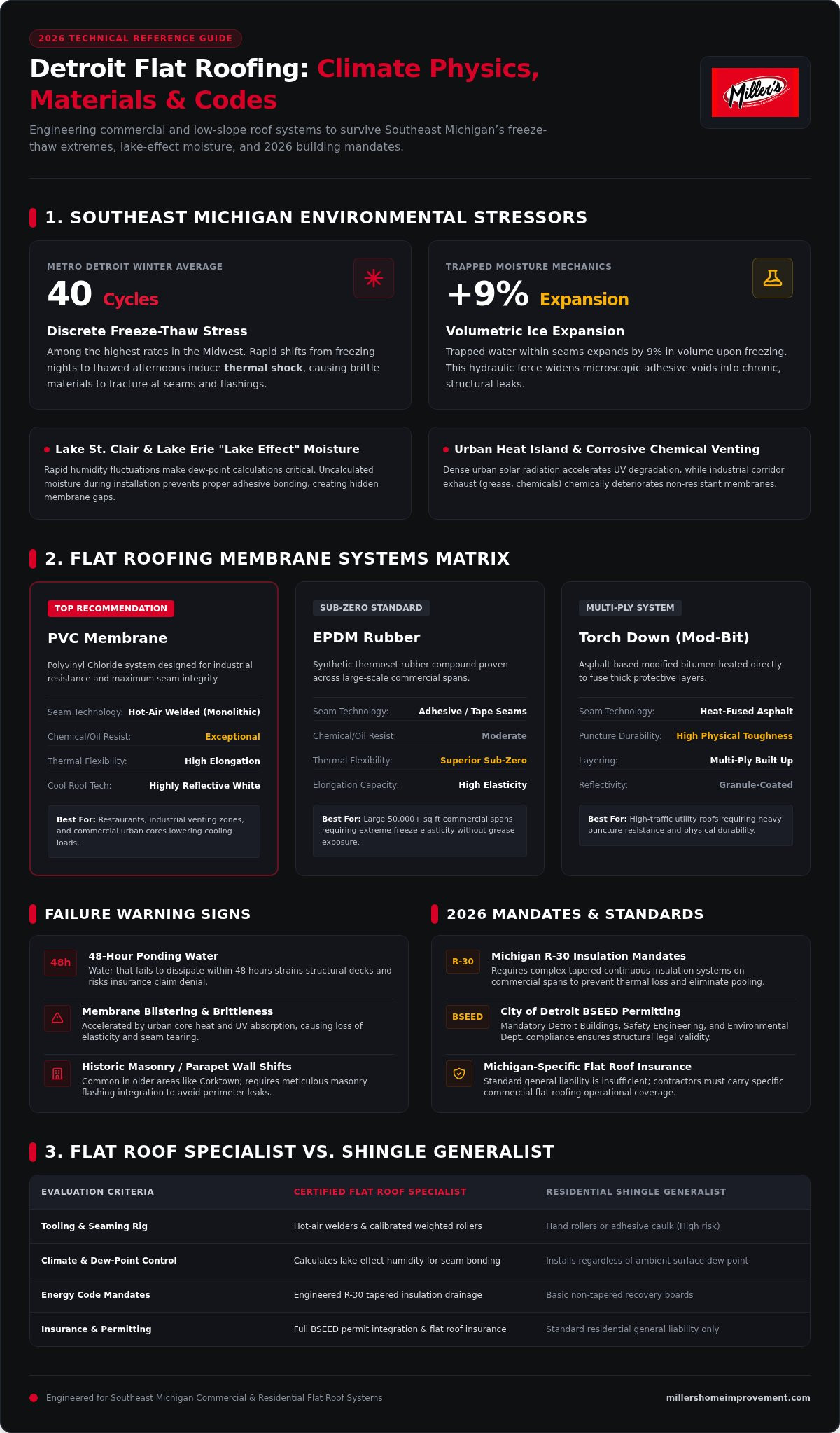
Metro Detroit records an average of 40 discrete freeze-thaw cycles each winter, which is among the highest rates in the Midwest. This constant environmental stress forces trapped seam water to expand by 9 percent in volume, explaining why those recurring leaks never seem to stay fixed despite multiple attempts. It’s exhausting to manage ponding water that won’t dissipate or to worry that a recent repair was just a temporary band-aid. You deserve the stability that comes from a structure built to withstand Michigan’s specific architectural and climatic demands.
This 2026 buying guide shows you how to identify true Detroit flat roof specialists who understand local building codes and advanced material science. We’ve designed this resource to help you navigate the complexities of modern roofing so you can secure a leak-free warranty, lower your energy costs with reflective membranes, and handle insurance claims without the typical headache. We’ll cover everything from the latest R-30 insulation mandates to the mandatory BSEED permit process, ensuring your next project is both legally compliant and physically durable for the long haul.
Key Takeaways
- Understand how Detroit's "Lake Effect" moisture and urban heat island temperatures require specific membrane selections to prevent premature failure.
- Identify why hiring certified Detroit flat roof specialists is the only way to ensure compliance with the 2026 Michigan R-30 insulation mandates.
- Compare the practical benefits of PVC, EPDM, and Torch Down systems to find the right balance of chemical resistance and puncture durability for your building.
- Learn to spot early warning signs like 48-hour ponding and membrane blistering before they lead to structural deck damage or insurance claim denials.
- Use our 2026 hiring checklist to verify that your contractor holds Michigan-specific flat roofing insurance rather than just general liability coverage.
Why Detroit Flat Roofs Require Specialized Expertise
Detroit’s location between Lake St. Clair and Lake Erie creates a microclimate where humidity levels fluctuate rapidly. For a successful low-slope roof design, this moisture is the primary enemy of membrane adhesion. If a contractor doesn't account for dew points during the installation process, the adhesive may fail to bond properly, leading to invisible gaps that eventually become major leaks. Detroit flat roof specialists understand that timing an installation around lake-effect humidity isn't just a preference; it's a technical requirement for ensuring a long-term, waterproof seal.
The "Urban Heat Island" effect further complicates roofing in the city. Within Detroit’s dense urban core, flat roofs absorb significantly more solar radiation than those in the shaded suburbs. Darker membranes can reach temperatures that accelerate UV degradation and cause materials to become brittle prematurely. This intense heat, combined with chemical exhaust from industrial venting, creates a corrosive environment that generic roofing materials aren't designed to survive. You need a system that can withstand both the chemical reality of an industrial city and the physical reality of a sun-baked roof deck.
Detroit’s architectural landscape also presents unique challenges, featuring a mix of historic masonry buildings in areas like Corktown and modern industrial facilities near the river. Older structures often have shifting parapet walls and complex drainage patterns that require meticulous masonry integration. Hiring a "shingle generalist"-a crew that primarily installs sloped residential roofs-is a high-risk move. Flat roofing requires specific tools, such as hot-air welders and specialized weighted rollers, that residential crews simply don't carry in their standard kits.
The Detroit Freeze-Thaw Cycle
Metro Detroit experiences an average of 40 discrete freeze-thaw cycles every winter. As temperatures swing from freezing nights to thawed afternoons, roofing membranes must expand and contract rapidly to maintain their integrity. When a system loses its flexibility due to age or poor material choice, it suffers from thermal shock. Thermal shock is the rapid expansion and contraction of roofing materials caused by sudden temperature changes, which leads to fractured seams and compromised flashing. Detroit flat roof specialists prioritize high-elongation membranes like PVC or EPDM to manage these constant physical shifts.
Commercial vs. Residential Flat Systems
While a residential garage or home addition might only require a few squares of material, the technical demands remain as high as a 50,000-square-foot warehouse. Commercial spans often involve complex tapered insulation systems to meet Michigan’s 2026 R-30 mandates, whereas residential projects might focus more on structural weight limits and aesthetic integration. Regardless of the scale, choosing a partner who provides Professional Roof Replacement in Detroit MI ensures that the correct specialized equipment is used for every weld. We bring the same level of precision to a residential flat porch as we do to a massive industrial complex.
Comparing Modern Flat Roofing Systems for Michigan Properties
Selecting a flat roofing system in Southeast Michigan requires more than just picking a material; it requires a strategic framework based on your building's specific usage. Detroit flat roof specialists often recommend PVC for industrial sites or restaurants because of its exceptional resistance to chemicals, grease, and oils. Heat-welded seams create a monolithic bond that is physically stronger than the membrane itself, providing high security against leaks. This durability is essential for properties located in Detroit’s industrial corridors where environmental pollutants are a daily reality.
EPDM remains a staple for large commercial spans because of its synthetic rubber composition. It offers remarkable flexibility in sub-zero temperatures, though it typically relies on adhesive seams rather than heat welding. For property owners focused on reducing summer cooling loads, "Cool Roof" technology is a priority. Highly reflective white membranes, common in PVC and TPO systems, bounce solar radiation away from the building, lowering interior temperatures during Detroit’s humid July afternoons. This reflective capability significantly reduces the strain on your HVAC system, leading to lower energy bills over the life of the roof.
PVC vs. EPDM: Which Survives Michigan Best?
PVC offers superior puncture resistance, making it ideal if your roof houses heavy HVAC equipment that requires regular maintenance foot traffic. EPDM excels in flexibility, staying pliable even when Detroit temperatures drop well below zero. During high-wind events, heat-welded PVC seams often hold firm where older adhesive-based systems might struggle. Before you commit to a major investment, it is wise to verify your contractor's license through Michigan LARA to ensure they are qualified for these technical installations. Miller’s Home Improvement brings over 25 years of owner experience to every project, helping you choose between these membranes based on your specific structural load and budget.
The Role of Torch Down Roofing
Torch Down roofing, also known as Modified Bitumen, involves melting layers of asphalt-based membranes together using a high-heat torch. This traditional multi-layer protection is excellent for roofs that expect heavy mechanical stress or residential flat porches. The installation process requires significant expertise to ensure a fire-safe, waterproof application that bonds correctly to the substrate. If you are dealing with an aging multi-ply system, you might need Torch Down Roof Repair in Michigan to restore the integrity of your seams. We recommend discussing your specific property needs with a specialist to determine if a multi-layer system or a single-ply membrane is the most cost-effective path forward for your building.
Solving Common Detroit Flat Roof Failures: Beyond Simple Repairs
Property owners in Southeast Michigan often view a small leak as a minor inconvenience, but on a flat roof, it typically signals a systemic failure. One of the most critical issues we encounter is ponding water. If water remains on your roof for more than 48 hours after a storm, it is considered a structural emergency. This standing weight puts immense pressure on the roof deck. During Detroit winters, that water cycles through freezing and thawing, which can tear apart membranes and compromise the structural integrity of the building.
Blistering and bubbling are equally concerning symptoms of a failing system. These issues occur when moisture becomes trapped between the membrane and the substrate. As the sun heats the roof, the moisture turns into vapor and expands, stretching the material from the inside out. This is particularly common in the city due to the urban heat island effect. To combat this, property owners can consult the EPA guide on cool roofing materials to understand how reflective surfaces mitigate temperature-driven damage.
Seam failure remains the leading cause of leaks in generic installations. Many contractors lack the specialized equipment required for heat-welding, relying instead on tapes or glues that degrade over time. True Detroit flat roof specialists focus on a comprehensive drainage strategy first. We ensure scuppers, gutters, and internal drains are clear and correctly positioned before addressing the membrane itself. A roof is only as good as its ability to shed water, regardless of how waterproof the material claims to be.
Flat Roof Ponding Repair Strategies for Detroit
Fixing ponding requires more than a surface-level patch. We often utilize tapered polyisocyanurate insulation systems to create an artificial slope on a flat deck, directing water toward the existing drains. In older Detroit buildings, we must also account for structural sag, where decades of heavy snow loads have caused the roof joists to dip. It is important to remember that adding more "goop" or liquid coatings never fixes a ponding issue because it does not address the underlying lack of slope.
Addressing Storm and Wind Damage
High winds coming off the Great Lakes create a vacuum effect known as "edge lift." If the perimeter flashing isn't secured with heavy-duty fasteners and specialized termination bars, the wind can peel the membrane right off the deck. This allows wind-driven rain to enter the building envelope, causing immediate interior damage. If you suspect your roof has been compromised by severe weather, seeking Hail Damage Roof Repair in Michigan is essential to document the loss for insurance purposes. Our team of Detroit flat roof specialists excels at identifying these subtle wind-related failures that generic crews often overlook.
The 2026 Checklist for Hiring a Flat Roof Specialist in Southeast Michigan
Selecting the right partner for a flat roofing project is the most significant variable in the lifespan of your property. While many contractors claim to handle all types of roofing, true Detroit flat roof specialists carry specific insurance riders that cover the unique risks of low-slope work. General liability insurance often excludes open-flame work or specific membrane applications, leaving you vulnerable if an accident occurs. Always ask to see a certificate of insurance that specifically mentions flat roofing operations rather than just residential shingles.
A reputable specialist should provide a portfolio that includes local projects within Detroit’s city limits. Seeing a contractor’s work on a Midtown commercial building or a historic Corktown flat roof demonstrates their familiarity with local permitting and architectural nuances. These projects prove that the team understands the specific wind loads and thermal stresses of the region. Additionally, check for manufacturer certifications. Brands like GAF or Carlisle only offer long-term NDL (No Dollar Limit) warranties when the system is installed by a certified contractor. Without this credential, your warranty might only cover material defects, leaving you to pay for labor if a seam fails.
The estimation process itself is a litmus test for expertise. A professional should never offer a quote over the phone without visiting the site. They must perform a core sample to determine how many layers exist and whether the underlying insulation is saturated. This step is non-negotiable because Michigan law restricts buildings to a maximum of two roofing layers. If your roof is already at its limit, you need to know When is a Roof Tear Off Necessary in Michigan? to avoid structural overload and legal non-compliance.
Questions Every Detroit Property Owner Should Ask
- "How do you handle seam welding for PVC vs. adhesive for EPDM?" This question reveals if they own the necessary hot-air welding equipment for a monolithic bond.
- "What is your plan for existing ponding water areas?" A specialist will discuss tapered insulation systems rather than suggesting temporary liquid coatings.
- "Do you assist with insurance claims for storm-related flat roof damage?" Handling the technical documentation for adjusters is a hallmark of a professional service.
The Importance of a Detailed Estimate
A professional estimate is a technical document, not a single-page price sheet. It should clearly outline the tear-off process, the specific R-value of the new insulation (which must meet the 2026 R-30 mandate), and a detailed drainage plan. It should also specify the mil-thickness of the membrane you are purchasing. When you interview Detroit flat roof specialists, look for those who prioritize education over a quick sale. If you are ready to move forward with a team that values precision and transparency, you can request a professional flat roof assessment from our seasoned team today.
Partnering with Miller’s Home Improvement for Your Detroit Flat Roof
For over 25 years, the leadership at Miller’s Home Improvement has focused on mastering the technical nuances of low-slope roofing in Southeast Michigan. We don't just install membranes; we engineer solutions that survive the specific environmental pressures of the Great Lakes region. As Detroit flat roof specialists, we recognize that our reputation is built on every seam we weld and every drain we clear. This commitment to quality over volume ensures that your commercial or residential property receives the focused attention it deserves from a seasoned crew.
Our team specializes in the systems that define modern flat roofing, including high-performance PVC, durable EPDM, and traditional Torch Down membranes. We also understand that the aftermath of a storm is often a period of high stress for property owners. Because we specialize in insurance claim restoration, we act as your advocate, providing the detailed assessments and documentation necessary to ensure your claim is handled fairly and accurately. We manage the technical paperwork so you can focus on your daily operations or family life.
Our Flat Roof Restoration Process
Every project begins with a free in-home estimate where we perform a comprehensive physical assessment of your roof's current state. We look for the underlying causes of failure, such as wet insulation or structural sag, rather than just looking at the surface. Our status as a fully licensed and insured Michigan contractor provides you with the peace of mind that your investment is protected by a professional entity. We only use high-quality materials that meet or exceed the 2026 Michigan energy codes, ensuring your building remains efficient and compliant for years to come.
Secure Your Property Today
Small leaks and minor ponding areas are early warning signs that shouldn't be ignored. Addressing these issues now prevents them from escalating into expensive structural failures or mold infestations. We serve the entire Detroit metro area and surrounding communities with a focus on stability and long-term performance. If you're concerned about the integrity of your current system, contact us for a free, professional flat roof assessment. Let our experience be the foundation for your property’s protection.
Protecting Your Investment with Proven Flat Roofing Solutions
Managing a flat roof in Southeast Michigan is a constant battle against the elements. From the 40 annual freeze-thaw cycles to the high-wind events off the Great Lakes, your building requires a system engineered for resilience. By choosing the correct membrane, whether it is chemical-resistant PVC or flexible EPDM, and adhering to the 2026 R-30 insulation mandates, you ensure long-term structural health and energy efficiency. You've learned how to spot the warning signs of failure and how to vet a contractor for the specialized insurance and certifications necessary for this technical work.
Partnering with true Detroit flat roof specialists is the only way to guarantee that your installation meets these rigorous standards. Miller’s Home Improvement brings over 25 years of owner experience to every project. We are A+ rated local experts who specialize in PVC, EPDM, and Torch Down systems, providing the meticulous workmanship your property deserves. Don't wait for a minor leak to become a major structural failure that compromises your entire building envelope.
Get Your Free Flat Roof Estimate from Miller’s Home Improvement today and gain the peace of mind that comes with a professionally managed roof. We look forward to helping you secure your property for the years ahead.
Frequently Asked Questions
How long does a flat roof typically last in the Detroit climate?
A professionally installed flat roof in the Detroit climate typically lasts between 15 and 25 years. The specific lifespan depends heavily on the chosen material; for example, PVC membranes often outperform others in urban heat islands. Detroit's 40 annual freeze-thaw cycles put immense stress on seams, so regular maintenance is vital. Choosing high-quality materials and Detroit flat roof specialists who understand Michigan’s temperature swings can extend the life of your system significantly.
Can I install a new flat roof over an existing one in Michigan?
You can only install a new roof over an existing one if there is currently only one layer present. Michigan building codes strictly limit structures to a maximum of two roofing layers. If your building already has two layers, a complete tear-off is legally required. Our team will perform a core sample to verify the layer count and check for trapped moisture, as covering wet insulation will cause the new membrane to fail prematurely.
What is the best flat roofing material for a commercial building in Detroit?
PVC is often considered the gold standard for Detroit commercial buildings due to its chemical resistance and heat-welded seams. It handles the city's industrial pollutants and urban heat island effect better than adhesive-based systems. However, EPDM is a reliable, cost-effective choice for large spans where cold-weather flexibility is the priority. The best material ultimately depends on your building's specific mechanical equipment, foot traffic, and budget requirements.
Does homeowners insurance cover flat roof leaks caused by storm damage?
Homeowners insurance typically covers flat roof leaks if they result from a sudden, accidental peril like wind or hail damage. It does not cover leaks caused by wear and tear or neglected maintenance. Because Miller’s Home Improvement specializes in insurance claim restoration, we provide the technical documentation adjusters need to verify storm-related failures. We recommend having a professional assessment immediately after a severe Michigan storm to identify subtle damage before your claim deadline expires.
Why is my flat roof ponding water after a Michigan rainstorm?
Ponding water usually occurs because of inadequate drainage or a lack of proper slope toward the roof's scuppers and drains. In older Detroit buildings, structural sag in the roof joists can create low spots where water collects. If water remains for more than 48 hours, it is a structural concern that requires attention. Specialists solve this by installing tapered insulation systems that create an artificial slope to direct water away from the deck.
How often should I have my Detroit flat roof inspected?
You should schedule a professional inspection at least twice a year, ideally in the spring and fall. Detroit’s harsh winters and humid summers cause roofing materials to expand and contract constantly. These inspections allow you to identify small seam separations or clogged drains before they lead to expensive interior damage. Regular check-ups are also often a requirement to keep your manufacturer's warranty valid, ensuring your investment remains protected under its original terms.
What is the difference between a flat roof specialist and a regular roofer?
A flat roof specialist possesses the specific equipment and insurance riders required for low-slope systems, which regular shingle roofers typically lack. Installing membranes like PVC requires hot-air welding tools and a deep understanding of tapered insulation and drainage physics. Regular roofers often rely on adhesives that fail in the Michigan climate. Detroit flat roof specialists focus on the technical engineering of the entire roof assembly rather than just the surface material.
Is a white "cool roof" effective in a climate as cold as Michigan?
White "cool roofs" are highly effective in Detroit, particularly for reducing cooling costs during our humid summers. While Michigan has long winters, the energy saved by reflecting solar radiation in July and August usually outweighs the minimal heat gain lost during the winter. These reflective membranes also help mitigate the urban heat island effect in the city core. This leads to lower interior temperatures and less mechanical strain on your building’s HVAC system year-round.


