
The most durable architectural shingle on the market will fail within a few seasons if it isn't installed to handle a Michigan winter. As a homeowner, you likely already feel the frustration of sorting through aggressive sales pitches, vague quotes, and transient storm chasers who vanish when temperatures drop. You understand that your roof is your home's primary shield, yet distinguishing true craftsmen from smooth-talking sales operations can feel overwhelming. Finding a quality roofing contractor Michigan families can rely on comes down to recognizing uncompromising field standards rather than polished marketing presentations.
In this 2026 guide, you'll discover how to evaluate local contractors based on verifiable installation methods, genuine warranty protection, and structural resilience. You'll learn how proper ice barrier membranes, balanced attic airflow, and deck inspections safeguard your investment against premature failure. We will break down the exact credentials you need to verify, the building practices required to conquer Great Lakes freeze-thaw cycles, and a step-by-step checklist to protect your home before signing any contract.
Key Takeaways
- Learn how to identify a quality roofing contractor Michigan homeowners can trust by verifying state credentials on the official licensing database.
- Understand the critical role complete tear-offs play in exposing hidden deck rot, preventing chronic freeze-thaw leaks, and outperforming short-lived shingle overlays.
- Discover why Great Lakes weather demands engineered ice barrier membranes, architectural shingles, and balanced attic ventilation to stop destructive ice dams.
- Use a practical vetting checklist to eliminate high-pressure sales outfits and out-of-state storm chasers before signing any construction agreement.
- Find out what seasoned craftsmen inspect during a thorough evaluation, from structural roof decking to attic thermal airflow, ensuring multi-decade protection.
What Defines a Quality Roofing Contractor in Michigan?
A quality roofing contractor Michigan homeowners can rely on approaches every project as an integrated structural system rather than a quick cosmetic repair. Great Lakes weather brings brutal freeze-thaw shifts, driving rain, and lake-effect snow that expose every hidden shortcut. While slick sales organizations rely on canvassers and subcontract to the lowest bidder, dedicated local craftspeople prioritize building science. Business longevity in Southeast Michigan communities demonstrates genuine accountability, proving that a builder stands behind their craftsmanship long after the final nail is driven.
Verifiable Credentials: State Licensing, Insurance, and Local History
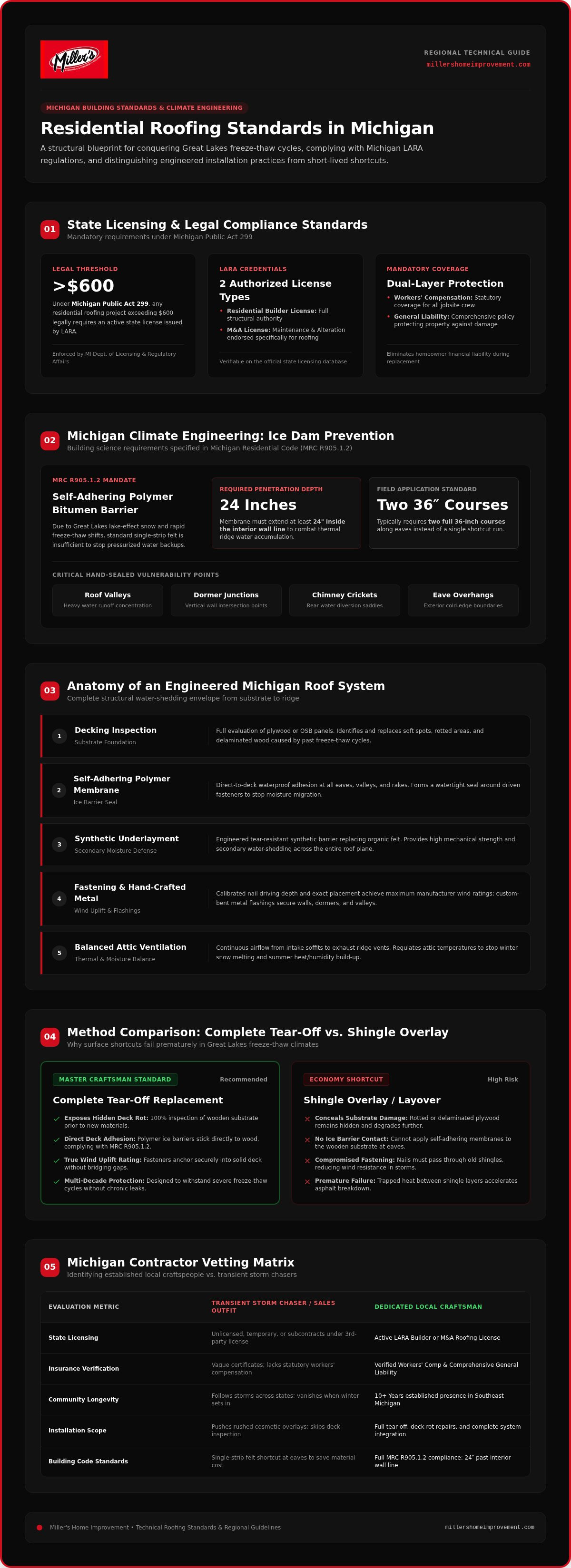
Under Michigan Public Act 299, any residential roofing project exceeding $600 legally requires an active license issued by the Michigan Department of Licensing and Regulatory Affairs (LARA). A qualified professional roofing contractor maintains either a full Residential Builder license or a Maintenance and Alteration license endorsed specifically for roofing trades. Beyond state testing, legitimate builders carry comprehensive general liability coverage and mandatory workers' compensation insurance to protect the property owner from jobsite liability.
To legally perform residential roof replacements in Michigan, a contractor must hold an active LARA builder license, carry statutory workers' compensation, and maintain comprehensive general liability coverage. Maintaining an established presence in Southeast Michigan for over a decade proves that a contractor resolves issues and honors workmanship pledges across years of harsh regional seasons.
System-Level Installation: Beyond Surface Shingle Appearance
A durable roof is an engineered water-shedding system, not just an arrangement of attractive shingles. True craftsmanship begins at the foundation: evaluating the structural integrity of the roof decking, applying self-adhering polymer membranes along vulnerable eaves, installing tear-resistant synthetic underlayment, and hand-crafting metal flashings at every wall transition and valley. Fastener placement and nail driving depth dictate whether shingles achieve their maximum wind resistance ratings or tear free during high-wind storms. Deep structural envelope weatherproofing seals the home against moisture migration, whereas rushed surface nailing merely masks underlying vulnerabilities.
Michigan Climate Challenges: Engineering Roofs for Extreme Weather
Michigan weather puts building materials through relentless punishment. Drastic temperature swings cause roofing components to expand and contract rapidly, stressing fasteners and breaking brittle seals. Lake-effect squalls and prairie winds sweep across open terrain, generating severe wind uplift that easily peels poorly fastened shingles. In the summer, high humidity levels test roof ventilation from underneath. Building a roof that survives these elements demands strict adherence to building science, which is why partnering with a quality roofing contractor Michigan residents trust makes all the difference in long-term storm resilience.
Ice Dam Prevention: Self-Adhering Waterproof Barriers
Heavy snowfall paired with attic heat loss creates destructive ice dams. Snow melts on the upper deck, trickles down toward the cold eaves, and refreezes into a solid ice ridge that forces pooling water backward under shingles. The Michigan Residential Code (MRC R905.1.2) mandates self-adhering polymer-modified bitumen underlayment along all eaves. This membrane must extend at least 24 inches inside the interior wall line, typically requiring two full 36-inch courses rather than a single shortcut strip. Seasoned crews hand-seal valleys, dormer junctions, and chimney crickets where runoff concentrates. Reviewing steps for winter roof preparation in Michigan helps homeowners catch vulnerable flashing points before the freeze begins. Ensuring your builder follows Michigan LARA contractor licensing requirements guarantees they understand these regional building codes.
Decking Integrity and Balanced Attic Ventilation Systems
A roof cannot perform if its wooden substrate is compromised. During complete tear-offs, experienced roofers inspect every sheet of plywood or oriented strand board (OSB). Soft spots, delamination, and mold growth indicate dry rot that prevents roofing nails from holding fast against heavy snow loads or gale-force winds. Rotten panels must be cut out and replaced with fresh CDX plywood or OSB sheathing.
Equally critical is a balanced attic ventilation system designed to maintain a 1:300 net free area ratio between intake soffits and ridge exhaust vents. Without adequate intake, heat and moisture become trapped within the attic envelope. This trapped heat prematurely blisters asphalt shingles, curls shingle tabs, and forces air conditioning systems to run continuously during humid Michigan summers. If you suspect your attic lacks balanced airflow, schedule an evaluation with Miller's Home Improvement to assess your decking and ventilation balance.
Specialized Materials vs. Economy Shortcuts: Durability Compared
Cutting corners on materials creates expensive consequences. Traditional three-tab shingles offer limited wind resistance up to 60 mph and quickly blow off during severe thunderstorms. Dimensional architectural shingles feature multi-layered construction that withstands wind gusts up to 130 mph while offering superior impact resistance. A quality roofing contractor Michigan homeowners trust builds for long-term endurance, pairing high-grade materials with full structural tear-offs rather than cosmetic layovers.
Tear-Off vs. Layover: Uncovering Hidden Structural Damage
Nailing a second layer of shingles over an aging roof might seem economical, but it introduces severe risks. Shingle overlays trap heat, accelerating asphalt breakdown and baking the roof deck. Crucially, layovers conceal deteriorated sheathing, mold growth, and water intrusion that compromise framing. Understanding when is a roof tear off necessary in Michigan prevents structural overloading, as multiple shingle layers trap unnecessary dead weight on rafters during heavy winter snowfalls. Starting fresh down to the wood deck is also essential for engineering roofs for ice dam prevention, as self-adhering membranes cannot adhere properly to old shingles.
Commercial and Low-Slope Systems: Membrane Selection Factors
Flat and low-slope roofs require specialized commercial solutions to eliminate ponding water risks:
- EPDM Flat Roofing: Synthetic rubber membranes retain elasticity in subzero temperatures and resist intense ultraviolet radiation without cracking.
- PVC Flat Roofing: Hot-air welded seams form a permanent monolithic barrier that resists ponding water, chemicals, and animal fats.
- Torch Down Flat Roofing: Multi-ply modified bitumen sheets heat-fused together provide exceptional puncture resistance and high foot-traffic durability.
| Roofing System | Wind Resistance | Expected Lifespan | Primary Advantage |
|---|---|---|---|
| Architectural Shingles (Complete Tear-Off) | 110 to 130 mph | 30 to 50 years | Superior wind uplift defense, full deck inspection |
| Three-Tab Shingles (Overlay) | 60 mph | 10 to 15 years | Cheaper upfront, hides structural deck decay |
| EPDM Single-Ply Membrane | High wind tolerance | 25 to 30 years | Unmatched flexibility during freeze-thaw cycles |
| PVC Heat-Welded Membrane | Extreme seam strength | 25 to 30+ years | Watertight protection against standing water |
| Torch Down Modified Bitumen | High puncture defense | 20 to 25 years | Multi-ply strength for high-traffic flat decks |
How to Vet a Michigan Roofing Contractor: The Evaluation Checklist
Protecting your property starts with a methodical screening process before money changes hands. Verifying an installer on the state licensing portal confirms their legal standing, but a truly thorough vetting process goes much deeper. A quality roofing contractor Michigan homeowners rely on provides transparent documentation, clear communication, and unambiguous contract language. You need to know precisely who is on your roof, what materials they are fastening down, and how both manufacturer and workmanship warranties protect your wallet over the long haul.
Critical Questions to Ask Before Signing Any Proposal
Demand transparency on site management and material specifications before signing any construction agreement. Vague proposals that list only "architectural shingles" leave room for substandard accessories. Walk through these essential checkpoints:
- On-Site Supervision: Ask who manages the jobsite daily and how the crew handles magnetic nail sweeps around landscaping.
- Accessory Brands: Verify that the starter strips, valley metal, ridge caps, and underlayment match manufacturer system requirements rather than generic aftermarket substitutes.
- Insurance Certificates: Require insurance certificates for general liability and statutory workers' compensation sent directly to you from the contractor's insurance carrier.
- Warranty Registration: Distinguish between the shingle manufacturer's material defect warranty and the contractor's independent workmanship guarantee covering installation labor.
Ensure the contract explicitly states that the builder will supply a signed supplier lien waiver upon final invoice completion.
Red Flags: Recognizing Storm Chasers and High-Pressure Tactics
Severe weather brings out-of-state operators who canvas neighborhoods immediately after hail and wind storms. These transient crews secure insurance checks, perform rushed overlay work, and skip town before cold weather reveals their errors. Be cautious if a contractor insists you file a claim before conducting a thorough physical inspection; reviewing our guide on hail damage roof repair in Michigan will help you spot legitimate impact patterns versus normal cosmetic wear. Avoid door-to-door solicitors who pressure you to sign contingency agreements on the spot or demand substantial upfront cash deposits before materials are delivered to your driveway. For transparent, pressure-free advice from experienced local builders, request a free in-home estimate to review your roofing needs.
Investing in Reliable Protection: The Master Craftsman Standard
Long-term roof performance relies on master craftsmanship, open communication, and attention to detail. A quality roofing contractor Michigan property owners choose treats every home as a unique structural system rather than an assembly-line job. When an installer prioritizes deep diagnostic evaluations over hurried surface bids, you gain predictable protection, transparent project scopes, and lasting peace of mind.
Comprehensive Diagnostic Assessments vs. Quick Drive-By Bids
Drive-by estimates and satellite aerial scans fail to reveal the true condition of your roof structure. Seasoned builders perform comprehensive diagnostic inspections inside and out before drafting a proposal:
- Attic Cavity Diagnostics: Checking the underside of the roof deck for dark water stains, localized mildew, rusty nail shanks, and visible daylight along ridges.
- Penetration and Flashing Audits: Inspecting chimney step-flashing, mortar joints, soil stack neoprene boots, and sidewall transitions for hairline splits.
- Valley and Eave Stress Testing: Walking low-slope transitions and valleys to detect spongy sheathing caused by chronic runoff.
Homeowners planning for a professional roof replacement in Detroit MI recognize that these thorough diagnostic evaluations identify hidden deck rot before tear-off day, preventing unexpected change orders and project delays.
Securing Your Michigan Property with Proven Local Expertise
Working directly with an experienced company owner brings a level of accountability that sales-heavy dealerships cannot match. With over 25 years of owner roofing experience and 13 years serving Southeast Michigan, Miller's Home Improvement focuses on doing the job right the first time. Meticulous standards extend across every stage of the project, including structured daily cleanups and magnetic nail sweeps to protect your family, pets, and driveway.
When selecting a quality roofing contractor Michigan homeowners deserve straightforward honesty, reliable building methods, and lasting structural integrity. Take the next step toward securing your home by scheduling a free in-home estimate featuring a comprehensive attic and deck evaluation.
Protecting Your Home with Proven Craftsmanship
A dependable roof requires far more than brand-name shingles. It demands a complete structural tear-off to inspect deck integrity, code-compliant ice barriers to halt freeze-thaw leaks, and an installer who treats your entire building envelope as a unified system. Finding a quality roofing contractor Michigan property owners can rely on comes down to verifying active state builder licensing, demanding line-item transparency, and partnering with dedicated local tradespeople.
At Miller's Home Improvement, we bring over 25 years of owner roofing experience as a fully licensed and insured residential builder and commercial contractor. Our dedicated local crews treat your property with unwavering respect, upholding rigorous installation standards and conducting thorough daily magnetic nail sweeps. When you are ready for clear, educational guidance without high-pressure sales tactics, schedule your free comprehensive in-home roofing estimate. Take the proactive step today to secure lasting peace of mind and structural protection for decades to come.
Frequently Asked Questions
How do I verify if a roofing contractor is properly licensed in Michigan?
Verify an installer's credentials online through the Michigan Department of Licensing and Regulatory Affairs (LARA) MiPLUS license lookup database. Search the company name or personal license number to confirm an active Residential Builder license or Maintenance and Alteration license with a roofing endorsement. Legitimate Detroit builders gladly provide their license details along with active certificates of general liability and statutory workers' compensation coverage before beginning work.
Why is a full roof tear-off better than installing a second layer of shingles?
A full tear-off exposes rotten decking, hidden water infiltration, and structural framing decay that shingle overlays conceal. Removing old shingles allows a quality roofing contractor Michigan homeowners rely on to inspect wooden sheathing, replace compromised plywood, and adhere waterproof ice membranes directly to the deck. Layovers trap summer attic heat, add excessive dead weight during snowstorms, and frequently void manufacturer warranties.
What type of roof lasts the longest in Michigan's freeze-thaw climate?
Heavyweight dimensional architectural shingles and commercial flat membranes deliver the longest lifespans across Michigan's severe freeze-thaw cycles. Architectural shingles built with high wind and impact ratings routinely endure 30 to 50 years of lake-effect snow and wind uplift. For flat or low-slope properties across Detroit, fully adhered EPDM rubber and heat-welded PVC membranes provide multi-decade flexibility without cracking during subzero winter cold.
What is the difference between a manufacturer warranty and a workmanship warranty?
A manufacturer warranty covers factory material defects, while a workmanship warranty covers installation errors committed by the roofing crew. If a shingle delaminates prematurely due to a manufacturing flaw, the shingle producer supplies replacement materials. If water leaks because flashings were misaligned or fasteners were improperly driven, only the contractor's workmanship warranty protects your investment. Always ensure both warranties are explicitly detailed in your contract.
What should be included in a detailed, professional roofing replacement estimate?
A comprehensive estimate must itemize specific product brands, structural deck evaluation terms, underlayment types, and site cleanup procedures. Look for line items listing the exact architectural shingle manufacturer, self-adhering ice barrier placement along eaves and valleys, drip edge metal specs, ridge ventilation systems, and municipal permit fees. In Southeast Michigan, transparent proposals also specify daily magnetic nail sweeps and deck replacement protocols.
How do quality roofing contractors prevent ice dams from causing winter leaks?
Quality contractors prevent ice dam leaks by combining self-adhering polymer ice barriers with balanced attic intake and exhaust ventilation. An experienced quality roofing contractor Michigan residents trust extends waterproof ice membranes at least 24 inches past interior wall lines. Pairing this physical barrier with balanced soffit intake and ridge exhaust vents ensures cold outside air circulates freely, preventing snow from prematurely melting and refreezing along eaves.
How long does a professional residential roof replacement take to complete?
Most residential roof replacements on single-family homes across Detroit take one to two days under favorable weather conditions. Timelines vary depending on total square footage, roof pitch, complexity of architectural valleys, and the volume of deteriorated decking uncovered during tear-off. Dedicated local crews work methodically, ensuring your home remains completely weatherized and protected from sudden Midwestern showers at the close of each workday.


